Maternity Leaves for Adoptive Mothers Latest News
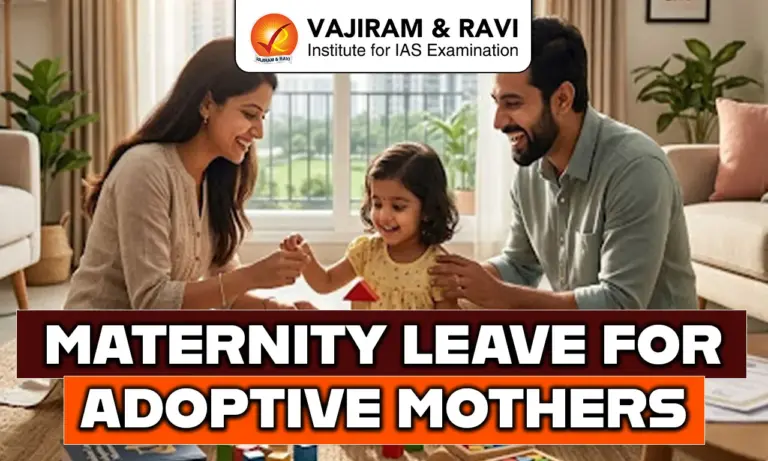
- The Supreme Court of India has read down provisions of the Code on Social Security, 2020 to extend 12 weeks of maternity leave to all adoptive mothers irrespective of the child’s age.
- Simultaneously, it has urged the Union Government to recognise paternity leave as a social security benefit.
- The judgment also intersects with an ongoing constitutional challenge to Section 5(4) of the Maternity Benefit Act, 1961, which restricts maternity benefits for adoptive mothers based on the age of the child.
Key Highlights of the Judgment
- Removal of age restriction for adoptive mothers:
- The Court read down Section 60(4) of the Code on Social Security, 2020.
- It held that all adoptive mothers are entitled to 12 weeks of maternity leave, regardless of whether the child is above or below 3 months.
- It declared the earlier restriction violative of Articles 14 (Right to Equality) and 21 (Right to Life and Personal Liberty).
- Motherhood beyond biological childbirth:
- The Court clarified maternity benefit is linked to motherhood, not childbirth.
- Adoptive mothers have similar caregiving responsibilities as biological mothers.
- Adoption recognised as part of reproductive and decisional autonomy under Article 21.
- Maternity leave as a human right: The judgment termed maternity protection as a “basic human right”, ensuring economic security, workplace inclusion of women, and freedom to exercise reproductive choices without employment penalty.
- Emphasis on role of fathers:
- The Court highlighted early childhood care requires both parents.
- Absence of paternity leave reinforces gender stereotypes, limits father’s participation in caregiving, and urges the government to frame a paternity leave policy as part of social security.





Legal and Policy Background
- Maternity Benefit Act, 1961:
- It aims to regulate employment of women before and after childbirth.
- Key provisions are paid maternity leave (the period of such leave could not exceed twelve weeks), protection from dismissal, etc.
- 2017 Amendment:
- Increased paid maternity leave to 26 weeks for biological mothers.
- Introduced, 12 weeks leave for adoptive mothers (only if child < 3 months), work-from-home provision, mandatory crèche facilities (in establishments having 50 or more employees).
- Code on Social Security, 2020: It consolidates labour laws, and retains similar restrictive provision for adoptive mothers (which is now read down by SC).
Pending Constitutional Challenge
- A PIL challenges Section 5(4) of the Maternity Benefit Act, 1961 as discriminatory and arbitrary, and violative of Part III (Fundamental Rights) of the Indian Constitution.
- Key issues:
- Denial of benefits to adoptive mothers of older children.
- Discrimination against orphaned and abandoned children.
- Conflict with the Juvenile Justice Act, 2015, and the adoption procedures that delay early adoption.
Key Issues and Challenges
- Discrimination in existing framework: Unequal treatment between biological and adoptive mothers, adoptive mothers based on child’s age.
- Structural barriers in adoption: Lengthy procedures make adoption of infants (<3 months) rare, legal requirements (e.g., declaration of child as “legally free”) cause delays.
- Lack of paternity leave: India lacks a comprehensive statutory paternity leave policy, leading to gender imbalance in caregiving, and reinforcement of traditional roles.
- Limited impact on women’s workforce participation: Evidence suggests that decline in women’s participation in several sectors post-2017 amendment, as a result of employer bias due to increased costs and lack of childcare support.
- Implementation gaps: Weak enforcement in the unorganised sector. Limited access to crèche facilities, work-from-home flexibility.
Way Forward
- Gender-neutral parental leave policy: Introduce statutory paternity leave, and move towards shared parental leave framework.
- Harmonisation of laws: Align the Maternity Benefit Act, Code on Social Security, and the Juvenile Justice Act. Remove inconsistencies affecting adoptive parents.
- Strengthening adoption ecosystem: Simplify procedures, reduce delays in declaring children legally free for adoption.
- Incentivising employers: Government support/subsidies to offset maternity costs, promote women-friendly workplace policies.
- Focus on unorganised sector: Expand social security schemes, ensure portability and accessibility of benefits.
Conclusion
- The SC’s intervention marks a progressive shift from a biology-centric to a care-centric understanding of parenthood.
- By recognising adoptive motherhood as equal to biological motherhood and advocating for paternity leave, the judgment advances substantive equality and gender justice.
- However, meaningful transformation will depend on legislative action, policy coherence, and effective implementation, ensuring that parental rights translate into real social security for all families.

 Last updated on April, 2026
→ UPSC Final Result 2025 is now out.
→ UPSC has released UPSC Toppers List 2025 with the Civil Services final result on its official website.
→ Anuj Agnihotri secured AIR 1 in the UPSC Civil Services Examination 2025.
→ UPSC Marksheet 2025 is now out.
→ UPSC Notification 2026 & UPSC IFoS Notification 2026 is now out on the official website at upsconline.nic.in.
→ UPSC Calendar 2026 has been released.
→ Check out the latest UPSC Syllabus 2026 here.
→ UPSC Prelims 2026 will be conducted on 24th May, 2026 & UPSC Mains 2026 will be conducted on 21st August 2026.
→ The UPSC Selection Process is of 3 stages-Prelims, Mains and Interview.
→ Prepare effectively with Vajiram & Ravi’s UPSC Prelims Test Series 2026 featuring full-length mock tests, detailed solutions, and performance analysis.
→ Enroll in Vajiram & Ravi’s UPSC Mains Test Series 2026 for structured answer writing practice, expert evaluation, and exam-oriented feedback.
→ Join Vajiram & Ravi’s Best UPSC Mentorship Program for personalized guidance, strategy planning, and one-to-one support from experienced mentors.
→ Shakti Dubey secures AIR 1 in UPSC CSE Exam 2024.
→ Also check Best UPSC Coaching in India
Maternity Leave for Adoptive Mothers FAQs
Q1. How did the SC reinterpret maternity benefits for adoptive mothers under the Code on Social Security, 2020? +
Q2. Why did the SC hold the age-based classification in maternity benefits for adoptive mothers as unconstitutional? +
Q3. How does the judgment expand the scope of reproductive rights under Article 21? +
Q4. What concerns has the SC raised regarding the absence of paternity leave in India? +
Q5. Why is Section 5(4) of the Maternity Benefit Act, 1961 being challenged constitutionally? +
Tags: mains articles maternity leaves for adoptive mothers upsc current affairs upsc mains current affairs