Maulana Barkatullah Latest News
- The executive council of Barkatullah University in Bhopal has passed a proposal to rename it Vagdevi Bhojpal University. The university was named after Maulana Barkatullah Bhopali in 1988 — before that, it was simply called Bhopal University.
- The rename proposal has sparked debate about who Barkatullah was and whether erasing his name amounts to erasing an important chapter of India’s freedom struggle.
Who Was Maulana Barkatullah
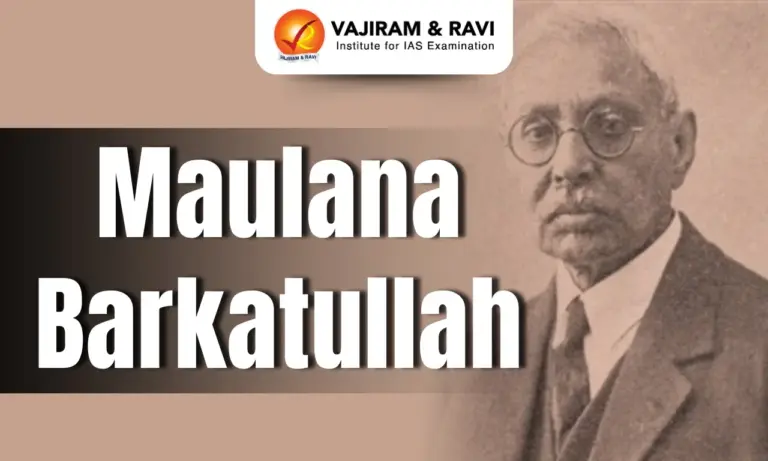
- Maulana Barkatullah Bhopali was born on July 7, 1854, in Bhopal. He was a scholar, freedom fighter, and revolutionary who spent virtually his entire adult life outside India — working to end British rule from abroad.
- He studied in Bombay and then London. He began teaching in Liverpool, where he came into contact with Indian revolutionaries.
- His writings and speeches drew the attention of British authorities, forcing him to leave for the United States in 1899.
- From that point, he never stopped moving — Japan, England, the US, Germany, Russia, Afghanistan, Brussels, Switzerland, France.
- In US, he corresponded with the freedom fighter Maulana Hasrat Mohani (who coined the slogan Inquilab Zindabad).
- Wherever he went, he built networks, wrote, spoke, and organised against British colonialism.
- He died in September 1927 in Sacramento, California, while attending a Ghadar Party event, with his lifelong associate Raja Mahendra Pratap by his side. He is buried there.


Core Beliefs of Barkatullah
- Barkatullah was a committed anti-colonial thinker who held one conviction above all others: India could only be free if Hindus and Muslims fought together.
- He saw the British policy of divide-and-rule as the primary obstacle to independence.
- He wrote about the suffering of ordinary Indians — both Hindu and Muslim — under colonial economic exploitation, noting that millions had died of starvation.
- His entire political career was built on the idea of composite nationalism — the belief that India’s freedom was a shared cause that transcended religion.
The Kabul Government: India’s First Government in Exile
- The most significant chapter of Barkatullah’s life came during World War I.
- In December 1915, Barkatullah, along with Raja Mahendra Pratap (a Hindu prince) and Maulana Ubaidullah Sindhi (an Islamic scholar), established the Provisional Government of India in Kabul, Afghanistan.
- This was India’s first government in exile — set up entirely outside British control.
- Raja Mahendra Pratap became President. Maulana Barkatullah became Prime Minister — which is why he is sometimes called the “first Prime Minister of independent India”.
- This was not merely symbolic. It was a bold political act — Indians of different faiths forming a government and asserting sovereign authority at a time when India was still firmly under British rule.
- The Kabul government sought support from Afghanistan, Germany, and later Soviet Russia to challenge British power.
Meeting Lenin
- Four years after the Kabul government was formed, its leaders travelled to Moscow to meet Vladimir Lenin, then head of Soviet Russia.
- Barkatullah’s statement in Russia captures his worldview clearly. He described himself as neither a communist nor a socialist, but said his goal was the expulsion of the British from Asia.
- He saw European colonialism — led by Britain — as the enemy, and found in the Soviets a natural ally against it.
- After the British victory in WWI dealt a severe blow to the revolutionaries’ plans, Barkatullah continued his work — travelling across Europe and keeping his cause alive until his death.
Why His Legacy Was Forgotten
- Barkatullah spent most of his life abroad and died in the US in 1927 — twenty years before Independence.
- He was never part of the mainstream nationalist movement led by the Congress inside India.
- His revolutionary activities were conducted across multiple countries, leaving little visible trace on the Indian public consciousness.
- He was formally recognised in 1988 when Bhopal University was renamed after him — a long-overdue acknowledgment of a son of the city who had given his life to its freedom.
- Historians argue that the proposal to rename the university now would undo even that belated recognition.
- Historians said that instead of changing the university’s name, more should be done to popularise the legacy of Barkatullah.
- They note the irony that the central government has been actively working to popularise Raja Mahendra Pratap — Barkatullah’s closest associate — while his name faces erasure.

 Last updated on Oct, 2026
→ UPSC 2027 Notification will be released on 13 January 2027 at upsconline.nic.in.
→ Asian Games 2026 are being held in Aichi-Nagoya, Japan, from 19 September to 4 October.
→ Check Nobel Prize 2026 Winners List here.
→ Download PIB PRiSM Monthly Magazine 2026 here.
→ Check UPSC Monthly Current Affairs Magazine The Recitals here.
→ Check out the latest UPSC Syllabus here.
→ Download UPSC Model Answers for Mains 2026
→ UPSC Mains Question Paper 2026 is out now for Essay & GS Paper 1, 2, 3 & 4.
→ UPSC Calendar 2027 has been released.
→ Enroll in Vajiram & Ravi’s UPSC Mains Test Series 2027 for structured answer writing practice, expert evaluation, and exam-oriented feedback.
→ Join Vajiram & Ravi’s UPSC Mentorship Program 2027 for personalized guidance, strategy planning, and one-to-one support from experienced mentors.
→ Go through the UPSC Mains Previous Year Papers to enhance your preparation.
→ UPSC has released UPSC Toppers List 2025 with the Civil Services final result on its official website.
→ Also check Best UPSC Coaching in India
Maulana Barkatullah FAQs
Q1. Who was Maulana Barkatullah?+
Q2. Why is Maulana Barkatullah important in India's freedom struggle?+
Q3. What was Maulana Barkatullah's vision for India?+
Q4. What was the Kabul Government associated with Maulana Barkatullah?+
Q5. Why is Maulana Barkatullah in the news today?+
Tags: mains articles Maulana Barkatullah upsc current affairs upsc mains current affairs