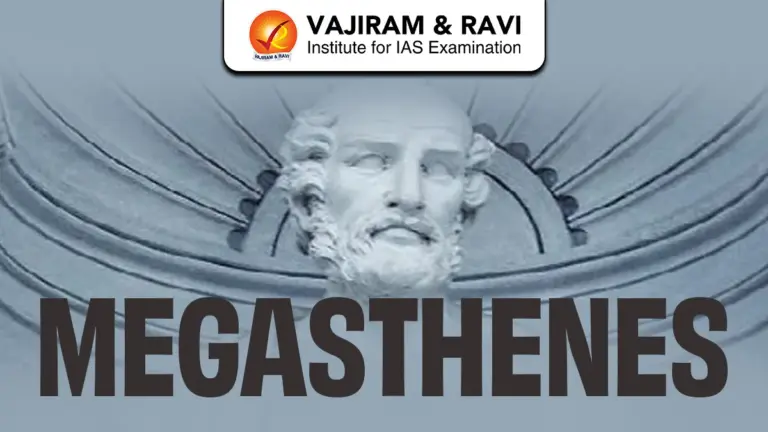
Megasthenes was an ancient Greek historian, diplomat, ethnographer and explorer who lived during the Hellenistic period and died around 290 BCE. He belonged to the Greek world under the Seleucid Empire and came to India as an ambassador of Seleucid ruler Seleucus I Nicator. His visit to India occurred during the reign of Mauryan Emperor Chandragupta Maurya, mainly to strengthen diplomatic relations after the Seleucid-Mauryan settlement. Megasthenes is remembered for providing the earliest detailed written account of India by a foreign observer.
Megasthenes Biography
Megasthenes was associated with the court of Sibyrtius, the satrap of Arachosia, before being appointed as an ambassador of Seleucus I Nicator to the Mauryan court at Pataliputra, modern day Patna. He lived in Arachosia and travelled to India through the northwestern regions, passing Punjab and following the Yamuna and Ganga river routes. His stay in India likely began after 303 BCE, following peace between the Seleucids and Mauryas, though scholars debate exact dates. During his residence at Chandragupta Maurya’s court, Megasthenes closely observed Indian society, administration, geography and natural life. He later compiled these observations into a work called “Indica”, which became the foundational Western source on ancient India.
The Indica of Megasthenes
The Indica is a lost Greek text describing Mauryan India through geography, society, economy, flora, fauna and administration, preserved only through later quotations. It was a descriptive account written in Greek, focusing on India’s land, people, economy and governance during Chandragupta Maurya’s reign, offering a foreign observer’s systematic narrative.
- The original Indica did not survive antiquity and is known only through fragments preserved in later Greek and Roman authors’ works.
- Writers like Arrian, Diodorus Siculus, Strabo, E. A. Schwanbeck and Pliny the Elder quoted Megasthenes, allowing partial reconstruction of Indica’s content.
- Indica became the primary source for Western knowledge of India for centuries, shaping Greek and Roman understanding of South Asia.
- Megasthenes relied on personal observation and local informants, combining accurate details with exaggerations common in ancient ethnography.
- It marked the first systematic written description of India by a Western author, earning Megasthenes lasting historical significance.





Megasthenes Observations for India
A broad, structured description of Indian civilization covering geography, society, economy, administration, biodiversity, philosophy and political organization.
Geography of India
- Geographical Shape of India: Megasthenes described India as quadrilateral, bounded by the ocean on east and south, the Indus on the west and mountains to the north.
- Mountain Systems: He grouped the Himalayas, Hindu Kush and Pamirs as one continuous northern barrier, known by Greeks as Kaukasos or Hemodos.
- River Systems: Detailed descriptions of the Indus, Ganga, Yamuna and Punjab rivers highlight India’s extensive navigable waterways supporting agriculture and transport.
- Gangaridai Region: He noted the Gangaridai kingdom near the Ganga delta, famous for large war elephant forces that deterred foreign invasions.
- Climate and Fertility: India’s land was described as exceptionally fertile due to seasonal rains, enabling abundant agricultural output and food security.
Economy of India
- Agricultural Cycles: Megasthenes recorded two annual crop cycles, supported by monsoon rains and winter showers, ensuring consistent harvests.
- Major Crops: Rice, millet, wheat, pulses, sesamum and a grain called bosporum were primary crops sustaining the population.
- Absence of Famine: He claimed India never experienced famine due to fertile soil, irrigation practices and protection given to farmers.
- Mineral Wealth: India possessed gold, silver, copper, iron and tin, used for weapons, ornaments, tools and economic prosperity.
Biodiversity of India
- Elephants in Warfare: Indian elephants were described as larger and stronger than Libyan elephants, widely trained for military operations.
- Elephant Longevity: Megasthenes reported elephants could live up to 200 years, reflecting Indian knowledge and reverence for animal life.
- Flora Diversity: India contained numerous mountains with fruit bearing trees, supporting both wildlife and human consumption.
- Faunal Richness: Diverse animal species thrived due to abundant vegetation, water sources and protected natural habitats.
Indian Society
- Indian Society Structure: Society was divided into seven hereditary and endogamous groups, each performing specialized social functions.
- Philosophers Class: Philosophers were considered closest to gods, advising rulers, studying nature and guiding moral conduct.
- Farmers Class: Farmers formed the backbone of society, exempt from military duties and protected from violence during wars.
- Herders and Hunters: This group lived outside towns, supplying meat and forest products while maintaining distance from urban life.
- Artisans Group: Artisans produced weapons, tools, ornaments and everyday goods essential for economic and military needs.
- Military Class: Soldiers were maintained by the state, receiving regular salaries, arms and equipment for defense and expansion.
Administration in India
- Overseers Role: Overseers managed administration, tax collection and regulation of economic and social activities.
- Councilors and Assessors: Wise elders assisted the king in governance, judicial decisions and policy formulation.
- Absence of Slavery: Megasthenes noted Indian laws prohibited slavery, considering all inhabitants free individuals under the king.
- Equality Before Law: Although property distribution varied, laws treated citizens equally in legal matters.
- Urban Planning: Pataliputra was described as a large fortified city with wooden walls, towers, gates and organized streets.
- Capital Administration: City governance involved multiple boards managing trade, industries, sanitation and public order.
- Centralized Kingship: The king actively participated in administration, military leadership and justice delivery.
- Judicial System: Severe punishments existed for crimes, including mutilation, ensuring deterrence and strict law enforcement.
- Military Organization: The army was divided into infantry, cavalry, chariots, elephants, transport and naval units.
- State Controlled Military: The Mauryan state supplied weapons, animals, wages and logistics, reflecting centralized authority.
Culture of India
- Treatment of Foreigners: Special officials protected foreigners, provided medical care, ensured fair justice and safeguarded property.
- Burial Practices: Foreigners who died in India were buried respectfully and their belongings returned to families.
- Food Habits: Indians consumed rice based meals served individually, with liquor prepared from rice rather than barley.
- Clothing and Ornamentation: People wore muslin garments, gold embroidery, jewels and valued personal adornment despite simple living.
- Philosophical Groups: Thinkers were divided into Brachmanes and Sarmanes, reflecting early observations of Indian philosophical traditions.
- Hylobioi Ascetics: Forest dwelling ascetics were highly respected for discipline, simplicity and spiritual pursuits.
- Physicians’ Status: Doctors ranked high in society due to their study of human nature and healing practices.
- Role of Women Thinkers: Some women participated in philosophy, divination and intellectual pursuits, noted as unusual by Greeks.
- Historical Narratives: Megasthenes recorded Indian legends of Dionysus and Herakles, blending Greek myth with local traditions.
- Unconquered India Idea: He emphasized India’s long history of resisting foreign conquest, highlighting geographic and military strength.
- Overall Reliability: Despite exaggerations, modern scholars consider Megasthenes broadly reliable due to firsthand observation and consistency.

 Last updated on April, 2026
→ UPSC Final Result 2025 is now out.
→ UPSC has released UPSC Toppers List 2025 with the Civil Services final result on its official website.
→ Anuj Agnihotri secured AIR 1 in the UPSC Civil Services Examination 2025.
→ UPSC Marksheet 2025 is now out.
→ UPSC Notification 2026 & UPSC IFoS Notification 2026 is now out on the official website at upsconline.nic.in.
→ UPSC Calendar 2026 has been released.
→ Check out the latest UPSC Syllabus 2026 here.
→ UPSC Prelims 2026 will be conducted on 24th May, 2026 & UPSC Mains 2026 will be conducted on 21st August 2026.
→ The UPSC Selection Process is of 3 stages-Prelims, Mains and Interview.
→ Prepare effectively with Vajiram & Ravi’s UPSC Prelims Test Series 2026 featuring full-length mock tests, detailed solutions, and performance analysis.
→ Enroll in Vajiram & Ravi’s UPSC Mains Test Series 2026 for structured answer writing practice, expert evaluation, and exam-oriented feedback.
→ Join Vajiram & Ravi’s Best UPSC Mentorship Program for personalized guidance, strategy planning, and one-to-one support from experienced mentors.
→ Shakti Dubey secures AIR 1 in UPSC CSE Exam 2024.
→ Also check Best UPSC Coaching in India
Megasthenes FAQs
Q1. Who was Megasthenes?+
Q2. Why did Megasthenes come to India?+
Q3. What is Indica by Megasthenes?+
Q4. Which Mauryan ruler did Megasthenes meet?+
Q5. Why is Megasthenes important in Indian history?+
Tags: megasthenes