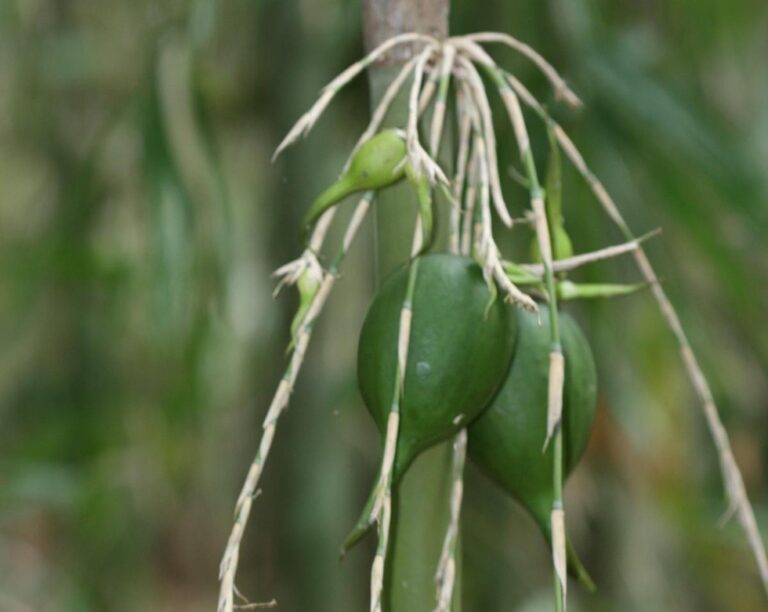
About Melocanna Baccifera:
- The Jawaharlal Nehru Tropical Botanic Garden and Research Institute (JNTBGRI), Thiruvananthapuram, conducted the study between 2009 and 2022 at its Bambusetum where the species was introduced during 1988-1996.
- The study was funded by the Science and Engineering Research Board (SERB), the Department of Science and Technology, the Government of India, and the Kerala State Council for Science, Technology and Environment (KSCSTE) under the Kerala government.
Melocanna baccifera:
- It is a tropical bamboo species known for its association with the occurrence of ‘bamboo death,’ ‘rat floods’ and famines in northeast India.
- Researchers detected a correlation between the sugar content in the fruit of Melocanna bacciferaand the frenzied feeding and population boom in rats during ‘Mautam’, the cyclical, mass bamboo flowering that occurs once in 48 years.
- Called ‘Muli’ in northeast India, Melocanna baccifera is the largest fruit-producing bamboo and is native to the northeast India-Myanmar region.
- During its gregarious flowering, the bamboo produces large fruits which draw animal visitors/predators.
- They include pollen predators (honey bees), fruit predators (millipedes, slugs and snails, fruit borers, monkeys, rats, porcupines, wild boars and palm civets), seedling predators (rabbits, deer), and insect/pest predators (ants, mantis).
- During this period, they also multiply rapidly, a phenomenon dubbed as ‘rat flood.’
- Once the fruits are gone, they start devouring standing crops, causing famines that have claimed thousands of human lives.
- Earlier, it was presumed that ‘high protein in fruits/seeds’ was attracting the rats. However, a JNTBGRI study in 2016 that was part of the research found that the fruit actually contains very little protein. The predation is mainly due to the high content of sugars.
Source : The Hindu






 Last updated on March, 2026
→ UPSC Final Result 2025 is now out.
→ UPSC has released UPSC Toppers List 2025 with the Civil Services final result on its official website.
→ Anuj Agnihotri secured AIR 1 in the UPSC Civil Services Examination 2025.
→ UPSC Marksheet 2025 is now out.
→ UPSC Notification 2026 & UPSC IFoS Notification 2026 is now out on the official website at upsconline.nic.in.
→ UPSC Calendar 2026 has been released.
→ Check out the latest UPSC Syllabus 2026 here.
→ UPSC Prelims 2026 will be conducted on 24th May, 2026 & UPSC Mains 2026 will be conducted on 21st August 2026.
→ The UPSC Selection Process is of 3 stages-Prelims, Mains and Interview.
→ Prepare effectively with Vajiram & Ravi’s UPSC Prelims Test Series 2026 featuring full-length mock tests, detailed solutions, and performance analysis.
→ Enroll in Vajiram & Ravi’s UPSC Mains Test Series 2026 for structured answer writing practice, expert evaluation, and exam-oriented feedback.
→ Join Vajiram & Ravi’s Best UPSC Mentorship Program for personalized guidance, strategy planning, and one-to-one support from experienced mentors.
→ Shakti Dubey secures AIR 1 in UPSC CSE Exam 2024.
→ Also check Best UPSC Coaching in India