Menstrual Leave Latest News
- The Supreme Court recently observed that making paid menstrual leave mandatory by law may unintentionally harm women’s career prospects and reduce their employment opportunities.
Menstrual Leave in India
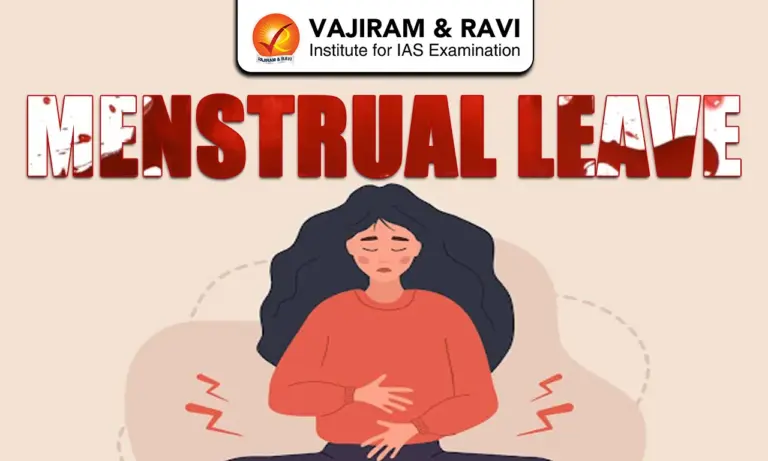
- Menstrual leave refers to leave granted to women during their menstrual cycle when they may experience severe physical discomfort, such as cramps or other medical conditions.
- The issue has increasingly become part of discussions on gender equality, workplace welfare, and labour rights.
- India does not currently have a nationwide law mandating menstrual leave. However, certain initiatives exist at the institutional or regional level. For example:
- Some educational institutions have introduced menstrual leave policies for students.
- Certain state governments have provided limited leave provisions in schools or universities.
- Several private companies have voluntarily implemented menstrual leave policies.
- These initiatives reflect growing awareness of menstrual health issues in workplaces and educational institutions.





Global Practices on Menstrual Leave
- Several countries have adopted policies related to menstrual leave, though their design and implementation vary. For instance:
- Spain introduced a law in 2023 allowing women to take 3-5 days of menstrual leave, with the cost borne by the government.
- Japan introduced menstrual leave legislation as early as 1947.
- South Korea, Indonesia, China, and Zambia also have provisions that allow menstrual leave under certain conditions.
- These international examples illustrate different approaches to addressing menstrual health in workplaces.
Supreme Court’s Observations on Mandatory Menstrual Leave
- The debate gained attention after a petition sought directions from the Supreme Court to introduce a uniform law granting paid menstrual leave to women workers and female students across the country.
- The Supreme Court Bench, headed by Chief Justice of India Surya Kant, observed that a mandatory legal provision for menstrual leave could negatively impact women’s careers.
- The Court highlighted several potential risks:
- Impact on Hiring Decisions: Employers might become reluctant to hire women if they are required to provide additional mandatory leave every month.
- Reduced Workplace Responsibilities: There is concern that employers may hesitate to assign major responsibilities to women if they perceive them as frequently unavailable during certain periods.
- Career Growth Concerns: The Court observed that mandatory leave policies might inadvertently create a perception that women are less capable of handling demanding roles.
- These observations were based on the broader realities of the labour market and workplace dynamics.
- Ultimately, the Court disposed of the petition and asked the Central Government to consider the representation and explore the possibility of framing an appropriate policy in consultation with stakeholders.
Distinction Between Voluntary Policies and Legal Mandates
- While expressing concerns about a compulsory law, the Court made an important distinction between voluntary workplace policies and statutory mandates.
- The judges encouraged voluntary initiatives by employers or institutions that support women employees. Such policies allow organisations to adapt to their workforce needs without creating rigid legal obligations.
- For example, some private companies and educational institutions have already introduced menstrual leave policies. Similarly, certain states have implemented limited provisions for menstrual leave in educational institutions.
- The Court indicated that such voluntary approaches may provide support to women without negatively affecting employment opportunities.
Broader Issues in the Debate
- The discussion around menstrual leave highlights broader issues concerning gender equality in workplaces.
- Supporters argue that menstrual leave recognises biological realities and promotes workplace dignity for women. It can help women manage severe menstrual pain, which may otherwise affect productivity and health.
- Critics, however, argue that mandatory leave policies could reinforce gender stereotypes and discourage employers from hiring women.
- Therefore, policymakers must balance workplace equality, health considerations, and labour market realities while designing such policies.

 Last updated on March, 2026
→ UPSC Final Result 2025 is now out.
→ UPSC has released UPSC Toppers List 2025 with the Civil Services final result on its official website.
→ Anuj Agnihotri secured AIR 1 in the UPSC Civil Services Examination 2025.
→ UPSC Marksheet 2025 is now out.
→ UPSC Notification 2026 & UPSC IFoS Notification 2026 is now out on the official website at upsconline.nic.in.
→ UPSC Calendar 2026 has been released.
→ Check out the latest UPSC Syllabus 2026 here.
→ UPSC Prelims 2026 will be conducted on 24th May, 2026 & UPSC Mains 2026 will be conducted on 21st August 2026.
→ The UPSC Selection Process is of 3 stages-Prelims, Mains and Interview.
→ Prepare effectively with Vajiram & Ravi’s UPSC Prelims Test Series 2026 featuring full-length mock tests, detailed solutions, and performance analysis.
→ Enroll in Vajiram & Ravi’s UPSC Mains Test Series 2026 for structured answer writing practice, expert evaluation, and exam-oriented feedback.
→ Join Vajiram & Ravi’s Best UPSC Mentorship Program for personalized guidance, strategy planning, and one-to-one support from experienced mentors.
→ Shakti Dubey secures AIR 1 in UPSC CSE Exam 2024.
→ Also check Best UPSC Coaching in India
Menstrual Leave FAQs
Q1. What is menstrual leave?+
Q2. Why did the Supreme Court express concerns about mandatory menstrual leave?+
Q3. Did the Supreme Court order a law on menstrual leave?+
Q4. Do any countries provide menstrual leave?+
Q5. Is menstrual leave currently mandatory in India?+
Tags: mains articles menstrual leave upsc current affairs upsc mains current affairs