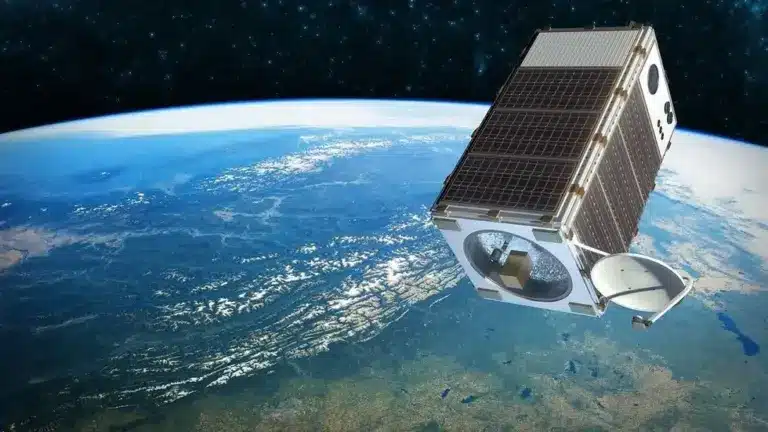
About MethaneSAT
- It will track and measure methane emissions at a global scale.
- It will provide more details and have a much wider field of view than any of its predecessors.
- The entity behind MethaneSAT is the Environmental Defense Fund (EDF) — a US-based nonprofit environmental advocacy group.
- It is developed in collaboration with Harvard University, the Smithsonian Astrophysical Observatory, and the New Zealand Space Agency.
- It will orbit the Earth 15 times a day, monitoring the oil and gas sector.
- It will create a large amount of data, which will tell “how much methane is coming from where, who’s responsible, and are those emissions going up or down over time”,
- The data collected by this will be made public for free in near real-time. This will allow stakeholders and regulators to take action to reduce methane emissions.
- Features
- t is equipped with a high-resolution infrared sensor and a spectrometer.
- It can track differences in methane concentrations as small as three parts per billion in the atmosphere, which enables it to pick up smaller emissions sources than the previous satellites.
- It also has a wide-camera view — of about 200 km by 200 km — allowing it to identify larger emitters so-called “super emitters”.
- The collected data will be analysed using cloud-computing and AI technology developed by Google — the company is a mission partner — and the data will be made public through Google’s Earth Engine platform.
Q1) What is cloud computing?
It is the delivery of computing services—including servers, storage, databases, networking, software, analytics, and intelligence—over the internet (“the cloud”) to offer faster innovation, flexible resources, and economies of scale.
Source: Meet MethaneSAT, a satellite which will ‘name and shame’ methane emitters






 Last updated on March, 2026
→ UPSC Final Result 2025 is now out.
→ UPSC has released UPSC Toppers List 2025 with the Civil Services final result on its official website.
→ Anuj Agnihotri secured AIR 1 in the UPSC Civil Services Examination 2025.
→ UPSC Marksheet 2025 is now out.
→ UPSC Notification 2026 & UPSC IFoS Notification 2026 is now out on the official website at upsconline.nic.in.
→ UPSC Calendar 2026 has been released.
→ Check out the latest UPSC Syllabus 2026 here.
→ UPSC Prelims 2026 will be conducted on 24th May, 2026 & UPSC Mains 2026 will be conducted on 21st August 2026.
→ The UPSC Selection Process is of 3 stages-Prelims, Mains and Interview.
→ Prepare effectively with Vajiram & Ravi’s UPSC Prelims Test Series 2026 featuring full-length mock tests, detailed solutions, and performance analysis.
→ Enroll in Vajiram & Ravi’s UPSC Mains Test Series 2026 for structured answer writing practice, expert evaluation, and exam-oriented feedback.
→ Join Vajiram & Ravi’s Best UPSC Mentorship Program for personalized guidance, strategy planning, and one-to-one support from experienced mentors.
→ Shakti Dubey secures AIR 1 in UPSC CSE Exam 2024.
→ Also check Best UPSC Coaching in India