


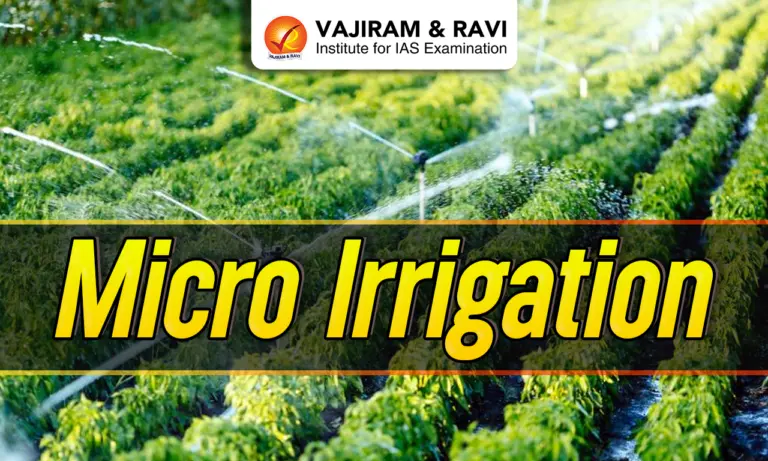
India is facing a growing water crisis due to increasing population pressure, over-exploitation of groundwater, climate change, and inefficient irrigation practices. Agriculture alone consumes nearly 80% of the country’s freshwater resources, while conventional flood irrigation leads to large-scale water wastage. In this context, micro irrigation has emerged as an important solution for improving irrigation efficiency, conserving water, and promoting sustainable agriculture.
Micro Irrigation Meaning
Micro irrigation is a modern irrigation technique in which water is supplied directly and slowly to the root zone of crops through a network of pipes, emitters, drippers, or sprinklers in a controlled manner with minimum wastage of water.
Major Types of Micro Irrigation
Micro irrigation systems are mainly classified based on the method through which water is delivered to crops in a controlled and efficient manner. The two major types of micro irrigation are drip irrigation and sprinkler irrigation.
- Drip Irrigation: In drip irrigation, water is supplied drop by drop directly to the root zone of plants through pipes and emitters. It helps minimise water wastage and is highly suitable for horticultural crops, vegetables, sugarcane, cotton, and orchards.
- Sprinkler Irrigation: In sprinkler irrigation, water is sprayed over crops in the form of artificial rainfall through rotating sprinklers and nozzles. It is suitable for uneven land, sandy soils, and crops such as wheat, pulses, and oilseeds.


Present Status of Micro Irrigation in India
India has an estimated micro irrigation potential of nearly 70 million hectares (mh). However, only around 14 million hectares are currently under micro irrigation coverage. According to the Committee on Doubling Farmers’ Income (Dalwai Committee), adoption of micro irrigation can:
- Reduce water consumption by nearly 40%.
- Increase agricultural productivity by around 45%.
- Enhance farmers’ income by almost 50%.
This highlights the vast untapped potential of micro irrigation in India.
Micro Irrigation Benefits
Micro irrigation has emerged as an effective solution for improving water-use efficiency, enhancing agricultural productivity, and promoting sustainable farming practices in India. By supplying water directly to the root zone in a controlled manner, it reduces wastage and improves overall farm efficiency.
- Improves Irrigation Efficiency: Micro irrigation significantly improves irrigation efficiency by reducing water losses caused by evaporation, runoff, and seepage. It can increase irrigation efficiency from nearly 38% under conventional methods to around 90%.
- Conserves Water Resources: Since water is supplied directly to plant roots in small quantities, micro irrigation helps save 30–70% water compared to traditional flood irrigation methods. This is particularly important in water-stressed and drought-prone regions.
- Enhances Crop Productivity: Timely and precise water supply improves nutrient absorption, plant growth, and crop health, leading to higher agricultural productivity and better crop yields.
- Promotes Efficient Fertiliser Use: Micro irrigation supports fertigation, in which fertilisers are mixed with irrigation water and supplied directly to the roots. This improves fertilizer-use efficiency and reduces nutrient wastage.
- Reduces Waterlogging and Soil Salinity: Controlled irrigation prevents excessive accumulation of water in fields, thereby reducing problems of waterlogging and soil salinity that are common under flood irrigation.
- Increases Farmers’ Income: Higher productivity, lower input costs, and efficient use of water and fertilisers help improve farm profitability and increase farmers’ income.
- Reduces Weed Growth: As water is supplied only near the root zone of crops, unnecessary wetting of surrounding soil is avoided, which reduces weed growth and lowers labour costs.
- Saves Energy and Labour: Micro irrigation requires less water pumping and allows automation in irrigation practices, thereby reducing energy consumption and labour requirements.
- Supports Climate-Resilient Agriculture: Efficient water management through micro irrigation helps agriculture adapt to droughts, erratic rainfall, and climate change-related challenges.
- Suitable for Uneven and Water-Scarce Areas: Micro irrigation systems can be effectively used in hilly terrain, sandy soils, arid regions, and areas with limited water availability, making them suitable for diverse agro-climatic conditions.
Government Initiatives to Promote Micro Irrigation
The Government of India has launched several schemes and institutional initiatives to promote micro irrigation in order to improve water-use efficiency, conserve groundwater, enhance agricultural productivity, and promote climate-resilient agriculture.
Pradhan Mantri Krishi Sinchayee Yojana (PMKSY)
- Pradhan Mantri Krishi Sinchayee Yojana was launched in 2015 to improve irrigation coverage and promote efficient water management in agriculture.
- PMKSY was formed by merging schemes such as the Accelerated Irrigation Benefits Programme (AIBP), Integrated Watershed Management Programme (IWMP), and On-Farm Water Management (OFWM).
- The scheme operates under the slogan “Har Khet Ko Pani, More Crop Per Drop.”
- PMKSY aims to expand irrigation access, improve water-use efficiency, reduce water wastage, and promote sustainable irrigation practices.
Per Drop More Crop (PDMC)
- It is a central government scheme to promote micro-irrigation — drip or sprinkler systems — which is implemented by the Department of Agriculture & Farmers’ Welfare.
- The scheme was launched in 2006 and was subsumed into the Pradhan Mantri Krishi Sichai Yojna (PMKSY) in 2015 as one of its four components.
- The funding is provided by the centre is around 40 per cent and the rest is financed by states and farmers themselves. The proportion is different in hilly and north-eastern states.
- The main objectives of the scheme are to enhance water-use efficiency and increase productivity, thus bolstering farmer incomes.
Micro Irrigation Fund (MIF)
- The Micro Irrigation Fund was established under National Bank for Agriculture and Rural Development (NABARD) with a corpus of ₹5,000 crore.
- The fund was operationalised in 2019 to expand micro irrigation coverage beyond the limits of PMKSY.
- The scheme is committed to providing access to irrigation for the agricultural farm by prioritising water conservation and its management.
- It has several benefits such as higher subsidy on micro irrigation systems, free service for 3 years after installation of micro irrigation systems and water use efficiency.
- States can avail the fund in form of a loan from NABARD at 3 per cent below the cost of funds and the 3 per cent being compensated by central government.
National Mission for Sustainable Agriculture (NMSA)
- The National Mission for Sustainable Agriculture promotes efficient water management as part of climate-resilient agriculture.
- NMSA integrates micro irrigation with soil health management, rainfed area development, agro-forestry, and efficient on-farm water management practices.
- The mission supports sustainable agricultural practices to address climate change and water scarcity challenges.
Har Medh Par Ped (HMPP)
- The Har Medh Par Ped initiative promotes tree plantation along farm boundaries to reduce water evaporation and conserve soil moisture. It integrates agro-forestry with water conservation and complements micro irrigation efforts.
Agricultural Infrastructure Fund (AIF)
- Agricultural Infrastructure Fund was launched with a corpus of ₹1 lakh crore to strengthen agricultural infrastructure.
- The scheme provides interest subvention of 3% for micro irrigation projects undertaken by Farmer Producer Organisations (FPOs), cooperatives, and agri-entrepreneurs.
- AIF promotes cluster-based adoption of micro irrigation systems through collective financing mechanisms.
Rashtriya Krishi Vikas Yojana (RKVY)
- Rashtriya Krishi Vikas Yojana provides flexible funding support to states for agricultural development initiatives.
- States use RKVY funds to supplement PMKSY subsidies and promote innovative irrigation projects such as solar-powered drip systems.
- The scheme encourages state-specific solutions for improving irrigation efficiency.
Sub-Mission on Agricultural Mechanisation (SMAM)
- Sub-Mission on Agricultural Mechanisation supports Custom Hiring Centres that may provide micro irrigation equipment to farmers on a rental basis. This reduces financial barriers for small and marginal farmers who cannot afford irrigation equipment individually.
State-Level Initiatives
- Gujarat established the Gujarat Green Revolution Company (GGRC) as a dedicated institution for promoting micro irrigation.
- Andhra Pradesh and Telangana provide aggressive subsidy support for micro irrigation in crops such as sugarcane, cotton, and horticulture crops.
- Maharashtra integrated watershed development and micro irrigation under the Jalyukt Shivar Abhiyan. The state has promoted drip irrigation in drought-prone regions such as Marathwada and Vidarbha.
- Rajasthan promotes sprinkler irrigation in arid and semi-arid regions where water availability is limited.
- Tamil Nadu implemented the Tamil Nadu Micro Irrigation Project (TNMIP) with World Bank assistance. The project focuses on expanding irrigation coverage among small and marginal farmers and women farmers.
Institutional and Technological Support
- Indian Council of Agricultural Research develops location-specific micro irrigation technologies suitable for different agro-climatic conditions.
- Krishi Vigyan Kendras (KVKs) conduct farmer training, demonstrations, and awareness programmes on drip and sprinkler irrigation systems.
- The PMKSY MIS Portal enables online monitoring and tracking of micro irrigation implementation across states.
- Direct Benefit Transfer (DBT) is increasingly used to transfer subsidies directly into farmers’ bank accounts to reduce leakages.
- Pilot projects using IoT-based smart irrigation systems, soil moisture sensors, and automated drip systems are being promoted for precision irrigation management.
Challenges Associated with Micro Irrigation
Despite several government initiatives and the growing recognition of micro irrigation as a solution to India’s water crisis, its large-scale adoption remains limited due to multiple economic, institutional, technical, and behavioural challenges
- High Initial Cost: Installation of drip and sprinkler systems requires significant investment, making them unaffordable for many small and marginal farmers.
- Recurring Maintenance Costs: Frequent wear and tear of pipes, emitters, and filters increases operational and maintenance expenses.
- Limited Access to Credit: Many farmers face difficulties in obtaining affordable institutional loans for micro irrigation equipment.
- Subsidised Water and Electricity: Cheap canal water and subsidised electricity reduce incentives for adopting water-efficient irrigation methods.
- Limited Suitability for Certain Crops: Crops such as paddy have limited compatibility with micro irrigation systems.
- Regional Disparities: Adoption of micro irrigation remains concentrated mainly in western and southern states of India.
- Lack of Awareness and Technical Knowledge: Many farmers lack proper training regarding installation, operation, and maintenance of micro irrigation systems.
- Dependence on Reliable Electricity Supply: Irregular rural power supply affects the effective functioning of drip and sprinkler systems.
- Water Quality Issues: Saline or impure water can clog emitters and reduce irrigation efficiency.
- Delays in Subsidy Disbursement: Administrative delays in subsidy release discourage farmers from adopting micro irrigation technologies.
- Fragmented Landholdings: Around 86% of Indian farmers are small and marginal farmers with landholdings below 2 hectares, making installation and efficient operation of micro irrigation systems economically difficult.
- Weak Institutional Coordination: Poor coordination among agriculture, irrigation, and financial agencies affects effective implementation.
- Water-Intensive Cropping Pattern: Continued cultivation of highly water-consuming crops such as paddy and sugarcane in water-scarce states like Punjab and Maharashtra reduces the overall water-saving benefits of micro irrigation.
Way Forward
- Rationalise Water and Electricity Subsidies: Reducing distortions in water and power pricing can encourage efficient irrigation practices.
- Promote Crop Diversification: Shifting from water-intensive crops to less water-consuming crops can improve sustainability.
- Strengthen Institutional Credit: Easier access to affordable loans and subsidies should be ensured for small farmers.
- Separate Agricultural Feeder Lines: Dedicated feeder lines can improve power supply management and reduce groundwater overuse.
- Regulate Groundwater Extraction: Strong groundwater governance and monitoring systems are necessary for long-term water security.
- Integrate Technology and Water Conservation: Combining micro irrigation with rainwater harvesting, AI-based irrigation systems, and precision farming can improve water-use efficiency.

 Last updated on Oct, 2026
→ UPSC 2027 Notification will be released on 13 January 2027 at upsconline.nic.in.
→ Check Nobel Prize 2026 Winners List here.
→ Download PIB PRiSM Monthly Magazine 2026 here.
→ Check UPSC Monthly Current Affairs Magazine The Recitals here.
→ Check out the latest UPSC Syllabus here.
→ Download UPSC Model Answers for Mains 2026
→ UPSC Mains Question Paper 2026 is out now for Essay & GS Paper 1, 2, 3 & 4.
→ UPSC Calendar 2027 has been released.
→ Enroll in Vajiram & Ravi’s UPSC Mains Test Series 2027 for structured answer writing practice, expert evaluation, and exam-oriented feedback.
→ Join Vajiram & Ravi’s UPSC Mentorship Program 2027 for personalized guidance, strategy planning, and one-to-one support from experienced mentors.
→ Go through the UPSC Mains Previous Year Papers to enhance your preparation.
→ UPSC has released UPSC Toppers List 2025 with the Civil Services final result on its official website.
→ Also check Best UPSC Coaching in India
Micro Irrigation FAQs
Q1. What is micro irrigation?+
Q2. What are the major types of micro irrigation?+
Q3. Why is micro irrigation important for India?+
Q4. What is the present status of micro irrigation in India?+
Q5. What are the major challenges associated with micro irrigation?+
Tags: micro irrigation











