Micrometeoroids and Orbital Debris Latest News
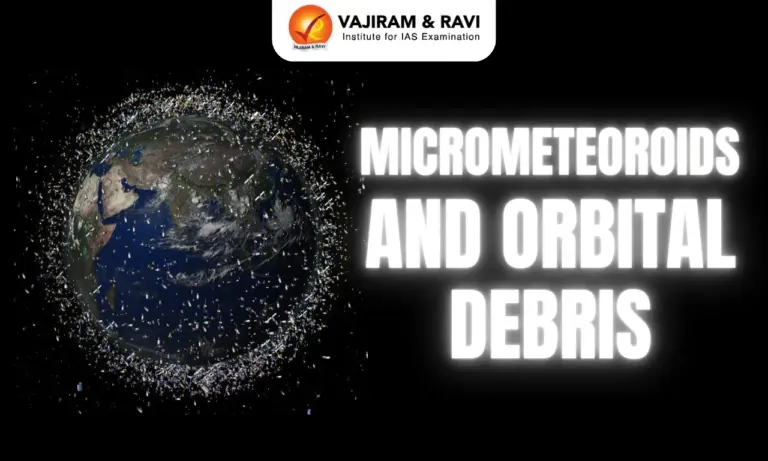
Recently, a piece of debris struck the Chinese crewed vehicle Shenzhou-20, causing a minor crack in the window of its return capsule which raised the concerns regarding protections of astronauts from Micrometeoroids and Orbital Debris (MMOD) that orbit the earth.
About Micrometeoroids
- Micrometeoroids are typically extremely small, with sizes ranging from a few micrometres (a millionth of a meter) to up to about two millimetres
- Origin: Most of them originate from collisions between asteroids in the Asteroid belt (between Mars and Jupiter) with a small portion coming from comets.
- Speed: They travel at extremely high velocities (about 11 to 72 km/s).
- Distribution: They exist everywhere in space, but due to the Earth’s gravity pull their distribution is slightly higher near our planet.
- The micrometeoroids in Earth’s orbital environment are effectively uncountable and they deliver billions of impacts to orbiting spacecraft annually.





About Orbital Debris
- They are also called space debris, space junk or space trash.
- They consist of human-made objects in the Earth’s orbit which no longer serves any useful purpose.
- Origin: All orbital debris originated primarily from exploded rocket stages, satellites, accidental collisions and intentional anti-satellite weapon tests.
- The typical average speed of orbital debris is about 10 km/s.
- Orbital debris is mostly concentrated in a “shell” around the Earth in Low earth Orbit (LEO) ranging from about 200 km up to 2,000 km altitude.
Source: TH

 Last updated on April, 2026
→ UPSC Final Result 2025 is now out.
→ UPSC has released UPSC Toppers List 2025 with the Civil Services final result on its official website.
→ Anuj Agnihotri secured AIR 1 in the UPSC Civil Services Examination 2025.
→ UPSC Marksheet 2025 is now out.
→ UPSC Notification 2026 & UPSC IFoS Notification 2026 is now out on the official website at upsconline.nic.in.
→ UPSC Calendar 2026 has been released.
→ Check out the latest UPSC Syllabus 2026 here.
→ UPSC Prelims 2026 will be conducted on 24th May, 2026 & UPSC Mains 2026 will be conducted on 21st August 2026.
→ The UPSC Selection Process is of 3 stages-Prelims, Mains and Interview.
→ Prepare effectively with Vajiram & Ravi’s UPSC Prelims Test Series 2026 featuring full-length mock tests, detailed solutions, and performance analysis.
→ Enroll in Vajiram & Ravi’s UPSC Mains Test Series 2026 for structured answer writing practice, expert evaluation, and exam-oriented feedback.
→ Join Vajiram & Ravi’s Best UPSC Mentorship Program for personalized guidance, strategy planning, and one-to-one support from experienced mentors.
→ Shakti Dubey secures AIR 1 in UPSC CSE Exam 2024.
→ Also check Best UPSC Coaching in India
Micrometeoroids and Orbital Debris FAQs
Q1. What is the main concern with orbital debris?+
Q2. What are micrometeoroids?+
Tags: micrometeoroids and orbital debris