Microplastics Latest News
Weather conditions, especially continuous rainfall, drive microplastics into city lakes, a new study reports.
About Microplastics
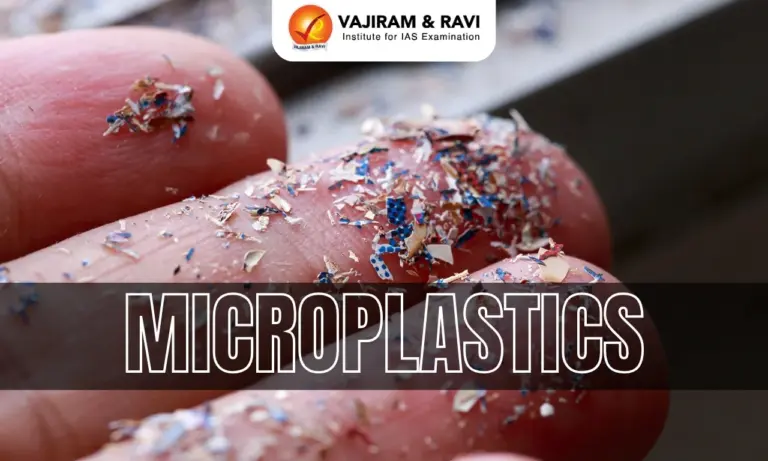
- Microplastics are small pieces of plastics, usually smaller than 5 mm.
- They are present in a variety of products, from cosmetics to synthetic clothing to plastic bags and bottles. Many of these products readily enter the environment as wastes.
- Microplastics consist of carbon and hydrogen atoms bound together in polymer chains.
- Other chemicals, such as phthalates, polybrominated diphenyl ethers (PBDEs), and tetrabromobisphenol A (TBBPA), are typically also present in microplastics, and many of these chemical additives leach out of the plastics after entering the environment.
- They are persistent, very mobile, and hard to remove from nature.
- There are two categories of microplastics: primary and secondary.
- Primary microplastics are tiny particles designed for commercial use, such as cosmetics, as well as microfibers shed from clothing and other textiles, such as fishing nets.
- They enter the environment directly through any of various channels—for example, product use, unintentional loss from spills during manufacturing or transport, or abrasion during washing.
- Secondary microplastics are particles that result from the breakdown of larger plastic items, such as water bottles.
- This breakdown is caused by exposure to environmental factors, mainly the sun’s radiation and ocean waves.
- Impacts:
- Once in the environment, microplastics do not biodegrade and tend to accumulate and persist.
- They can be ingested by marine organisms, leading to potential harm to aquatic life and bioaccumulation along the food chain.
- They can also carry toxic chemicals and pollutants, posing additional risks to organisms and ecosystems.
Source: TOI






 Last updated on April, 2026
→ UPSC Final Result 2025 is now out.
→ UPSC has released UPSC Toppers List 2025 with the Civil Services final result on its official website.
→ Anuj Agnihotri secured AIR 1 in the UPSC Civil Services Examination 2025.
→ UPSC Marksheet 2025 is now out.
→ UPSC Notification 2026 & UPSC IFoS Notification 2026 is now out on the official website at upsconline.nic.in.
→ UPSC Calendar 2026 has been released.
→ Check out the latest UPSC Syllabus 2026 here.
→ UPSC Prelims 2026 will be conducted on 24th May, 2026 & UPSC Mains 2026 will be conducted on 21st August 2026.
→ The UPSC Selection Process is of 3 stages-Prelims, Mains and Interview.
→ Prepare effectively with Vajiram & Ravi’s UPSC Prelims Test Series 2026 featuring full-length mock tests, detailed solutions, and performance analysis.
→ Enroll in Vajiram & Ravi’s UPSC Mains Test Series 2026 for structured answer writing practice, expert evaluation, and exam-oriented feedback.
→ Join Vajiram & Ravi’s Best UPSC Mentorship Program for personalized guidance, strategy planning, and one-to-one support from experienced mentors.
→ Shakti Dubey secures AIR 1 in UPSC CSE Exam 2024.
→ Also check Best UPSC Coaching in India
Microplastics FAQs
Q1. What are microplastics?+
Q2. What are primary microplastics?+
Q3. What are secondary microplastics?+
Tags: microplastics prelims pointers upsc current affairs upsc prelims current affairs