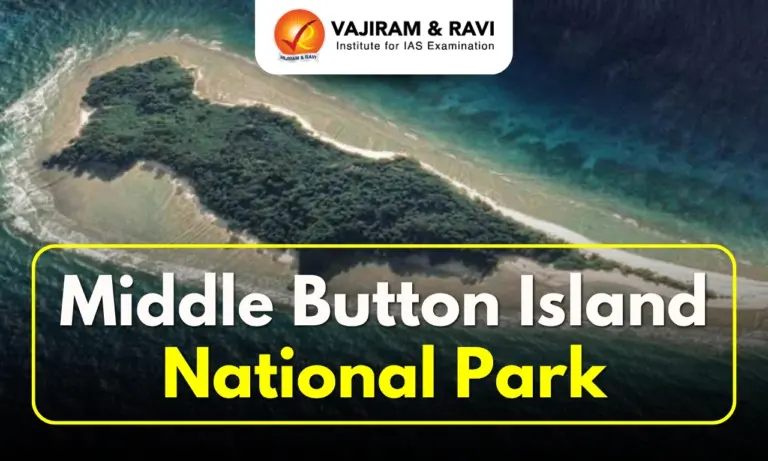
Middle Button Island National Park is an important marine national park located in the Andaman and Nicobar Islands. It was established in 1979 under the Wildlife (Protection) Act, 1972, to protect the rich biodiversity of the region. The park is known for its coral reefs, tropical forests, mangroves, seagrass beds, and diverse marine life. Although relatively small in size, it plays a significant role in conserving the fragile ecosystems of the Andaman Sea and forms an important part of India’s network of Marine Protected Areas (MPAs).
Middle Button Island National Park Location and Geographical Features
- Middle Button Island National Park is located in the South Andaman district of the Andaman and Nicobar Islands.
- It lies within Ritchie’s Archipelago, a group of islands known for their rich marine biodiversity.
- The park is situated about 200 km northeast of Port Blair.
- It covers an area of approximately 64 sq. km.
- The park lies between North Button Island National Park and South Button Island National Park.
- The island is surrounded by sandy beaches, shallow coastal waters, mangroves, and coral reefs.
- The climate is tropical and humid, with temperatures generally ranging from 20°C to 30°C.
- Heavy rainfall occurs during the southwest monsoon season from June to October.
Middle Button Island National Park Ecological Significance
Middle Button Island National Park is important because it protects both terrestrial and marine ecosystems within a single protected area.
Coral Reef Ecosystem:
- The park contains healthy fringing coral reefs that support a wide variety of marine species.
- Coral reefs provide shelter, breeding grounds, and feeding areas for fish and other marine organisms.
- They protect coastlines from erosion and reduce the impact of waves and storms.
- The reefs support fisheries and contribute to the overall health of the marine ecosystem.
Mangroves and Seagrass Beds:
- Mangroves help stabilize coastlines and prevent soil erosion.
- They serve as nursery grounds for many fish and crustacean species.
- Seagrass beds provide food and habitat for dugongs and sea turtles.
Biodiversity Conservation:
- The park acts as a refuge for several endangered and threatened species.
- It provides habitat for marine mammals, sea turtles, birds, and reef-associated organisms.
- Its protected status helps maintain the ecological balance of the Andaman Sea.


Middle Button Island National Park Flora
The island supports tropical moist deciduous forests along with mangrove vegetation along the coast.
- Important plant species include Dipterocarpus grandiflorus, Hopea odorata, Calamus palustris, Dinochloa andamanica, and Artocarpus gomeziana.
- Dense forest cover provides habitat for wildlife and protects the island from soil erosion.
- Mangroves along the coastline contribute to coastal stability and ecological productivity.
- The vegetation supports nutrient cycling and maintains ecological balance.
Middle Button Island National Park Fauna
Marine Fauna: The waters surrounding the island support a rich variety of marine life.
- Coral reefs provide habitat for numerous species of fish, molluscs, crustaceans, sea cucumbers, and starfish.
- Dolphins are commonly found in the surrounding waters.
- The endangered Dugong is one of the most important species associated with the park.
- Blue whales have occasionally been reported from nearby marine areas.
- The park provides habitat for the Green Sea Turtle.
- It also supports populations of the Hawksbill Sea Turtle and Olive Ridley Sea Turtle.
Coastal areas serve as feeding and nesting grounds for sea turtles.
Terrestrial Fauna
- Spotted deer are among the most commonly observed mammals on the island.
- Other animals include fruit bats, water lizards, and monitor lizards.
- Fruit bats play an important ecological role by pollinating flowers and dispersing seeds.
Avifauna: The park supports a variety of resident and migratory birds.
- Important bird species include the Andaman teal, white-bellied sea eagle, and palm swift.
Middle Button Island National Park Major Threats
Middle Button Island National Park faces several natural and human-induced threats that endanger its fragile and terrestrial ecosystems.
- Overfishing and Reef Exploitation: Excessive harvesting of reef fish, sea cucumbers, and shell resources disrupts coral reef ecosystems and marine food chains.
- Climate Change and Coral Bleaching: Rising sea temperatures cause coral bleaching, leading to coral mortality and loss of marine biodiversity.
- Marine Pollution: Plastic waste, abandoned fishing gear, and domestic waste threaten marine organisms and damage coral reefs.
- Tourism Pressure: Unregulated snorkeling, scuba diving, and boat anchoring can physically damage fragile coral ecosystems.
- Sedimentation and Water Pollution: Sediments and pollutants entering coastal waters reduce water quality and adversely affect coral growth.
- Ocean Acidification: Increased absorption of atmospheric carbon dioxide by oceans weakens coral skeletons and reduces reef resilience.
- Natural Disasters: Cyclones, earthquakes, and tsunamis periodically damage coral reefs, coastal habitats, and island ecosystems.
- Historical Timber Extraction: Past logging activities altered natural vegetation and affected ecological stability on the island.
- Human-Induced Habitat Disturbance: Fishing activities and nearby human settlements create pressure on wildlife habitats and breeding grounds.
Conservation Measures in Middle Button Island National Park
- National Park Status: Middle Button Island was declared a National Park in 1979 and receives the highest level of protection under the Wildlife (Protection) Act, 1972.
- Ban on Exploitative Activities: Hunting, poaching, grazing, timber extraction, coral collection, and commercial exploitation of natural resources are prohibited within the park.
- Protection of Coral Reef Ecosystems: The park safeguards fringing coral reefs that support diverse marine life and maintain ecological balance in the Andaman Sea.
- Conservation of Endangered Species: Special protection is provided to dugongs, sea turtles, dolphins, and other threatened marine species inhabiting the park.
- Regulated Tourism: Visitor access, scuba diving, and snorkeling activities are regulated to minimize damage to coral reefs and wildlife habitats.
- Biodiversity Monitoring: Scientific studies and ecological monitoring are undertaken to assess the health of coral reefs, forests, and wildlife populations.
- Integrated Marine Conservation: The park is managed in coordination with North Button Island and South Button Island National Parks as part of a broader marine conservation landscape.
- Community-Based Conservation: Local island communities are encouraged to participate in ecotourism and conservation activities to promote sustainable livelihoods.

 Last updated on Oct, 2026
→ UPSC 2027 Notification will be released on 13 January 2027 at upsconline.nic.in.
→ Check Nobel Prize 2026 Winners List here.
→ Download PIB PRiSM Monthly Magazine 2026 here.
→ Check UPSC Monthly Current Affairs Magazine The Recitals here.
→ Check out the latest UPSC Syllabus here.
→ Download UPSC Model Answers for Mains 2026
→ UPSC Mains Question Paper 2026 is out now for Essay & GS Paper 1, 2, 3 & 4.
→ UPSC Calendar 2027 has been released.
→ Enroll in Vajiram & Ravi’s UPSC Mains Test Series 2027 for structured answer writing practice, expert evaluation, and exam-oriented feedback.
→ Join Vajiram & Ravi’s UPSC Mentorship Program 2027 for personalized guidance, strategy planning, and one-to-one support from experienced mentors.
→ Go through the UPSC Mains Previous Year Papers to enhance your preparation.
→ UPSC has released UPSC Toppers List 2025 with the Civil Services final result on its official website.
→ Also check Best UPSC Coaching in India
Middle Button Island National Park FAQs
Q1. Where is Middle Button Island National Park located?+
Q2. Why is Middle Button Island National Park ecologically important?+
Q3. Which important species are found in the park?+
Q4. What are the major threats faced by the park?+
Q5. What measures have been taken to conserve Middle Button Island National Park?+
Tags: middle button island national park