What’s in today’s article?
- Why in News?
- What are the Migration Trends in India Highlighted in the EAC-PM Report?
- Major Migration Routes and District-Level Insights:
- Methodology of the EAC-PM Report and its Limitations:
- Conclusion
Why in News?
- A recent working paper by the Economic Advisory Council to the Prime Minister (EAC-PM), titled “400 Million Dreams!”, sheds light on the evolving migration trends in India.
- The similar exercise was undertaken in Economic Survey 2016-17, when Arvind Subramanian was Chief Economic Advisor, for calculating the migration trends.




What are the Migration Trends in India Highlighted in the EAC-PM Report?
- Top states for migrant destinations:
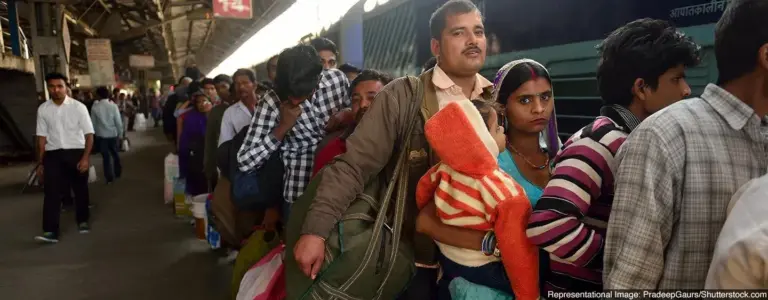
- West Bengal and Rajasthan emerged as new hotspots for migrant inflows, joining Uttar Pradesh, Maharashtra, and Madhya Pradesh in the top five states receiving the highest number of 2nd-class railway passengers.
- States showing the highest growth in incoming migrants: West Bengal, Rajasthan, and Karnataka.
- In contrast, states like Andhra Pradesh and Bihar saw a decline in rankings compared to 2012.
- Decline in overall migration:
- The report notes an 11.78% reduction in the overall number of migrants since the 2011 Census.
- This decline is attributed to improved economic opportunities in smaller cities, reducing the need for long-distance migration.
Major Migration Routes and District-Level Insights:
- Top state-to-state routes (2023):
- Uttar Pradesh to Delhi
- Gujarat to Maharashtra
- Telangana to Andhra Pradesh
- Bihar to Delhi
- Bihar to West Bengal
- Top destination districts for migrants:
- Mumbai
- Bengaluru urban
- Howrah
- Central Delhi
- Hyderabad
- Emerging origin districts (2023):
- Villupuram (Tamil Nadu)
- Saharsa (Bihar)
- Moradabad (Uttar Pradesh)
- Murshidabad (West Bengal)
- Major intra-state movement: The Murshidabad-Kolkata route is the most traveled path for general class passengers, reflecting significant intra-state movement.
- Migration to major urban centers:
- Delhi: Major source districts include Agra, Patna, Kanpur Nagar, Jhansi, and Bareilly, with new entrants like Dausa (Rajasthan) and Ludhiana (Punjab).
- Mumbai: Valsad, Surat, Nashik, Ratnagiri, and Varanasi remain key origin districts, with Sindhudurg as a notable addition.
Methodology of the EAC-PM Report and its Limitations:
- Methodology:
- The report analyses migration patterns using Indian Railways’ unreserved ticketing data, mobile roaming data, and banking remittance records.
- The 2nd-class in Mail Express and Ordinary trains is the most affordable travel option predominantly used by blue-collar workers.
- Limitations:
- Lack of demographic details (age, gender, reasons for migration).
- Data captures station-to-station travel rather than actual origin-destination routes.
Conclusion:
- The EAC-PM report provides crucial insights into migration patterns in India, highlighting significant changes in destination preferences and reduced migration trends due to localised economic opportunities.
- These findings are vital for policymakers addressing urban planning, infrastructure, and economic development.
https://www.youtube.com/watch?v=Qjv-xS-Qz1w
Q.1. What is the Economic Advisory Council to the Prime Minister (EAC-PM)?
The EAC-PM is an independent body that advises the Government of India on economic issues. The EAC-PM provides neutral analysis and advice to the Prime Minister on economic issues such as inflation, industrial output, and microfinance.
Q.2. Why was there a reverse migration?
The phenomenon of reverse migration is often seen in regions experiencing economic change, where migrants return due to better job opportunities or improved living conditions back home.
Source: West Bengal & Rajasthan new migrant destination hotspots; Uttar Pradesh tops

 Last updated on March, 2026
→ UPSC Final Result 2025 is now out.
→ UPSC has released UPSC Toppers List 2025 with the Civil Services final result on its official website.
→ Anuj Agnihotri secured AIR 1 in the UPSC Civil Services Examination 2025.
→ UPSC Marksheet 2025 is now out.
→ UPSC Notification 2026 & UPSC IFoS Notification 2026 is now out on the official website at upsconline.nic.in.
→ UPSC Calendar 2026 has been released.
→ Check out the latest UPSC Syllabus 2026 here.
→ UPSC Prelims 2026 will be conducted on 24th May, 2026 & UPSC Mains 2026 will be conducted on 21st August 2026.
→ The UPSC Selection Process is of 3 stages-Prelims, Mains and Interview.
→ Prepare effectively with Vajiram & Ravi’s UPSC Prelims Test Series 2026 featuring full-length mock tests, detailed solutions, and performance analysis.
→ Enroll in Vajiram & Ravi’s UPSC Mains Test Series 2026 for structured answer writing practice, expert evaluation, and exam-oriented feedback.
→ Join Vajiram & Ravi’s Best UPSC Mentorship Program for personalized guidance, strategy planning, and one-to-one support from experienced mentors.
→ Shakti Dubey secures AIR 1 in UPSC CSE Exam 2024.
→ Also check Best UPSC Coaching in India