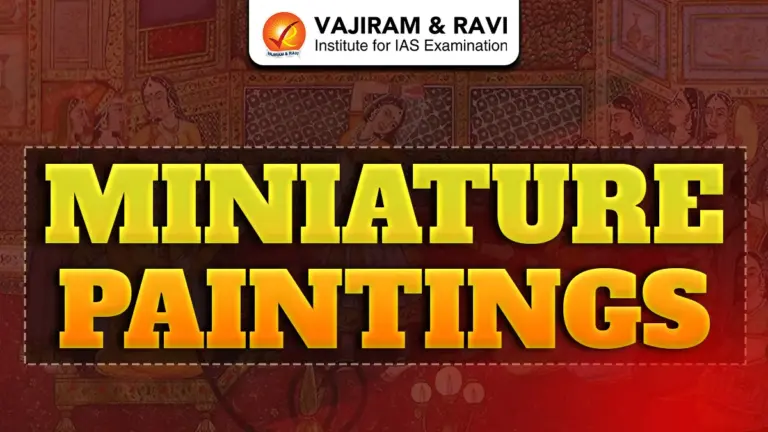
Miniature Paintings are small, detailed and colorful artworks that were mainly created on paper, cloth, or ivory. They often depict scenes from history, mythology or court life and are known for their fine brushwork and intricate details. They are an integral part of Indian Painting history.
Miniature Paintings About
- Miniature paintings are small-sized paintings made with great detail and bright colours.
- They were mainly painted on paper, cloth, or palm leaves.
- These paintings show stories from history, religion and royal court life.
- Miniature paintings developed in medieval India, especially under the Mughal, Rajput, and Deccan rulers.
Read about: Mural Paintings
Miniature Paintings Techniques
- Miniature paintings were usually made using the tempera technique, where colours were mixed with a binding material to make them long-lasting. This method helped artists create fine lines and clear details, which is the main feature of miniature art.
- These paintings are small in size, generally very compact, so that every part of the artwork looks neat and balanced. The small size helped artists focus more on detail rather than large backgrounds.
- The main subject is drawn much smaller than real life, which gives the painting a decorative and stylized look instead of a realistic one.
- The painting should not be more than 25 square inches in size.
- Human figures are shown in a stylised manner, often in side view rather than full front view. This was done to maintain uniformity and traditional artistic rules.
- The figures usually have large expressive eyes, sharp nose and slim body, making them easily recognizable. Skin colours are shown as fair or brown, while gods like Lord Krishna are painted blue to show divinity.
- Hair and eyes are mostly shown in black colour. Women are often painted with long hair, while men are shown wearing turbans, reflecting the social and cultural life of the time.
- Artists mainly used natural colours made from plants, minerals and stones. Colours like red, yellow, blue, white, black and brown were commonly used to give brightness and beauty to the paintings.
- Traditional Indian clothes, ornaments, slippers and shoes are carefully shown, which helps us understand the culture and lifestyle of the period.





Early Miniature Paintings
- Early miniature paintings were small paintings with fine details, mainly made for manuscripts, books and albums.
- They were painted on perishable materials such as paper, palm leaves and cloth, which is why many early works have not survived.
- This form of painting developed between the 8th and 12th centuries, partly as a response to large wall and mural paintings.
- Early miniature art was found in both eastern and western parts of India, showing regional influence.
- In the beginning, these paintings were simple and less decorative, but over time they became more refined and detailed.
- Two important early schools of miniature painting were the Pala School of Art and the Apabhramsa School of Art, which played a key role in the growth of this tradition.
Pala School of Painting
- The Pala School of Painting is one of the earliest forms of miniature painting in India and developed between the 8th and 12th centuries (about 750-1150 AD).
- It flourished under the Pala rulers of Bengal and eastern India, during a period when Buddhism and Buddhist art were at their peak.
- These paintings were mainly made for Buddhist manuscripts and were painted on palm leaves or early paper, which were easily available materials.
- The style is known for its smooth, flowing lines and soft, dull colours, giving the paintings a calm and natural look.
- Most paintings show single figures, usually of Buddha or Buddhist deities, and group scenes are rarely seen.
- The paintings have simple backgrounds and compositions, similar in style to Ajanta art and contemporary sculptures.
- They were patronised by Buddhist monks, Pala kings and followers of the Vajrayana school of Buddhism.
- Famous artists of this school include Dhimman and Vitapala, who contributed greatly to its development.
Read about: Indian Paintings
Apabhramsa School of Painting
- The Apabhramsa School of Art, also known as the Western Indian School, developed in Gujarat and the Mewar region of Rajasthan.
- It flourished between the 11th and 15th centuries and was the most popular painting style in western India during this period.
- In the early phase, the paintings were mainly inspired by Jain religion, especially stories of Jain monks and scriptures.
- Later, Vaishnava themes were also included, such as stories from the Gita Govinda and scenes of secular love.
- At first, paintings were made on palm leaves, but later paper was used as writing materials improved.
- Though these paintings were used as book illustrations, their style remained similar to mural paintings but in a smaller size.
- The artists used symbolic colours like red, yellow and ochre, and in later times bright and golden colours were added.
- Human figures were shown in a stylised manner, with large fish-shaped eyes, pointed nose and stiff posture.
- Female figures were often drawn with broad hips and prominent features, while animals and birds looked toy-like.
- Famous examples of this school include illustrations from Kalpasutra and Kalakacharya Katha manuscripts.
Miniature Painting during the Delhi Sultanate
- During the Delhi Sultanate period, miniature painting developed as an Indo-Persian style, combining Persian influences with Indian artistic traditions, including Jain elements.
- Most of these paintings were produced between 1450 and 1550 CE, mainly in centres like Mandu and Jaunpur, with some activity in Delhi and Gujarat.
- A well-known example is the Nimatnama, a recipe book prepared during the rule of Nasir Shah of Mandu, which shows scenes of court life, food preparation, and daily activities.
- Though painted by Indian artists, the works followed Persian models, using bright colours, decorative borders, green landscapes and stylised figures arranged in rows.
- Another style called Lodi Khuladar was also popular in Sultanate-ruled regions between Delhi and Jaunpur.
- These paintings were experimental in nature and later influenced the development of the Mughal, Rajput and Deccan schools of miniature painting.
Miniature Painting during Mughal Era
- During the Mughal period, miniature painting developed as a new and refined art form with strong Persian influence, but it gradually took on an Indian character.
- The main themes changed from religious subjects to the life of the emperor, such as court scenes, hunting, wars and important events.
- These paintings are known for their natural look, fine details, and bright yet balanced colours. Artists carefully showed human figures, animals, flowers and landscapes, often with hills in the background.
- Mughal painters introduced the technique of foreshortening, where objects are drawn in a way that makes them appear near or far, giving a sense of depth.
- Mughal art covered many subjects, not only religion, which made it rich and varied.
Contribution of Mughal Rulers
The development of Mughal miniature painting was shaped by the support of different Mughal emperors. Each ruler added new ideas, themes, and techniques to this art form. From Akbar’s organized royal workshop to Jahangir’s love for nature and Shah Jahan’s decorative style, Mughal painting evolved continuously. Though Aurangzeb withdrew royal patronage, the art survived and spread to regional courts, influencing later Indian painting traditions.
Akbar (1556-1605)
- Akbar gave strong support to painting and created a separate department for art and writing.
- He set up a royal workshop called Tasvir Khana, where painters were appointed on salary and trained professionally.
- Akbar believed paintings were useful for learning and entertainment and rewarded artists who produced realistic images.
- He invited skilled Indian artists from earlier kingdoms, which brought a strong Indian element into Mughal painting.
- Paintings of this period show three-dimensional figures, use of foreshortening, and calligraphy.
- Art shifted from popular themes to court scenes, such as royal life and administration.
- Famous painters: Daswanth, Basawan, Kesu.
- Important illustrated manuscripts: Hamzanama, Tutinama, Anvar-i-Suhaili, and Gulistan of Sadi.
Jahangir (1605-1627)
- Mughal painting reached its highest level during Jahangir’s reign.
- He was a lover of nature and preferred paintings of birds, animals, plants and flowers.
- Artists focused more on portraits and albums rather than manuscripts.
- A new feature of this period was highly decorated borders around paintings.
- Paintings became more naturalistic and detailed, especially in animal studies.
- Ustad Mansoor was the most famous painter, known for realistic animal and bird paintings.
- Ayar-i-Danish was an important illustrated work of this period.
Shah Jahan (1628-1658)
- During Shah Jahan’s reign, Mughal painting became more formal and decorative.
- He preferred artificial beauty and stillness instead of natural expressions.
- European influence increased, and artists began using pencil sketches instead of charcoal.
- Greater use of gold, silver and bright colours was encouraged.
- Paintings mainly showed court scenes, royal portraits, festivals, processions and durbars.
- Though the royal workshop expanded, the style became less lively than before.
Aurangzeb (1658-1707)
- Aurangzeb did not support painting, considering it unimportant.
- As royal patronage declined, many Mughal painters migrated to regional courts like Rajasthan and Awadh.
- There, Mughal style mixed with local traditions, leading to the rise of Provincial Mughal painting.
- Awadh became an important centre of this new style.
Miniature Paintings of Rajput Style
-
- Rajput miniature painting developed mainly between the 16th and 18th centuries under the patronage of Rajput rulers of Rajasthan, Central India, and the Punjab Himalayan region. In the early stage, this art was influenced by mural and fresco traditions, but later it became popular in the miniature form.
- These paintings were deeply rooted in Indian culture and traditions. Most themes were religious and devotional, drawn from Indian epics and sacred texts such as the Ramayana, Mahabharata, Bhagavata Purana, Shiva Purana and Gita Govinda of Jayadeva. Folk stories and musical themes also inspired the artists.
- Rajput Paintings commonly used Hindu symbols like the lotus, peacock and swan, which had spiritual meanings. The style reflected devotion, emotion, and a strong connection with nature.
- Broadly, Rajput miniature paintings are divided into two main schools:
- Rajasthani School of Painting
-
- Pahari School of Painting (developed mainly between the 17th and 19th centuries)
Rajasthani School of Painting
- Rajasthani paintings developed in the princely states of present-day Rajasthan and parts of Madhya Pradesh between the 16th and early 19th centuries, under the patronage of Rajput rulers.
- Earlier called “Rajput paintings” by scholars, they are now mainly grouped as Rajasthani and Pahari schools, and they followed strong Indian artistic traditions different from Mughal art.
- These paintings were made on Wasli (layers of handmade paper) using natural colours from minerals, gold and silver and fine brushes made of animal hair, then polished for a smooth finish.
- Painting was a team effort, where the main artist planned the design and other artists added colours and details.
- Most themes were religious and devotional, especially stories of Radha–Krishna, inspired by texts like Gita Govinda, Rasamanjari and Rasikapriya.
- Other popular subjects included Ragamala paintings, scenes from epics like the Ramayana and Mahabharata and royal life such as court scenes, festivals, hunting, animals and birds.
- Important centres were Mewar, Bundi, Kota, Jaipur, Bikaner, Kishangarh, Marwar, Malwa and nearby regions.
| Rajasthani School of Paintings | |
|
Mewar School of Painting |
|
|
Malwa School of Painting |
|
|
Bundi School of Painting |
|
|
Bikaner School of Painting |
|
|
Kishangarh School of Painting |
|
|
Jodhpur (Marwar) School of Paintings |
|
|
Jaipur School of Painting |
|
|
Kota School of Painting |
|
Miniature Paintings in South India
- Miniature Paintings in South India developed during the early medieval period and had a style different from North Indian schools.
- These paintings used a lot of gold, which made them bright and decorative.
- Artists mainly painted Hindu gods and goddesses, while rulers were shown less often.
- The climate and local traditions of South India influenced their painting style.
- The main schools of South Indian miniature painting are Tanjore and Mysore.
Tanjore School of Painting
- Tanjore paintings developed in South India during the late 18th and 19th centuries and are famous for their heavy use of gold.
- These paintings use bright colours, bold outlines and simple shading to make the figures stand out.
- Artists decorated the paintings with gold foil, pearls, glass pieces and semi-precious stones, giving them a rich look.
- Most paintings show Hindu gods and goddesses, especially Lord Krishna, often shown smiling in different scenes from his life.
- The figures are large, with round and calm faces, giving them a divine appearance.
- This style grew under the support of Maratha ruler Maharaja Serfoji II, who encouraged art and culture.
- Today, Tanjore paintings are still made, and artists also paint birds, animals and buildings along with religious themes.
Mysore School of Painting
- Mysore paintings began in South India during the Vijayanagara period and later developed under the rulers of Mysore.
- These paintings are known for their soft colours, neat work and very fine detailing.
- The main subjects are Hindu gods and goddesses and stories from Indian epics and mythology.
- Usually, more than one figure is shown, but one main figure is larger and brighter than the others.
- Artists used thin lines and gentle brush strokes to give the figures a graceful look.
- A special feature is the use of gesso work, a paste used to raise designs of jewellery, clothes and temple pillars, which are then covered with gold.
- Mysore rulers supported this art and it continued even during the British period.
Pahari School of Painting
- Pahari painting developed in the sub-Himalayan regions, mainly in present-day Himachal Pradesh, Jammu, parts of Punjab and Uttarakhand.
- These areas had many small Rajput kingdoms, where kings supported artists between the 17th and 19th centuries.
- Paintings were made in royal workshops (called atelier) across about 22 princely states.
- Pahari paintings are mainly divided into two schools: Basholi School and Kangra School.
- The paintings show stories from mythology, literature and love themes, with many moving figures on one canvas.
- Each figure looks different in colour, posture and expression, giving life to the scene.
- Famous painters of this tradition include Nainsukh, Manaku and Sansar Chand.
Basholi School of Painting
- Basholi (Basohli) School was the earliest Pahari painting style and developed in the Basholi region.
- These paintings are known for bold lines, bright colours like red, yellow and green and strong expressions.
- Human figures have large lotus-shaped eyes, expressive faces and a receding hairline.
- Most paintings show Radha–Krishna stories and texts like Rasamanjari, Gita Govinda and Ramayana.
- Raja Kirpal Pal was the first major patron of this school.
- Devi Das was the most famous painter, known for Radha-Krishna themes and royal portraits.
Kangra School of Painting
- Kangra School of painting developed in Himachal Pradesh after Mughal artists moved to hill states when Mughal power declined.
- It grew from the Guler style and became the most mature phase of Pahari painting in the late 18th century.
- The school reached its highest level under Raja Sansar Chand, who was a great patron of art.
- These paintings are known for soft lines, natural beauty and emotional expressions.
- Women figures have sharp chins, long eyes and gentle facial features.
- Common themes include Radha-Krishna love stories, Gita Govinda, Bhagavata Purana and the Barahmasa (twelve months) theme.
Kangra style later influenced painting centres in Kullu, Chamba and Mandi.

 Last updated on April, 2026
→ UPSC Final Result 2025 is now out.
→ UPSC has released UPSC Toppers List 2025 with the Civil Services final result on its official website.
→ Anuj Agnihotri secured AIR 1 in the UPSC Civil Services Examination 2025.
→ UPSC Marksheet 2025 is now out.
→ UPSC Notification 2026 & UPSC IFoS Notification 2026 is now out on the official website at upsconline.nic.in.
→ UPSC Calendar 2026 has been released.
→ Check out the latest UPSC Syllabus 2026 here.
→ UPSC Prelims 2026 will be conducted on 24th May, 2026 & UPSC Mains 2026 will be conducted on 21st August 2026.
→ The UPSC Selection Process is of 3 stages-Prelims, Mains and Interview.
→ Prepare effectively with Vajiram & Ravi’s UPSC Prelims Test Series 2026 featuring full-length mock tests, detailed solutions, and performance analysis.
→ Enroll in Vajiram & Ravi’s UPSC Mains Test Series 2026 for structured answer writing practice, expert evaluation, and exam-oriented feedback.
→ Join Vajiram & Ravi’s Best UPSC Mentorship Program for personalized guidance, strategy planning, and one-to-one support from experienced mentors.
→ Shakti Dubey secures AIR 1 in UPSC CSE Exam 2024.
→ Also check Best UPSC Coaching in India
Miniature Paintings FAQs
Q1. What are Miniature Paintings?+
Q2. When did Miniature Painting develop in India?+
Q3. What technique was used in miniature paintings?+
Q4. Which are the earliest schools of miniature painting?+
Q5. What are the main features of Miniature Paintings?+
Tags: miniature paintings