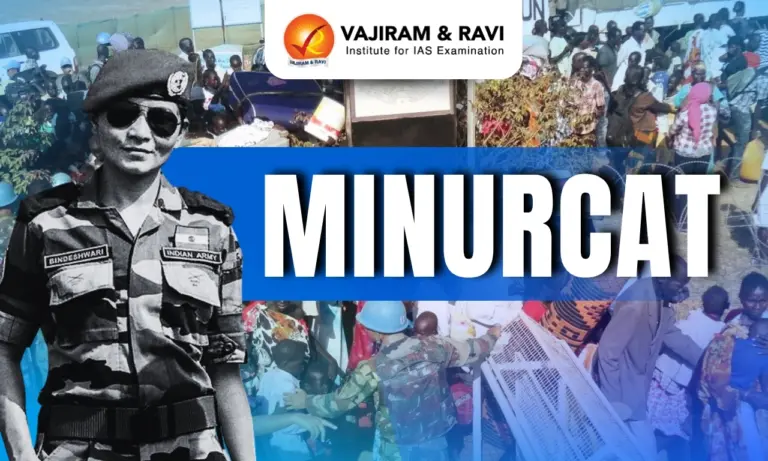
The MINURCAT (United Nations Mission in the Central African Republic and Chad) was a multidimensional United Nations peacekeeping mission established in September 2007 to address the growing humanitarian and security crisis in Central Africa. The mission primarily focused on protecting refugees, internally displaced persons (IDPs), and civilians affected by the spillover of the Darfur conflict from Sudan into eastern Chad and the north-eastern Central African Republic (CAR).
MINURCAT Operation Background
The MINURCAT (United Nations Mission in the Central African Republic and Chad) was created in response to the humanitarian crisis caused by the Darfur conflict in Sudan, which began in 2003.
- Violence in Darfur forced hundreds of thousands of refugees to flee into eastern Chad and the Central African Republic, creating severe regional instability.
- Refugee camps and local communities faced constant threats from armed rebel groups, militias, banditry, and cross-border attacks.
- The growing insecurity disrupted humanitarian operations and endangered aid workers providing food, shelter, and medical assistance to displaced civilians.
- Internal conflicts in Chad and the Central African Republic also increased the number of internally displaced persons (IDPs) in the region.
- To address the worsening security and humanitarian situation, the UN Security Council adopted Resolution 1778 on 25 September 2007, authorizing the establishment of MINURCAT.
- The mission was launched as a multidimensional peacekeeping operation to protect civilians, support humanitarian aid, improve security, and promote regional stability in Chad and the Central African Republic.
MINURCAT Objectives
MINURCAT was created to establish security and humanitarian stability in Chad and the Central African Republic. Its major objectives included:
- Protecting civilians, refugees, and internally displaced persons
- Supporting humanitarian aid operations
- Promoting human rights and the rule of law
- Assisting local security forces
- Reducing violence caused by armed groups
- Encouraging regional peace and stability
- Supporting the safe return of displaced populations
- Preventing cross-border attacks and criminal activities


Withdrawal and End of the Mission
In January 2010, the Government of Chad requested the withdrawal of MINURCAT, arguing that national authorities could independently handle civilian protection and security responsibilities.
Following negotiations, the UN Security Council adopted Resolution 1923 (2010), extending the mission for a final period until 31 December 2010 while planning a gradual withdrawal.
MINURCAT officially completed its mandate on 31 December 2010. After its departure, the United Nations country team and peacebuilding offices continued humanitarian and development work in the region.
MINURCAT Operation Significance
- Protection of Civilians: MINURCAT played a major role in protecting refugees, internally displaced persons (IDPs), women, and children affected by violence in Chad and the Central African Republic.
- Humanitarian Support: The mission helped create safer conditions for humanitarian agencies to deliver food, healthcare, shelter, and emergency aid in conflict-affected regions.
- Regional Stability: MINURCAT helped reduce the spillover effects of the Darfur conflict and contributed to maintaining stability in Central Africa.
- Support to Refugee Camps: UN peacekeepers improved security around refugee camps that were frequently threatened by rebel attacks, armed militias, and criminal groups.
- Strengthening Local Security Forces: The mission trained and supported the Détachement Intégré de Sécurité (DIS), a local Chadian police force responsible for civilian protection.
- Promotion of Human Rights: MINURCAT monitored human rights violations and worked to prevent gender-based violence, child recruitment, and abuses against civilians.
- UN-EU Cooperation Model: The operation became an important example of cooperation between the United Nations and the European Union through coordination with EUFOR Tchad/RCA.
- Focus on Humanitarian Peacekeeping: Unlike traditional military-focused missions, MINURCAT highlighted the growing importance of humanitarian protection and civilian-centered peacekeeping.
- Improved International Attention: The mission brought global attention to the humanitarian crisis in Chad, CAR, and the wider impact of the Darfur conflict.

 Last updated on Oct, 2026
→ UPSC 2027 Notification will be released on 13 January 2027 at upsconline.nic.in.
→ Check Nobel Prize 2026 Winners List here.
→ Download PIB PRiSM Monthly Magazine 2026 here.
→ Check UPSC Monthly Current Affairs Magazine The Recitals here.
→ Check out the latest UPSC Syllabus here.
→ Download UPSC Model Answers for Mains 2026
→ UPSC Mains Question Paper 2026 is out now for Essay & GS Paper 1, 2, 3 & 4.
→ UPSC Calendar 2027 has been released.
→ Enroll in Vajiram & Ravi’s UPSC Mains Test Series 2027 for structured answer writing practice, expert evaluation, and exam-oriented feedback.
→ Join Vajiram & Ravi’s UPSC Mentorship Program 2027 for personalized guidance, strategy planning, and one-to-one support from experienced mentors.
→ Go through the UPSC Mains Previous Year Papers to enhance your preparation.
→ UPSC has released UPSC Toppers List 2025 with the Civil Services final result on its official website.
→ Also check Best UPSC Coaching in India
MINURCAT Operation FAQ
Q1. What does MINURCAT stand for?+
Q2. When was MINURCAT established?+
Q3. Why was MINURCAT created?+
Q4. Which countries hosted MINURCAT?+
Q5. When did MINURCAT end?+
Tags: international relations international relations notes minurcat operation