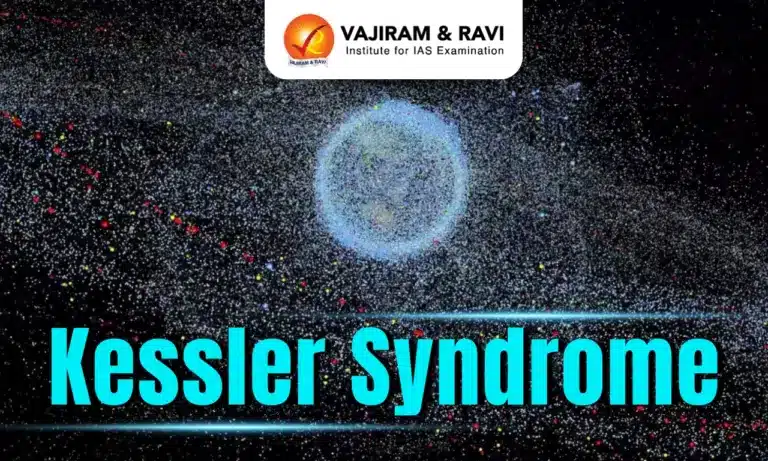
Kessler Syndrome is a theoretical scenario in space science where the density of objects in Earth’s orbit becomes so high that collisions between satellites and space debris create a chain reaction. Each collision generates more debris, which increases the likelihood of further collisions. Over time, this could make certain orbital regions extremely dangerous or even unusable for satellites and space missions.
The concept was proposed in 1978 by Donald J. Kessler, a scientist associated with NASA. Today, Kessler Syndrome is considered one of the biggest long-term threats to space exploration, satellite communication, weather forecasting, and global navigation systems.
Kessler Syndrome Causes
Kessler Syndrome is mainly caused by the increasing amount of space debris and the growing number of satellites and spacecraft orbiting Earth, which raise the chances of collisions in space.
- Increase in Satellite Launches – Thousands of satellites are being launched for communication, internet, navigation, and research purposes, leading to overcrowding in Earth’s orbit.
- Space Debris Accumulation – Non-functional satellites, broken rocket parts, and fragmented debris remain in orbit for years and create collision risks.
- Satellite Collisions – Accidental collisions between satellites generate thousands of debris fragments that continue spreading in space.
- Anti-Satellite (ASAT) Weapon Tests – Missile tests that intentionally destroy satellites create massive amounts of dangerous orbital debris.
- Abandoned Rocket Stages – Old rocket bodies left in orbit can explode or collide with other objects, increasing debris levels.
- Lack of Proper Space Traffic Management – The absence of a strong international system to regulate satellite movement increases the risk of accidents.
- Explosions in Spacecraft – Fuel leaks, battery failures, or leftover energy in inactive spacecraft can cause explosions that produce debris.
- Growth of Mega Satellite Constellations – Large satellite networks launched by companies such as SpaceX and OneWeb increase orbital congestion.
- High Orbital Speeds – Objects in orbit travel at extremely high speeds, so even small fragments can cause severe damage during collisions.
Major Real-Life Incidents Related to Kessler Syndrome
Several real-world space accidents and anti-satellite tests have increased concerns about Kessler Syndrome by generating large amounts of dangerous orbital debris.
Chinese Anti-Satellite Test (2007)
China destroyed its weather satellite Fengyun-1C using a missile during an anti-satellite weapon test. The event created more than 3,000 trackable debris fragments and thousands of smaller particles, making it one of the worst space debris incidents in history.
Iridium 33 and Cosmos 2251 Collision (2009)
The American communication satellite Iridium 33 accidentally collided with the inactive Russian satellite Cosmos 2251 in Low Earth Orbit. The collision generated thousands of debris pieces and highlighted the growing danger of crowded orbital paths.
Russian Anti-Satellite Missile Test (2021)
Russia destroyed its old satellite Cosmos 1408 during an anti-satellite missile test. The explosion produced a massive debris cloud that threatened astronauts aboard the International Space Station and other satellites.


Effects of Kessler Syndrome
- Destruction of Satellites – Collisions with space debris can damage or destroy communication, navigation, weather, and scientific satellites operating in Earth’s orbit.
- Increase in Space Debris – Every collision creates thousands of new debris fragments, leading to a dangerous collision cascade effect in space.
- Threat to Astronaut Safety – High-speed debris poses serious risks to astronauts and spacecraft, including the International Space Station.
- Disruption of Communication and GPS Services – Damage to satellites can affect internet services, television broadcasting, mobile networks, and GPS navigation systems worldwide.
- Challenges for Future Space Missions – Excessive orbital debris can make satellite launches, Moon missions, and deep-space exploration more difficult and expensive.
- Economic and Scientific Losses – Governments and private companies may face huge financial losses, while weather forecasting, disaster monitoring, and scientific research may also be affected.
Methods to Prevent Kessler Syndrome
- Active Debris Removal – Scientists are developing technologies to capture and remove space debris, inactive satellites, and rocket fragments from Earth’s orbit.
- Controlled Satellite Deorbiting – Satellites should be safely guided back into Earth’s atmosphere after completing their missions to reduce orbital congestion.
- Improved Space Traffic Management – Advanced tracking systems can monitor satellite movements and help prevent accidental collisions in space.
- International Space Regulations – Countries and space agencies need strict global rules for responsible satellite launches, operations, and disposal.
- Collision Avoidance Systems – Modern satellites are equipped with automatic systems that help detect and avoid nearby debris or spacecraft.
- Reducing Anti-Satellite Weapon Tests – Limiting destructive ASAT tests can significantly reduce the creation of dangerous orbital debris.
- Designing Sustainable Satellites – Satellites should be built with technologies that minimize debris generation and support safe disposal after mission completion.
- Use of Debris Removal Technologies – Tools such as robotic arms, nets, harpoons, drag sails, and laser systems are being tested to clean orbital debris.
- Regular Monitoring of Space Debris – Space agencies continuously track debris to warn satellites and spacecraft about potential collision risks.
- Global Cooperation in Space Safety – Organizations such as NASA, European Space Agency, and the United Nations are promoting long-term space sustainability initiatives.
Indian and Global Initiatives
- NETRA Project (India) – Indian Space Research Organisation launched the NETRA (Network for Space Object Tracking and Analysis) project to monitor space debris and protect Indian satellites from collisions.
- ISRO’s Debris Mitigation Guidelines – Indian Space Research Organisation follows international debris mitigation practices, including controlled satellite disposal and reducing space waste during missions.
- Project NETRA Space Surveillance System – India is developing advanced radar and telescope systems under Project NETRA to improve Space Situational Awareness (SSA) capabilities.
- NASA Orbital Debris Program (USA) – NASA operates programs to track orbital debris, study collision risks, and develop technologies for debris mitigation.
- European Space Agency Clean Space Initiative – European Space Agency launched the Clean Space Initiative to reduce space pollution and support active debris removal missions.
- ClearSpace-1 Mission – Supported by the European Space Agency, the ClearSpace-1 mission aims to capture and remove inactive satellites from orbit.
- United Nations Space Debris Guidelines – The United Nations has introduced international guidelines for the peaceful and sustainable use of outer space.
- Inter-Agency Space Debris Coordination Committee (IADC) – Multiple space agencies cooperate through the IADC to share research and develop global debris mitigation standards.
- Space Surveillance Networks – Countries such as the United States, Russia, China, and India use advanced tracking systems to monitor satellites and debris movement in Earth’s orbit.

 Last updated on Oct, 2026
→ UPSC 2027 Notification will be released on 13 January 2027 at upsconline.nic.in.
→ Check Nobel Prize 2026 Winners List here.
→ Download PIB PRiSM Monthly Magazine 2026 here.
→ Check UPSC Monthly Current Affairs Magazine The Recitals here.
→ Check out the latest UPSC Syllabus here.
→ Download UPSC Model Answers for Mains 2026
→ UPSC Mains Question Paper 2026 is out now for Essay & GS Paper 1, 2, 3 & 4.
→ UPSC Calendar 2027 has been released.
→ Enroll in Vajiram & Ravi’s UPSC Mains Test Series 2027 for structured answer writing practice, expert evaluation, and exam-oriented feedback.
→ Join Vajiram & Ravi’s UPSC Mentorship Program 2027 for personalized guidance, strategy planning, and one-to-one support from experienced mentors.
→ Go through the UPSC Mains Previous Year Papers to enhance your preparation.
→ UPSC has released UPSC Toppers List 2025 with the Civil Services final result on its official website.
→ Also check Best UPSC Coaching in India
Kessler Syndrome FAQs
Q1. What is Kessler Syndrome?+
Q2. Who proposed the Kessler Syndrome theory?+
Q3. Why is Kessler Syndrome dangerous?+
Q4. What is space debris?+
Q5. Which orbit is most affected by Kessler Syndrome?+
Tags: kessler syndrome physics space science