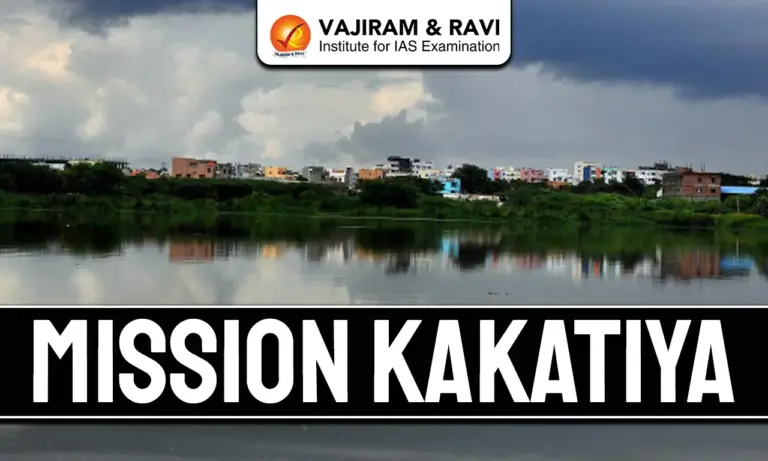
Mission Kakatiya is a large-scale tank restoration and rejuvenation programme launched by the Government of Telangana in 2015. It aims to restore traditional irrigation tanks that have historically supported agriculture and rural livelihoods. The programme focuses on reviving minor irrigation sources to improve water security and agricultural productivity across the state.
Mission Kakatiya Historical Background
- The programme is named after the historic Kakatiya dynasty, which ruled the Telangana region between the 12th and 14th centuries.
- The Kakatiya rulers developed an advanced and decentralized irrigation system based on thousands of artificial tanks to store rainwater.
- These tanks were constructed scientifically, considering slope, catchment area, and rainfall pattern to ensure maximum water storage.
- A unique feature of their system was the “chain tank system,” where overflow from one tank would automatically fill another downstream.
- Tank irrigation became the backbone of agriculture in the region due to semi-arid climate and uneven rainfall.
- During later periods and especially after the colonial era, many tanks were neglected, leading to silt accumulation and structural damage.
- Over time, reduced storage capacity of tanks forced farmers to depend heavily on borewells, resulting in groundwater depletion.
- After the formation of Telangana in 2014, reviving the historic tank system became a priority to restore irrigation potential and rural livelihoods.
- Mission Kakatiya was thus conceptualized to restore these traditional water bodies and revive the legacy of sustainable water management practiced during the Kakatiya period.
Also Read: Solar Charkha Mission
Mission Kakatiya Implementation Strategy and Targets
Mission Kakatiya was inaugurated by Chief Minister K. Chandrashekhar Rao at Sadashiva Nagar Village with a clear phased implementation plan. The government identified 46,531 minor irrigation tanks for restoration and aimed to restore approximately 9,306 tanks every year, covering 20% annually. The goal was to restore nearly 10 lakh acres of gap ayacut under irrigation within five years.
- Total tanks identified: 46,531 across the state.
- Annual restoration target: Around 9,306 tanks (20% each year).
- Aim to bring 10 lakh acres of additional land under irrigation.





Mission Kakatiya Agricultural and Economic Impact
Mission Kakatiya has significantly improved irrigation coverage and agricultural productivity across Telangana. By restoring tanks and increasing water availability, the programme has strengthened rural incomes and revitalized the local economy.
- Increased irrigation potential leading to higher crop yields.
- Expansion of cultivable land under assured irrigation.
- Promotion of multi-cropping and crop diversification.
- Improved soil fertility due to distribution of nutrient-rich tank silt.
- Reduction in input costs such as fertilizers and electricity.
- Higher and more stable income for small and marginal farmers.
- Growth in allied activities like fisheries and livestock rearing.
- Generation of rural employment during restoration and farming activities.
Also Read: National Critical Minerals Mission
Mission Kakatiya Significance
Mission Kakatiya holds great significance as a sustainable water management initiative in Telangana. It revives traditional irrigation systems while addressing modern challenges like water scarcity, groundwater depletion, and rural distress.
- Revives the historic tank irrigation system developed during the rule of the Kakatiya dynasty.
- Strengthens water security in a semi-arid region with uneven rainfall.
- Enhances groundwater recharge and improves the overall water table.
- Reduces overdependence on borewells and saves electricity in agriculture.
- Improves agricultural productivity and farmer incomes.
- Promotes community participation in water resource management.
- Supports climate resilience by acting as a buffer during drought years.
- Contributes to ecological balance by restoring natural water bodies.
- Complements large irrigation projects like the Kaleshwaram Lift Irrigation Scheme.
- Ensures inter-generational equity by conserving water resources for future generations.

 Last updated on March, 2026
→ UPSC Final Result 2025 is now out.
→ UPSC has released UPSC Toppers List 2025 with the Civil Services final result on its official website.
→ Anuj Agnihotri secured AIR 1 in the UPSC Civil Services Examination 2025.
→ UPSC Marksheet 2025 is now out.
→ UPSC Notification 2026 & UPSC IFoS Notification 2026 is now out on the official website at upsconline.nic.in.
→ UPSC Calendar 2026 has been released.
→ Check out the latest UPSC Syllabus 2026 here.
→ UPSC Prelims 2026 will be conducted on 24th May, 2026 & UPSC Mains 2026 will be conducted on 21st August 2026.
→ The UPSC Selection Process is of 3 stages-Prelims, Mains and Interview.
→ Prepare effectively with Vajiram & Ravi’s UPSC Prelims Test Series 2026 featuring full-length mock tests, detailed solutions, and performance analysis.
→ Enroll in Vajiram & Ravi’s UPSC Mains Test Series 2026 for structured answer writing practice, expert evaluation, and exam-oriented feedback.
→ Join Vajiram & Ravi’s Best UPSC Mentorship Program for personalized guidance, strategy planning, and one-to-one support from experienced mentors.
→ Shakti Dubey secures AIR 1 in UPSC CSE Exam 2024.
→ Also check Best UPSC Coaching in India
Mission Kakatiya FAQs
Q1. What is Mission Kakatiya?+
Q2. Why is it called Mission Kakatiya?+
Q3. When was Mission Kakatiya launched?+
Q4. What are the main objectives of Mission Kakatiya?+
Q5. How does Mission Kakatiya help farmers?+
Tags: agriculture mission kakatiya