Mitochondrial Protein Import Latest News
Recently, researchers at Caltech University have uncovered new rules governing mitochondrial protein import, revising the long-standing understanding of how proteins are transported into mitochondria.
About Mitochondria
- Mitochondria are double-membraned organelles that generate ATP (adenosine triphosphate), the universal cellular energy currency.
- They originated over a billion years ago through endosymbiosis between a primitive archaeal cell and a bacterium.
- Over time, mitochondria transferred most of their genes to the host nucleus, making them dependent on the host cell for protein supply.
Traditional Model of Protein Import
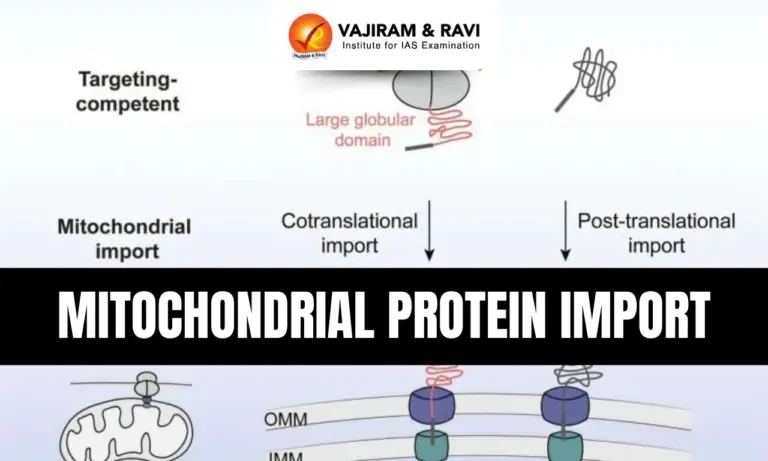
- Earlier, it was believed that mitochondrial proteins are imported only after translation is completed in the cytosol.
- Proteins were thought to fully synthesize on ribosomes before passing through mitochondrial membrane channels.





New Findings by Caltech Scientists
- Around 20% of mitochondrial proteins are cotranslationally imported, i.e., they are imported while still being synthesized by ribosomes.
- This mechanism mainly applies to large and structurally complex proteins that require assistance during folding.
- If these proteins fully fold in the cytosol, they risk forming irreversible structures that block import channels.
Mechanism of Cotranslational Import
- Such proteins contain a mitochondrial targeting sequence, but this alone is insufficient for cotranslational delivery.
- A second signal is required – the first large protein domain that emerges during translation.
- This domain acts like a “code to unlock the boarding pass”, ensuring the protein is guided into mitochondria early.
- Experiments confirmed that transplanting these domains onto other proteins rerouted them for cotranslational import.
Source: PHY

 Last updated on March, 2026
→ UPSC Final Result 2025 is now out.
→ UPSC has released UPSC Toppers List 2025 with the Civil Services final result on its official website.
→ Anuj Agnihotri secured AIR 1 in the UPSC Civil Services Examination 2025.
→ UPSC Marksheet 2025 is now out.
→ UPSC Notification 2026 & UPSC IFoS Notification 2026 is now out on the official website at upsconline.nic.in.
→ UPSC Calendar 2026 has been released.
→ Check out the latest UPSC Syllabus 2026 here.
→ UPSC Prelims 2026 will be conducted on 24th May, 2026 & UPSC Mains 2026 will be conducted on 21st August 2026.
→ The UPSC Selection Process is of 3 stages-Prelims, Mains and Interview.
→ Prepare effectively with Vajiram & Ravi’s UPSC Prelims Test Series 2026 featuring full-length mock tests, detailed solutions, and performance analysis.
→ Enroll in Vajiram & Ravi’s UPSC Mains Test Series 2026 for structured answer writing practice, expert evaluation, and exam-oriented feedback.
→ Join Vajiram & Ravi’s Best UPSC Mentorship Program for personalized guidance, strategy planning, and one-to-one support from experienced mentors.
→ Shakti Dubey secures AIR 1 in UPSC CSE Exam 2024.
→ Also check Best UPSC Coaching in India
Mitochondrial Protein Import FAQs
Q1. Why are mitochondria dependent on the host cell for proteins?+
Q2. What is cotranslational import?+
Q3. What signals guide proteins into mitochondria?+
Tags: mitochondrial protein import prelims pointers upsc current affairs upsc prelims current affairs