MGNREGA Latest News
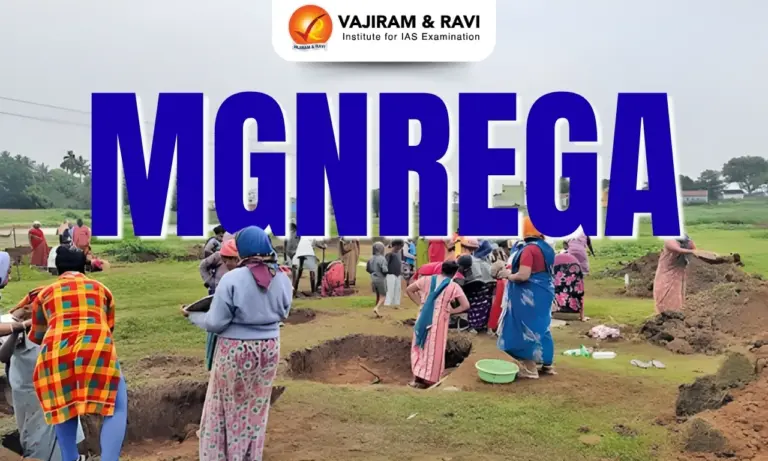
- The Ministry of Rural Development (MoRD) has amended Schedule-I of the Mahatma Gandhi National Rural Employment Guarantee Act (MGNREGA), 2005.
- This is to ensure a minimum proportion of funds is allocated for water conservation and harvesting works across rural India.
- The amendment aims to address India’s deepening groundwater crisis and promote sustainable rural livelihoods.
Background – Understanding Schedule-I of MGNREGA
- MGNREGA provision: Every state government shall introduce a scheme to provide at least 100 days of guaranteed employment in a financial year to every rural household, based on demand.
- Schedule-I: Lists permissible public works and defines the scheme’s minimum features.
- Amendment power: While changes to the Act need Parliament’s approval, the Centre can amend the Schedule via notification (issued by the Ministry of Rural Development [MoRD]) — done nearly 24 times since 2005.





The Latest Amendment
- The amendment inserts a new proviso mandating minimum expenditure on water-related works at the block level, depending on groundwater status.
- Earlier, 60% of district-level works (in terms of cost) had to create productive assets directly linked to agriculture and allied activities through development of land, water and trees.
- Now, the focus has shifted from district-level to block-level implementation.
- Proportion of expenditure on water works: Categories as per –
-
- For over-exploited rural blocks (groundwater extraction>100%), minimum 65% of MNREGA funds for water-related works.
- For critical rural blocks (90–100%) – 65%
- For semi-critical (70–90%) – 40%
- For safe (≤70%) – 30%
- Reference of (above) categorisation:
- The Central Ground Water Board’s (CGWB) Dynamic Ground Water Resources Assessment Report (2024) serves as the reference for categorisation.
- As per CGWB’s report, there are total 6,746 blocks, out of which –
- Over-exploited blocks are 751 (11.13%)
- Critical: 206 (3.05%)
- Semi-critical: 711 (10.54%)
- Safe: 4,951 (73.39%)
- Saline: 127 blocks
Likely Benefits of the Decision
- Out of the Rs 86,000 crore allocated for MGNREGS in FY 2025–26, about Rs 35,000 crore is expected to be directed toward water-related works.
- The states with the highest number of over-exploited and critical blocks will gain the most funds – Rajasthan (214), Punjab (115), Tamil Nadu (106), Haryana (88), Uttar Pradesh (59).
Significance for Rural India
- Encourages climate-resilient rural infrastructure.
- Aligns MGNREGA with the Jal Shakti Abhiyan and Atal Bhujal Yojana.
- Reduces groundwater stress through community-based interventions.
- Promotes employment generation in water management sectors.
Way Forward
- Integrated planning: Convergence with schemes like PM Krishi Sinchayi Yojana (PMKSY) and watershed programmes.
- Capacity building: Training for Gram Sabhas and local engineers for scientific water management.
- Monitoring and transparency: Use of GIS mapping and real-time dashboards for implementation tracking.
- Sustainability focus: Promote recharge structures, afforestation, and soil-water conservation.
Conclusion
- The amendment marks a strategic shift in India’s rural employment and water management framework.
- By linking MGNREGA works to groundwater sustainability, the government seeks to tackle one of India’s most pressing environmental challenges while strengthening rural livelihoods and climate resilience.
- Effective execution at the block and Gram Panchayat levels will be crucial for realising these objectives.
Source: IE

 Last updated on March, 2026
→ UPSC Final Result 2025 is now out.
→ UPSC has released UPSC Toppers List 2025 with the Civil Services final result on its official website.
→ Anuj Agnihotri secured AIR 1 in the UPSC Civil Services Examination 2025.
→ UPSC Marksheet 2025 is now out.
→ UPSC Notification 2026 & UPSC IFoS Notification 2026 is now out on the official website at upsconline.nic.in.
→ UPSC Calendar 2026 has been released.
→ Check out the latest UPSC Syllabus 2026 here.
→ UPSC Prelims 2026 will be conducted on 24th May, 2026 & UPSC Mains 2026 will be conducted on 21st August 2026.
→ The UPSC Selection Process is of 3 stages-Prelims, Mains and Interview.
→ Prepare effectively with Vajiram & Ravi’s UPSC Prelims Test Series 2026 featuring full-length mock tests, detailed solutions, and performance analysis.
→ Enroll in Vajiram & Ravi’s UPSC Mains Test Series 2026 for structured answer writing practice, expert evaluation, and exam-oriented feedback.
→ Join Vajiram & Ravi’s Best UPSC Mentorship Program for personalized guidance, strategy planning, and one-to-one support from experienced mentors.
→ Shakti Dubey secures AIR 1 in UPSC CSE Exam 2024.
→ Also check Best UPSC Coaching in India
MNREGA FAQs
Q1. Why did the Centre amend Schedule-I of the MGNREGA, 2005?+
Q2. What are the key changes introduced in the recent amendment to Schedule-I of MGNREGA?+
Q3. How does the Central Ground Water Board (CGWB) classify blocks under the new framework?+
Q4. Which states are expected to benefit most from the amended MGNREGA norms?+
Q5. How does the MGNREGA amendment contribute to India’s broader water security goals?+
Tags: mains articles mgnrega upsc current affairs upsc mains current affairs