What’s in today’s article?
- Why in News?
- Finance Bill
- Money Bill
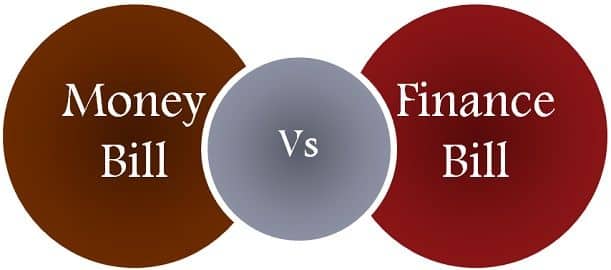
- Difference between Finance Bill and Money Bill
Why in News?
- Parliamentary Affairs Minister Pralhad Joshi said that the Digital Personal Data Protection (DPDP) Bill, 2023 is an ordinary Bill and not a money bill.
- Earlier, it was reported that Bill was being introduced under Article 117 of the Constitution, which deals with special provisions for Financial Bills.
Finance Bill:
- In a general sense, any Bill that relates to revenue or expenditure is a financial Bill.
- A money Bill is also a specific type of financial Bill, that must deal only with matters specified in Article 110 (1) (a) to (g).
- Financial bills are responsible for the fiscal matters such as government spending or revenue.
- It specifies the amount of money to be spent by the government and the way it is to be spent.
- More specifically, Article 117 of the Constitution deals with the special provisions relating to financial Bills.
- Financial bills are a component of the Constitution and the Union Budget.





Types of Finance Bill:
- Financial Bills (i): Article 117 (1)
- It includes not only the subjects stated in Article 110 of the Constitution but also other legislative provisions.
- Financial bill (i) is comparable to the money bill in two ways.
- Firstly, both of these bills can only originate in the Lok Sabha and not Rajya Sabha.
- Secondly, both the bills can be introduced only on the President’s advice.
- This type follows the same parliamentary procedures as any ordinary bill. It follows the same parliamentary process as an ordinary bill in all other respects.
- The president may call a joint session of the two Houses if they cannot agree on such a measure. This will end the impasse.
- When the measure is presented to the President, he has three options: to approve it, decline to do so, or send it back to the Houses for further consideration.
- Financial Bills (ii): Article 117 (3)
- A financial bill (II) does not contain any of the items listed in Article 110, but it does contain measures impacting Consolidated Fund of India spending.
- It is regarded as an ordinary bill and is handled in every way by the same parliamentary process as an ordinary bill.
- This bill’s sole unique feature is that neither House of Parliament may pass it without the President first requesting that it be brought up for consideration.
- Financial bill (ii) can be filed in either house of the Parliament and the President’s approval is not required.
- However, the President’s suggestion can be taken during the consideration stage of the bill.
Money Bill:
- Article 110 defines a money Bill as one containing provisions dealing with taxes, regulation of the government’s borrowing of money, and expenditure or receipt of money from the Consolidated Fund of India, among others.
- Article 109 delineates the procedure for the passage of such a Bill and confers an overriding authority on the Lok Sabha in the passage of money Bills.
- The Speaker certifies a Bill as a Money Bill, and the Speaker’s decision is final.
- Over the last seven years, the government has introduced multiple legislations through the money Bill route, the most notable of which are the Aadhaar Act, 2016, and the Finance Act, 2017.
What is the Difference Between Money Bills and Financial Bills?
- While all Money Bills are Financial Bills, all Financial Bills are not Money Bills.
- E.g., the Finance Bill which only contains provisions related to tax proposals would be a Money Bill.
- However, a Bill that contains some provisions related to taxation or expenditure, but also covers other matters would be considered as a Financial Bill.
- The Compensatory Afforestation Fund Bill, 2015, which establishes funds under the Public Account of India and states, was introduced as a Financial Bill.
- The procedure for the passage of the two bills varies significantly.
- The Rajya Sabha has no power to reject or amend a Money Bill.
- After being passed by the Lok Sabha, money Bills are sent to the Rajya Sabha for its recommendations.
- Within 14 days, the Upper House must submit the Bill back to the Lower House with its non-binding recommendations.
- If the Lok Sabha rejects the recommendations, the Bill is deemed to have passed by both Houses in the form in which it was passed by the Lok Sabha without the recommendations of the Rajya Sabha.
- Even if the Rajya Sabha doesn’t respond with its recommendations within 14 days, the same consequences would follow.
- However, a Financial Bill must be passed by both Houses of Parliament.
- The Rajya Sabha has no power to reject or amend a Money Bill.
- While an ordinary Bill can originate in either house, a money Bill can only be introduced in the Lok Sabha, as laid down in Article 117 (1).
- Additionally, no one can introduce or move money Bills in the Lok Sabha, except on the President’s recommendation.
- Amendments relating to the reduction or abolition of any tax are exempt from the requirement of the President’s recommendation.
- The two prerequisites for any financial Bill to become a money Bill are that
- It must only be introduced in the Lok Sabha and not the Rajya Sabha.
- These bills can only be introduced on the President’s recommendation.
Q1) What is the Digital Personal Data Protection (DPDP) Bill 2023?
The Digital Personal Data Protection Bill, 2023, aims to regulate personal digital data and provide resolution for breaches.
Source: Money Bills vs Finance Bills: What are the differences, what the court has ruled

 Last updated on March, 2026
→ UPSC Final Result 2025 is now out.
→ UPSC has released UPSC Toppers List 2025 with the Civil Services final result on its official website.
→ Anuj Agnihotri secured AIR 1 in the UPSC Civil Services Examination 2025.
→ UPSC Marksheet 2025 is now out.
→ UPSC Notification 2026 & UPSC IFoS Notification 2026 is now out on the official website at upsconline.nic.in.
→ UPSC Calendar 2026 has been released.
→ Check out the latest UPSC Syllabus 2026 here.
→ UPSC Prelims 2026 will be conducted on 24th May, 2026 & UPSC Mains 2026 will be conducted on 21st August 2026.
→ The UPSC Selection Process is of 3 stages-Prelims, Mains and Interview.
→ Prepare effectively with Vajiram & Ravi’s UPSC Prelims Test Series 2026 featuring full-length mock tests, detailed solutions, and performance analysis.
→ Enroll in Vajiram & Ravi’s UPSC Mains Test Series 2026 for structured answer writing practice, expert evaluation, and exam-oriented feedback.
→ Join Vajiram & Ravi’s Best UPSC Mentorship Program for personalized guidance, strategy planning, and one-to-one support from experienced mentors.
→ Shakti Dubey secures AIR 1 in UPSC CSE Exam 2024.
→ Also check Best UPSC Coaching in India