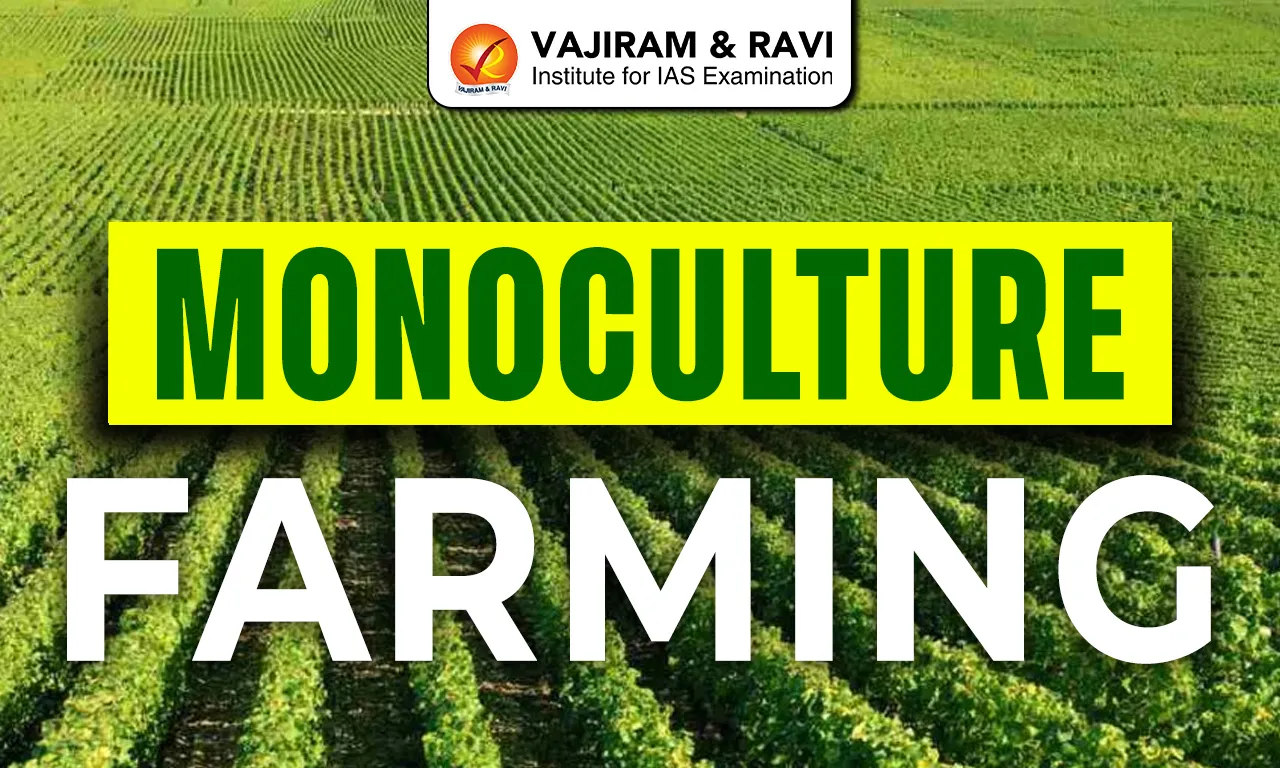
Monoculture Farming refers to the practice of cultivating a single crop species on a specific field or large land area at one time. It has become a dominant feature of modern industrial agriculture due to mechanisation and input intensive farming. Earlier, continuous monocropping was limited because non legume crops depleted soil nitrogen. However, the availability of low cost chemical fertilisers transformed this system, enabling farmers worldwide to grow uniform crops repeatedly with higher productivity.
Monoculture Farming Features
Monoculture Farming is characterised by uniform crop cultivation across large areas with high dependence on inputs and technology. It promotes specialization and large scale production but reduces ecological diversity.
- Monoculture involves growing only one crop species on a field at a time, whether annually rotated or continuously repeated, leading to uniformity in planting, maintenance and harvesting operations.
- In many systems, the same crop is grown year after year without rotation, which increases dependency on fertilizers and chemicals due to nutrient depletion and pest accumulation.
- Uniform crop patterns allow extensive use of tractors, combine harvesters, irrigation systems and automatic weeders, enabling cultivation of large land areas with reduced labour requirements.
- Monoculture depends heavily on synthetic fertilizers, pesticides, herbicides and irrigation to maintain soil fertility and control pests, especially in intensive farming systems.
- Farmers focus on one crop suited to local soil and climate, improving efficiency and productivity while aligning production with market demand and profitability.
- Crops in monoculture fields follow similar growth stages, making it easier to plan sowing, irrigation, pest control and harvesting activities with precision and efficiency.
- Monoculture is largely market driven and export oriented, especially for cash crops like cotton, sugarcane, tea and oil palm, contributing to global agricultural trade.
- Modern tools such as drones, satellite monitoring and soil sensors are widely used in Monoculture Farming for precision agriculture and efficient resource management.
Monoculture Farming in India
In India, Monoculture Farming is prominent in regions with irrigation support and government backed crop policies, especially for staple crops like wheat and paddy.
- Punjab Monoculture Pattern: Wheat and paddy together occupy about 84.6% of cultivated area in Punjab, reducing crop diversity and increasing dependence on irrigation, fertilizers and pesticides.
- Groundwater Depletion: Paddy cultivation requires intensive irrigation, often exceeding 30 cycles per season, leading to groundwater decline of around 0.5 metres annually in parts of Punjab.
- Green Revolution Impact: The Green Revolution promoted high yield varieties of wheat and rice, encouraging monoculture practices supported by subsidised fertilizers, irrigation and minimum support price systems.
- Soil Nutrient Imbalance: Continuous cultivation of non legume crops like wheat and rice reduces soil nitrogen levels, increasing reliance on chemical fertilizers instead of natural nutrient replenishment.
- Government Regulations: Policies such as the Punjab Preservation of Subsoil Water Act 2009 regulate paddy sowing to conserve groundwater, but also affect cropping cycles and residue management practices.
- Stubble Burning Issue: Delayed harvesting due to regulated sowing periods leaves limited time for field preparation, leading to stubble burning and contributing to seasonal air pollution in northern India.
- Limited Crop Diversification: Crops like pulses, maize and oilseeds receive less attention due to price and policy support for wheat and paddy, affecting nutritional security and soil health.
- Economic Dependence: Farmers relying on monoculture systems are vulnerable to market fluctuations, climate variability and crop failure due to lack of diversification in income sources.


Monoculture Farming Examples
Monoculture Farming is widely practiced globally across food, fiber and plantation crops, often driven by industrial agriculture and export demand.
- Wheat and Rice: Large scale monoculture of wheat and rice is common in countries like India and China, where these cereals are grown extensively for food security and commercial supply.
- Cotton: Cotton is grown as a monoculture crop in many regions, using mechanised harvesting and chemical inputs, especially in countries like India and the United States.
- Oil Palm: Vast monoculture plantations of oil palm in Indonesia and Malaysia have replaced natural forests, contributing to deforestation and biodiversity loss.
- Sugarcane: Sugarcane is cultivated as a monoculture in tropical countries, requiring heavy irrigation and fertiliser inputs for high yields and industrial processing.
- Tea and Coffee: Plantation agriculture in countries like India, Sri Lanka and Brazil focuses on single crops like tea and coffee, often grown over large estates for export.
- Soybean and Maize: In countries like the United States and Brazil, monoculture systems dominate soybean and maize production, supported by mechanisation and genetically modified crop varieties.
- Rubber and Eucalyptus: These plantation crops are grown as monocultures for industrial raw materials, often replacing natural ecosystems and affecting biodiversity.
Monoculture Farming Advantages
Monoculture Farming offers efficiency, productivity and economic benefits due to uniform crop management and mechanisation.
- Simplified Farm Management: Growing a single crop reduces complexity in field preparation, irrigation, pest control and harvesting, making operations easier and more predictable for farmers.
- Higher Productivity: Many crops such as cereals produce higher yields when grown in monoculture due to optimized spacing, uniform care and focused nutrient management practices.
- Mechanisation Efficiency: Uniform crop fields allow the use of specialised machinery like combine harvesters and automated irrigation systems, reducing labour costs and increasing operational efficiency.
- Cost Reduction: Standardised inputs and processes lower production costs over time, although initial investment in machinery and inputs may be high in monoculture systems.
- Better Planning Flexibility: Farmers can adjust cropping patterns annually based on market demand without disrupting the overall farm structure due to uniform field management.
- Specialised Soil Management: Soil fertility and irrigation can be tailored precisely for a single crop, improving efficiency compared to managing multiple crops with varying requirements.
- Large scale Production: Monoculture enables cultivation of vast land areas quickly, supporting industrial agriculture and large scale food supply chains.
- Technological Advancement: The system encourages adoption of modern technologies such as satellite monitoring, precision farming and data driven agriculture for improved productivity.
Monoculture Farming Disadvantages
Monoculture Farming creates environmental, economic and ecological challenges due to lack of diversity and heavy reliance on external inputs.
- Soil Nutrient Depletion: Continuous cultivation of a single crop exhausts essential nutrients like nitrogen, reducing soil fertility and requiring increased use of chemical fertilizers.
- Increased Pest and Disease Risk: Uniform crop fields allow pests and diseases to spread rapidly, often leading to severe outbreaks and heavy dependence on pesticides and resistant varieties.
- Environmental Pollution: Excessive use of fertilizers and pesticides leads to runoff, causing water pollution, eutrophication and contamination of groundwater resources.
- Soil Erosion and Degradation: Frequent tilling and absence of crop cover increase vulnerability to erosion, leading to loss of fertile topsoil and reduced agricultural productivity.
- Loss of Biodiversity: Monoculture reduces plant, insect and microbial diversity, affecting ecological balance and harming pollinators such as bees and butterflies.
- Water Overuse: Intensive irrigation requirements, especially for crops like paddy and sugarcane, lead to depletion of water resources and increased pressure on groundwater systems.
- Chemical Dependency: Farmers rely heavily on herbicides, insecticides and fertilizers, which may enter the food chain and impact human and environmental health.
- Climate Vulnerability: Lack of crop diversity makes monoculture systems more susceptible to climate change impacts such as droughts, floods and extreme weather events.
Monoculture Farming Alternatives
Sustainable alternatives aim to reduce environmental impacts of Monoculture Farming while maintaining productivity through diversification and improved resource management.
- Crop Rotation: Alternating different crops annually helps maintain soil fertility, break pest cycles and reduce dependence on chemical fertilizers and pesticides.
- Polyculture Farming: Growing multiple crops simultaneously improves biodiversity, enhances soil health and reduces risks associated with pests and climate variability.
- Agroforestry Systems: Integrating trees with crops improves soil stability, increases biodiversity and provides additional income sources such as timber and fruits.
- Precision Fertilizer Use: Modern technologies enable targeted application of fertilizers based on soil needs, reducing wastage and minimizing environmental damage.
- Organic Farming Practices: Using natural inputs like compost and biofertilizers reduces chemical dependency and improves long term soil health and sustainability.
- Integrated Pest Management: Combining biological, cultural and minimal chemical methods helps control pests effectively while reducing environmental impact.
- Efficient Water Management: Techniques such as drip irrigation and rainwater harvesting reduce water consumption and improve irrigation efficiency in farming systems.
- Crop Diversification Policies: Promoting alternative crops like pulses, millets and oilseeds enhances nutritional security, reduces ecological stress and improves farmer resilience.

 Last updated on Oct, 2026
→ UPSC 2027 Notification will be released on 13 January 2027 at upsconline.nic.in.
→ Check Nobel Prize 2026 Winners List here.
→ Download PIB PRiSM Monthly Magazine 2026 here.
→ Check UPSC Monthly Current Affairs Magazine The Recitals here.
→ Check out the latest UPSC Syllabus here.
→ Download UPSC Model Answers for Mains 2026
→ UPSC Mains Question Paper 2026 is out now for Essay & GS Paper 1, 2, 3 & 4.
→ UPSC Calendar 2027 has been released.
→ Enroll in Vajiram & Ravi’s UPSC Mains Test Series 2027 for structured answer writing practice, expert evaluation, and exam-oriented feedback.
→ Join Vajiram & Ravi’s UPSC Mentorship Program 2027 for personalized guidance, strategy planning, and one-to-one support from experienced mentors.
→ Go through the UPSC Mains Previous Year Papers to enhance your preparation.
→ UPSC has released UPSC Toppers List 2025 with the Civil Services final result on its official website.
→ Also check Best UPSC Coaching in India
Monoculture Farming FAQs
Q1. What is Monoculture Farming?+
Q2. Why is Monoculture Farming widely used in modern agriculture?+
Q3. What is the major problem of Monoculture Farming?+
Q4. How does Monoculture Farming affect the environment?+
Q5. What are alternatives to Monoculture Farming?+
Tags: geography geography notes monoculture farming