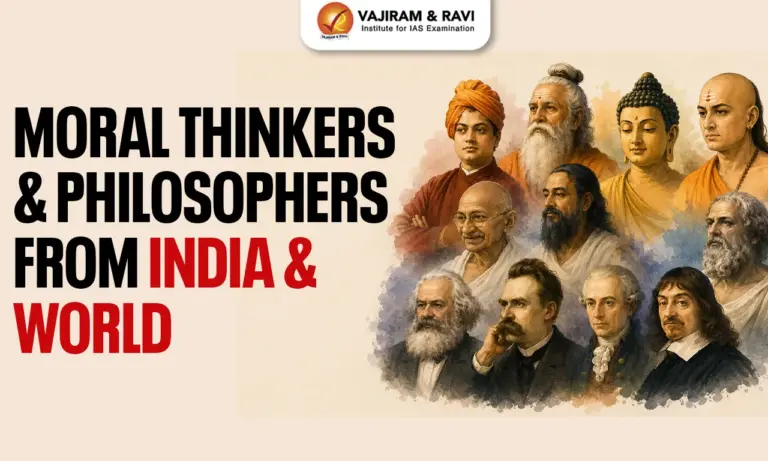
Moral Thinkers & Philosophers From India & World have played an important role in shaping ideas about ethics, duty, justice, and human values. Through their teachings and writings, they have provided different ways to understand right and wrong, helping individuals and societies make better decisions and lead a balanced and meaningful life. Some of the Major Thinkers and Philosophers from India and World, who have shaped society, human thoughts have been discussed in detail in this article.
Moral Thinkers and Philosophers From India
India has a rich tradition of Moral Thinkers, Philosophers and Teachers who have shared deep insights about life and values. Their ideas have greatly shaped the country’s culture, traditions and philosophical thought, and continue to guide people in leading a meaningful and ethical life. Some of the Prominent Thinkers and Philosophers from India are discussed below:
Chanakya
- Chanakya (also known as Kautilya or Vishnugupta) was a great teacher, strategist, philosopher and royal advisor in ancient India. He is best known as the author of the “Arthashastra”, an important text on politics, governance and economy.
- He played a key role in assisting Chandragupta Maurya to rise to power and establish the Great Mauryan Empire and then later served as a chief advisor to both Chandragupta and Bindusara.
- The Arthashastra is considered one of the earliest works on political economy and statecraft. It explains how a ruler should govern, manage resources and maintain law, order and stability in the state.
- According to Chanakya, the king is the face of the state and is responsible for everything happening in society. The ruler should always work for the welfare and happiness of the people.
- He emphasized that a good ruler must follow Dharma (righteousness), ensure justice, punish the guilty and protect the innocent. He also stressed that justice should be quick and should not be delayed.
- Chanakya believed in a balance between material life and spirituality. While wealth is important, it should be earned through ethical means and should not become the sole purpose of life.
- His ideas supported a welfare state, where the king is available to people, ensures fair taxation and avoids misuse of public resources.
- Chanakya accepted that it is difficult to completely eliminate corruption, but it can be controlled through proper systems. He suggested four methods:
- Saam (education and awareness) about ethics
- Daam (incentives and rewards) for honest officials
- Dand (punishment) to create fear against wrongdoing
- Bhed (surveillance and intelligence) to detect corruption
- The Saptang Theory of State given by Kautilya explains that a strong state depends on seven elements: Swami (ruler), Amatya (ministers), Janapada (people and territory), Durga (fort), Kosha (treasury), Danda (army), Mitra (allies).
- His work “Chanakya Niti” provides practical guidance on leadership, ethics, decision-making and personal conduct, which focuses on wisdom, discipline and strategic thinking.
- He also explained the key life goals: Dharma (righteousness), Artha (wealth), Kama (desires) and Moksha (liberation), focusing balance and moderation in life.
- To this date, Chanakya’s ideas remain relevant in areas like governance, administration, leadership and ethics, making him one of the most influential thinkers in Indian history.
Mahatma Gandhi
- Mahatma Gandhi strongly believed in the existence of God and felt that God can be experienced within oneself through faith and inner realization. His belief gave him strength to face challenges in life.
- According to Mahatma Gandhi, Truth (Satya) was the same as God. He believed that truth should not be limited to speech but must be followed in thoughts, actions and behaviour in every aspect of life.
- He emphasized three key principles: Truth, Ahimsa (non-violence) and Goodness, through which one can understand and experience God.
- According to his philosophy, Truth and Ahimsa were inseparable. He explained that Ahimsa is the means and Truth is the ultimate goal.
- Gandhi believed that non-violence is a powerful force, not a weakness. It involves love, patience, self-control, sacrifice and tolerance and helps overcome hatred and conflict.
- He highlighted that violence disturbs social harmony, while non-violence promotes peace and moral strength in society.
- In his book Hind Swaraj, he criticized Western materialism and stressed the need for spiritual and moral development over blind industrial growth.
- His idea of Swaraj (self-rule) was not just political independence but also self-discipline and moral growth. He supported decentralization of power and supported the growth of India as a group of self-reliant villages.
- Gandhi introduced the idea of Ram Rajya, meaning an ideal society based on justice, morality and equality, which starts from individual transformation.
- His concept of Sarvodaya focused on the welfare of all, promoting equality, social justice and upliftment of every section of society.
- He supported Swadeshi (use of local goods) and trusteeship, where wealth should be used for the benefit of society, not just for personal gain.
- He gave value to ethical politics, that is, politics should be based on moral values (Dharmic politics) and should be used as a tool for service, not power.
- His philosophy combined spiritual, moral, social, economic and political ideas, focusing on the overall development of individuals and society.
- Gandhi also listed Seven Social Sins that harm society: Politics without principles, Wealth without work, Pleasure without conscience, Knowledge without character, Commerce without morality, Science without humanity, Worship without sacrifice.
- His method of Satyagraha was a way of non-violent resistance, based on truth and moral force, aiming to change the opponent through understanding and self-suffering, not force.
- Gandhi’s ideas are still relevant today in dealing with issues like violence, inequality, environmental problems, and moral decline, making his philosophy timeless and universal.
Swami Vivekananda
- Swami Vivekananda, a disciple of Ramakrishna Paramahamsa, was a great philosopher, spiritual leader and reformer who played an important role in shaping modern Indian thought.
- He was a strong follower of Vedanta Philosophy, especially Advaita Vedanta of Adi Shankaracharya, but he presented it in a practical way known as Practical Vedanta, which focuses on applying spiritual ideas in daily life.
- He believed in combining Indian spirituality with Western scientific thinking and material progress to create a balanced and better life for mankind.
- He advocated rational thinking and scientific temper and strongly opposed blind beliefs and superstitions, saying that they lead to ignorance and slow down progress.
- Through the establishment of the Ramakrishna Mission and Ramakrishna Math, he contributed towards education, social service and upliftment of society, especially the poor and needy.
- His famous speech at the World Parliament of Religions (1893) spread the message of universal brotherhood, tolerance, and unity, making him globally respected.
- He also believed in the idea of a Universal Religion, where all religions are seen as different paths leading to the same truth, promoting religious harmony and acceptance.
- He emphasized self-realisation, teaching that every individual has a divine nature, and the goal of life is to realise this inner potential through meditation, discipline and knowledge.
- His concept of Karma Yoga encouraged people to do their duties with dedication and selflessness, without expecting rewards, and to serve society.
- He strongly believed in service to humanity, expressed in the idea “Jiva is Shiva”, meaning serving people is equal to serving God.
- Vivekananda saw education as a tool for character building and personality development, defining it as the “manifestation of perfection already within a person.”
- He focused on developing self-confidence, discipline and moral values, rather than just gaining bookish knowledge.
- He encouraged patriotism, national pride, and human dignity, inspiring people to work for the progress of the nation. Vivekananda supported women’s empowerment.
- He believed that youth have the power to transform the country, which is why his birthday is celebrated as National Youth Day.
- His ideas were influenced by the Upanishads, Bhagavad Gita and Vedanta and focused on the overall development of human life.
Buddha
- Gautama Buddha was a great spiritual teacher and reformer who lived in ancient India and laid the foundation of Buddhism, focusing on practical ways to reduce human suffering.
- He advised people to avoid extremes like luxury (indulgence) and severe austerity, and instead follow the Middle Path (Madhyam Marg), which promotes balance in life.
- Buddha believed that each person is responsible for their own happiness and suffering, highlighting the significance of individual effort and self-discipline.
- His core teachings are based on the Four Noble Truths, which explain the reality of life:
- Dukkha (suffering) – Life involves suffering and dissatisfaction
- Samudaya (cause of suffering) – Desire, attachment and ignorance cause suffering
- Nirodha (end of suffering) – Suffering can be ended
- Magga (path to end suffering) – There is a path to overcome suffering
- To overcome the suffering, Buddha suggested the Eightfold Path (Ashtangika Marg), which includes: Right View, Right Intention, Right Speech, Right Action, Right Livelihood, Right Effort, Right Mindfulness and Right Concentration.
- He also gave a simple code of conduct (Five Precepts / Panchsheel) for a moral life: abstain from violence, abstain from theft, abstain from sexual misconduct, abstain from falsehood, abstain from intoxicants.
- Buddha emphasized the law of Karma, meaning our actions decide our future and good actions lead to good outcomes.
- The final goal of life, according to Buddha, is Nirvana, a state where desires end, suffering stops, and one becomes free from the cycle of birth and death.
- He introduced the idea of Non-self (Anatta), which means there is no permanent, unchanging soul; instead, life is made up of changing elements.
- Buddha also explained dependent origination, meaning everything exists because of causes and conditions, and nothing exists independently.
- He focused more on practical living and ethics rather than discussing complex questions about God or soul, encouraging people to improve their lives through actions.
- Buddha stressed Ahimsa (non-violence) and compassion, asking people to show love and kindness to all living beings.
- He believed that the world and society are shaped by human actions, so people must act with morality and responsibility.
- The concept of Dhamma refers to his teachings and the right path of living, which leads to wisdom and peace.
- He also spoke about the Three Jewels (Triratna): Buddha (the teacher), Dhamma (the teachings), Sangha (the community), which guide a person on the spiritual path.
Adi Shankaracharya
- Adi Shankaracharya was a great Indian philosopher and spiritual teacher who lived in the 8th century and was born in Kaladi (Kerala) on the banks of the Periyar River.
- He played a major role in reviving Hindu philosophy and strengthening faith in ancient texts like the Vedas and Upanishads.
- His main philosophy is called Advaita Vedanta (Non-dualism), which teaches that there is only one ultimate reality, known as Brahman.
- According to him, the individual soul (Atman) and the Supreme Reality (Brahman) are actually one and the same and any difference we see is not real.
- He explained that the world we see around us appears different because of Maya (illusion), which creates false differences and confusion.
- Shankaracharya believed that Brahman alone is real and eternal, while the world is temporary and ever-changing.
- He described Brahman as something beyond words and understanding, using the idea of “Neti, Neti” (not this, not that) to show that it cannot be fully explained.
- He also explained the concept of Avidya (ignorance), saying that lack of true knowledge makes people believe in separation and duality.
- According to his philosophy, liberation (Moksha) can be achieved through true knowledge (Jnana) and realization of the unity between Atman and Brahman.
- He explained the relationship between cause and effect (Karya-Karana) by saying that everything comes from Brahman, and all things are just its different forms.
- Shankaracharya accepted different ways of gaining knowledge such as Pratyaksha (direct perception), Anumana (inference), Upamana (comparison), Shabda (scriptural testimony), Arthapatti (logical reasoning) and Anupalabdhi (non-existence/negation).
- He also founded the Dashanami Sampradaya, encouraging a life of renunciation and spiritual discipline.
- To spread his teachings, he established four major Mathas (monasteries) in Sringeri, Dwaraka, Puri, and Jyotirmath, each linked with a Veda and a Mahavakya (great saying) like “Aham Brahmasmi” and “Tat Tvam Asi.”
- Shankaracharya wrote many important texts, including commentaries on the Brahma Sutras, Bhagavad Gita and Upanishads, along with works like Vivekachudamani, Bhaja Govindam, and Saundarya Lahari.
- His teachings simplified complex spiritual ideas and made people understand that true reality is one, and realizing this truth leads to freedom from suffering and rebirth..
Moral Thinkers and Philosophers From World
Moral thinkers and philosophers from the world have played an important role in shaping ideas about ethics, justice, and human behaviour. Through their teachings, they have tried to explain what is right and wrong, how individuals should act in society, and how a just and moral life can be lived. Some of the Prominent Thinkers and Philosophers from the World are discussed below:
Socrates
- Socrates (469-399 BCE) is known as the father of Western philosophy and one of the earliest moral philosophers. He focused on understanding human life, ethics and right conduct rather than nature or the physical world.
- He believed that the main aim of life is to live a “good and virtuous life”, not just to gain power or success. According to him, what matters most is knowing what is right and wrong and acting accordingly.
- His famous idea, “the unexamined life is not worth living,” highlights the importance of self-reflection and questioning our own thoughts, actions, and beliefs.
- Socrates introduced the Socratic Method, a way of teaching through continuous questioning and dialogue. Instead of giving direct answers, he asked questions to help people think deeply and discover truth on their own.
- He strongly believed in intellectual humility, meaning accepting that “one knows nothing.” According to him, recognizing our ignorance is the first step towards gaining true knowledge and wisdom.
- For Socrates, knowledge and virtue are closely connected. He argued that “virtue is knowledge”, and if a person truly understands what is good, they will naturally do good actions.
- He also believed that wrong actions happen due to ignorance, not intentionally. People do wrong because they do not fully understand what is right.
- Socrates emphasized the idea of “care of the soul,” meaning that individuals should focus more on moral character, wisdom, and inner goodness rather than wealth, power, or physical pleasures.
- He did not write any books; his ideas are known through the works of his students, especially Plato. His method of questioning and thinking has had a lasting influence on philosophy and ethical thought.
Plato
- Plato (428-348 BCE) was a Greek philosopher, a student of Socrates and teacher of Aristotle, who made major contributions to ethics, politics and philosophy. He is often called the father of political philosophy.
- He believed that the ultimate goal of life is human well-being (eudaimonia), which can be achieved through the practice of virtues like wisdom, courage, and self-control.
- In his works like Apology, Crito, and Phaedo, he described the life and death of Socrates, while also discussing ethical living, simplicity and moral thinking.
- Plato explained that philosophy is a way of life, where one should focus on the soul, truth and moral values rather than material things.
- He believed in the idea of the immortality of the soul and explained that the soul has three parts – reason, spirit and appetite, which must be balanced for a just and happy life.
- His famous idea, the “Theory of Forms”, states that the real world we see is only a shadow of a higher, perfect reality, where true concepts like justice, truth and beauty exist in their pure form.
- Through the “Allegory of the Cave”, Plato showed that most people live in ignorance, mistaking illusion for reality, and that education helps in discovering truth.
- Plato strongly believed that knowledge is essential for a good life, and that people should move from ignorance to true understanding through learning and reasoning.
- His concept of the Philosopher King suggests that the best rulers are those who have wisdom and knowledge and who govern in the interest of society and not for personal gain.
- According to him, justice means a state where everyone performs their proper role, and where reason controls desires, both in individuals and in society.
- He emphasized that the state should provide education, as it helps in developing rational thinking, discipline, and responsible citizens.
- Plato’s famous work “The Republic” discusses the idea of an ideal state, justice, education and the role of philosophers in governance.
- Over time, his ideas evolved, moving from a focus on practical ethics to deeper discussions on reality, knowledge, and metaphysics, but he always stressed the importance of moral values and rational thinking.
Aristotle
- Aristotle (384-322 BCE) was a Greek philosopher, a student of Plato, and one of the most influential thinkers in ethics, politics and science. He is often called the father of Political Science.
- He focused on developing a virtuous character, and believed that virtues are habits formed through practice, which guide our actions and emotions in the right way.
- According to Aristotle, a virtuous person maintains a balance (Golden Mean) between extremes. For example, too much anger and too little anger are both wrong; the right behaviour lies in moderation.
- He explained that non-virtuous behaviour comes from excess or deficiency and such people often face inner conflict and dissatisfaction, while virtuous people feel inner satisfaction and happiness.
- Aristotle gave one of the earliest and most systematic theories of ethics in works like Nicomachean Ethics, Eudemian Ethics and Politics, laying the foundation of normative ethics.
- He believed that the ultimate goal of life is happiness, which is achieved through living a life of virtue and rational thinking, not just pleasure or wealth.
- Unlike Plato, Aristotle took a more practical and realistic approach, focusing on real-life behaviour and experiences rather than abstract ideas.
- His famous idea, “Man is a political animal,” means that humans naturally live in society and the state, and cannot exist in isolation.
- Aristotle explained justice in a practical way and divided it into two types: Distributive Justice (fair distribution of resources based on contribution) and Rectificatory Justice (fair correction of wrongs through laws and courts).
- He emphasized the importance of the Rule of Law, meaning that everyone, including rulers, must follow the law, and no one should act in an arbitrary manner.
- Aristotle also contributed to the idea of good governance, highlighting concepts like deliberative democracy and fairness in decision-making.
Confucius
- Confucius (551-479 BCE) was a Chinese philosopher, teacher and political thinker whose ideas deeply influenced Chinese and East Asian society. His teachings are known as Confucianism, which focuses more on moral values and ethical living than on religion.
- He emphasized personal morality and good behaviour, teaching that a person should develop qualities like kindness, sincerity, honesty and respect in everyday life.
- A key idea in his philosophy is self-cultivation, meaning individuals should constantly improve their character and conduct rather than just follow rules blindly.
- Confucius believed that actions should come from inner goodness, not from fear of punishment. According to him, a truly moral person acts rightly because it is the right thing to do.
- He highlighted the importance of human relationships, especially family relations, where values like respect, patience, and care are essential. Proper behaviour at home, according to him, forms the base of a well-ordered society.
- His concept of “Ren” (humaneness) means showing compassion and empathy towards others, summed up in the idea: do not treat others the way you would not like to be treated.
- Another important concept is “Li” (rituals or proper conduct), which includes manners, traditions and social behaviour that help maintain harmony in society.
- Confucius believed that a good government should be based on moral example, not force. Leaders should guide people through their virtue and good character, not through punishment or strict laws.
- He stressed that trust (Xin) is essential for governance. Without trust between rulers and people, no system can function properly.
- His teachings also valued education, culture and arts (like poetry and music) as tools to develop a balanced and refined personality.
- Confucius’s ideas were later compiled by his followers in a book called the “Analects”, which continues to guide ethical thinking even today.
Thomas Hobbes
- Thomas Hobbes was a political philosopher who explained how society and government are formed to maintain order and security.
- According to him, human beings are naturally self-interested and individualistic, meaning they think first about their own survival and benefit rather than others.
- He believed that without any government or laws (called the State of Nature), there would be constant conflict and insecurity, where life would be “nasty, poor, brutish and short.”
- In such a situation, there would be a “war of all against all”, because everyone would try to protect themselves and compete for resources.
- To escape this chaos, people agree to a Social Contract, where they give up some of their freedom to a central authority in return for safety and protection.
- This leads to the creation of a State or Commonwealth, whose main purpose is the protection of life, which Hobbes considered the most important right.
- The State has absolute power and a monopoly over force, meaning only the government can use force to maintain law and order.
- Hobbes supported a strong and absolute sovereign (ruler), because he believed that too much liberty leads to anarchy, which again threatens human life.
- People must obey the laws of the State, as disobedience can lead society back into chaos and violence.
- However, he also believed that if the State fails to protect life, people may lose their reason to obey it.
Jeremy Bentham
- Jeremy Bentham was an English philosopher and legal reformer, best known as the founder of Utilitarianism, a theory that focuses on human happiness and well-being.
- His main idea was the Principle of Utility, which means an action is right if it increases happiness and wrong if it causes pain or suffering.
- According to Bentham, humans are guided by two forces, pleasure and pain and all decisions should aim to maximize pleasure and reduce pain.
- He believed morality should be based on logic and reason, not religion, so he tried to give ethics a secular (non-religious) foundation.
- Bentham emphasized that it is not just individual happiness that matters, but the happiness of everyone affected by an action.
- This idea is summed up in his famous principle: “greatest happiness of the greatest number”, meaning the best action benefits the maximum number of people.
- He rejected the idea of natural rights, calling them unrealistic, and argued that rights are created and enforced by the State.
- Bentham supported many social reforms, such as equality, individual freedom, abolition of slavery and legal reforms, because they increase overall happiness.
- He also designed the idea of the Panopticon, a model prison system based on constant observation, to improve discipline and efficiency.
John Stuart Mill
- John Stuart Mill was a British philosopher, economist, and political thinker who further developed the idea of Utilitarianism and strongly supported individual freedom.
- He agreed with Utilitarianism, but improved it by saying that not all pleasures are equal, some are higher (intellectual and moral) while others are lower (physical).
- According to him, true happiness comes from quality pleasures, like knowledge and creativity, not just simple physical enjoyment.
- He believed that an action is right if it increases happiness and wrong if it causes suffering, and importantly, everyone’s happiness matters equally.
- J.S. Mill explained happiness as pleasure and absence of pain, and unhappiness as pain and lack of pleasure.
- One of his most important ideas is the Harm Principle, which says that people are free to do whatever they want as long as their actions do not harm others.
- He strongly supported individual liberty, arguing that a person should have control over their own life, body, and thoughts without unnecessary interference from the state.
- Mill was a powerful supporter of freedom of speech, believing that even wrong opinions are useful, because they help in discovering truth and improving knowledge.
- In his famous work On Liberty, he defended the idea that open discussion and disagreement are essential for a healthy society.
- He also warned about the “tyranny of the majority”, where society can pressure individuals to conform, even without laws, which can harm individual creativity and freedom.
- Mill supported social reforms, including women’s rights and equality, believing that society progresses when people are given equal opportunities.
- He also believed in empiricism, meaning knowledge comes from experience and observation, and he contributed to methods of scientific reasoning.
John Rawls
- John Rawls was an American political philosopher who focused on the idea of justice and fairness in society, and he strongly criticized Utilitarianism for ignoring the rights of minorities.
- He believed that a good society should be based on fairness, where institutions work to benefit everyone, especially those who are less advantaged.
- In his famous book A Theory of Justice, he explained that society should be well-ordered, meaning people accept common principles of justice and trust that these rules are followed by all.
- Rawls explained that justice becomes important because of certain circumstances, such as limited resources and conflicts of interest among people.
- He divided these into Objective Circumstances (like scarcity of resources and equal human capacity) and Subjective Circumstances (like different needs and competing interests), which make cooperation necessary.
- One of his key ideas is the Original Position, where people imagine choosing rules for society without knowing their own status or identity.
- This idea is linked to the Veil of Ignorance, where no one knows their caste, class, gender, wealth or abilities, so decisions are made in a fair and unbiased way.
- According to Rawls, rational people in this situation would choose rules that protect everyone, especially in case they end up being disadvantaged.
- He proposed the Principle of Equal Liberty, which says that every person should have basic freedoms like freedom of speech, thought, and expression, and these should not be violated.
- His second idea is the Difference Principle, which allows inequality only if it benefits the poorest or weakest sections of society.
- He also emphasized Fair Equality of Opportunity, meaning everyone should have an equal chance to achieve positions in life, supported by access to education and resources.
- Rawls did not oppose inequality completely, but he insisted that it must be just and beneficial, not harmful to the weaker sections.
Immanuel Kant
- Immanuel Kant was a German Enlightenment philosopher who made major contributions to ethics, political theory and philosophy, and is considered one of the most important thinkers in modern philosophy.
- Kant believed that morality comes from reason, not from emotions or personal desires and that human beings are capable of deciding what is right through rational thinking.
- His idea of freedom is different from simply doing whatever one wants; for Kant, true freedom means acting according to moral rules that we give ourselves, which is called autonomy.
- According to him, morality and freedom are connected, because a person is truly free only when they act in a morally right way.
- One of his most important ideas is the Categorical Imperative, which is a universal moral rule that applies to everyone in all situations.
- It says that a person should act only in a way that their action can become a universal law, meaning something that everyone can follow. For example, lying is wrong because if everyone starts lying, trust in society would break down, making communication impossible.
- Kant also said that we must treat every human being as an “end in themselves”, meaning we should respect their dignity and value, and never use people just as a means to achieve our goals.
- In his political philosophy, Kant believed that a good government must be based on laws, rights, and respect for individual freedom, usually in the form of a constitutional state.
- He opposed absolute power and warned that when power is concentrated, it can lead to despotism and misuse of authority.
- Kant did not support revolution, as he believed people should follow laws but can still criticize the government using reason.
- In terms of international relations, he supported the idea of “Perpetual Peace”, where countries cooperate, avoid wars, and follow republican systems and international rules.
- He believed that trade and cooperation between countries can reduce conflicts, as war becomes harmful to mutual progress and prosperity.
Jean-Jacques Rousseau
- Jean-Jacques Rousseau was an important thinker of the 18th century whose ideas shaped modern political and social thought, especially during the Enlightenment and events like the French Revolution.
- He believed that in the state of nature (before society was formed), human beings were simple, peaceful, and mostly independent. People were naturally good, did not harm others, and lived freely without much conflict or competition.
- According to him, morality, laws, and social rules did not exist in this early stage, so people were innocent rather than selfish or evil. Real problems began only when humans started living together in organised societies.
- Rousseau argued that as society developed, especially with the growth of relationships and comparison among people, feelings like jealousy, pride, and competition increased. This led to inequality and moral decline.
- He strongly criticised private property, saying that once people started claiming land and possessions, inequality grew. The rich became more powerful, while the poor became dependent and disadvantaged.
- He explained that society and government were often created to protect property, which mainly benefited the rich. This made social inequality deeper and more permanent.
- In his work Discourse on Inequality, he described how humans moved from a simple and equal life to a complex and unequal society, blaming social institutions rather than human nature for corruption.
- To solve this problem, Rousseau proposed the idea of a social contract, where people come together and agree to form a society based on equality and common good.
- In this ideal system, laws are made by the people themselves, and everyone follows them. This ensures that individuals remain free while living in a society.
- His most important idea is the “general will,” which means the collective will of all people aiming at the common good. He believed that true laws should reflect this general will, not individual or group interests.
- Rousseau said real freedom is not doing whatever one wants, but living under laws that one has helped create. This kind of freedom is more meaningful and stable.
- He also believed that sometimes individuals may need to be guided or corrected by society if they act against the common good, as this ultimately helps maintain true freedom.
- His famous works like The Social Contract, Emile, and Discourse on Inequality influenced politics, education, literature, and modern ideas of democracy and equality.


 Last updated on Oct, 2026
→ UPSC 2027 Notification will be released on 13 January 2027 at upsconline.nic.in.
→ Check Nobel Prize 2026 Winners List here.
→ Download PIB PRiSM Monthly Magazine 2026 here.
→ Check UPSC Monthly Current Affairs Magazine The Recitals here.
→ Check out the latest UPSC Syllabus here.
→ Download UPSC Model Answers for Mains 2026
→ UPSC Mains Question Paper 2026 is out now for Essay & GS Paper 1, 2, 3 & 4.
→ UPSC Calendar 2027 has been released.
→ Enroll in Vajiram & Ravi’s UPSC Mains Test Series 2027 for structured answer writing practice, expert evaluation, and exam-oriented feedback.
→ Join Vajiram & Ravi’s UPSC Mentorship Program 2027 for personalized guidance, strategy planning, and one-to-one support from experienced mentors.
→ Go through the UPSC Mains Previous Year Papers to enhance your preparation.
→ UPSC has released UPSC Toppers List 2025 with the Civil Services final result on its official website.
→ Also check Best UPSC Coaching in India
Moral Thinkers & Philosophers From India & World FAQs
Q1. Who are the major Moral Thinkers & Philosophers From India & World?+
Q2. What is the importance of Moral Thinkers & Philosophers From India & World in society?+
Q3. What are Chanakya’s key teachings on governance and ethics?+
Q4. What were Mahatma Gandhi’s main principles?+
Q5. What is the core philosophy of Buddha?+
Tags: ethics ethics notes moral thinkers & philosophers from india & world