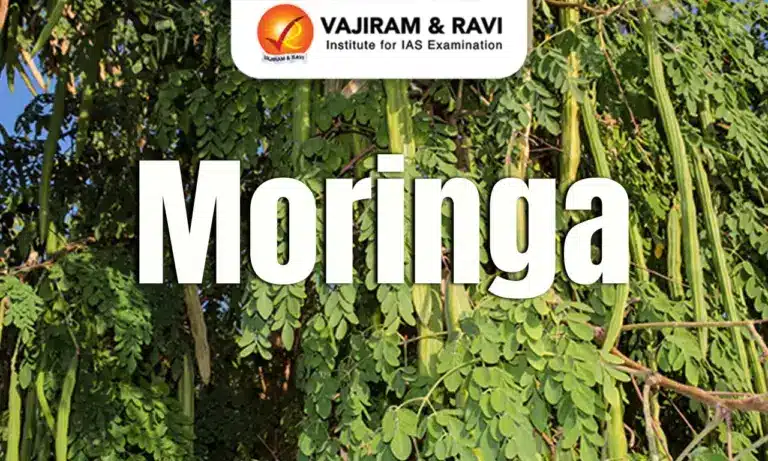
Moringa Latest News
PKM1, a variety of Moringa oleifera, has had a global impact, especially in countries such as Senegal, Rwanda, and Madagascar on the African continent.
About Moringa
- It is known as the “tree of life” or “miracle tree,” and is classified as an important herbal plant.
- Its botanical name is Moringa oleifera, and it is native to India, which was introduced from India to Africa, Southeast Africa, and the Philippines in ancient times.
- Required climatic conditions
- It requires tropical and subtropical regions and grows at a temperature of about 25–35 °C
- It is a deciduous type of tree typically grown in tropical and subtropical regions across the globe
- It grows best in indirect sunlight and without waterlogging, and the soil should be slightly acidic to alkaline.
- The tree begins to bear fruit at 6 to 8 months of age.
- Distribution: It is widely distributed worldwide, but its indigenous origin is in India, Arabia and the East Indies.
- It is common in Asia, Africa, the Caribbean, Latin America, the Pacific Islands, Florida, Madagascar, Central America, Cuba, the Philippines, Ethiopia, and Nigeria.
Benefits of Moringa
- With its high nutritional values, every part of the tree is suitable for either nutritional or commercial purposes.
- The leaves are rich in minerals, vitamins and other essential phytochemicals.
- Extracts from the leaves are used to treat malnutrition, augment breast milk in lactating mothers.
Moringa FAQs
Q1: Is moringa a leguminous evergreen tree?
Ans: The Moringa (drumstick tree) is a leguminous evergreen tree.
Q2: What is moringa called in India?
Ans: Indian common name of Moringa oleifera Hindi mungna, saijna, shajna.
Q3: What is the scientific name of moringa?
Ans: Moringa oleifera
Source: TH






 Last updated on March, 2026
→ UPSC Final Result 2025 is now out.
→ UPSC has released UPSC Toppers List 2025 with the Civil Services final result on its official website.
→ Anuj Agnihotri secured AIR 1 in the UPSC Civil Services Examination 2025.
→ UPSC Marksheet 2025 is now out.
→ UPSC Notification 2026 & UPSC IFoS Notification 2026 is now out on the official website at upsconline.nic.in.
→ UPSC Calendar 2026 has been released.
→ Check out the latest UPSC Syllabus 2026 here.
→ UPSC Prelims 2026 will be conducted on 24th May, 2026 & UPSC Mains 2026 will be conducted on 21st August 2026.
→ The UPSC Selection Process is of 3 stages-Prelims, Mains and Interview.
→ Prepare effectively with Vajiram & Ravi’s UPSC Prelims Test Series 2026 featuring full-length mock tests, detailed solutions, and performance analysis.
→ Enroll in Vajiram & Ravi’s UPSC Mains Test Series 2026 for structured answer writing practice, expert evaluation, and exam-oriented feedback.
→ Join Vajiram & Ravi’s Best UPSC Mentorship Program for personalized guidance, strategy planning, and one-to-one support from experienced mentors.
→ Shakti Dubey secures AIR 1 in UPSC CSE Exam 2024.
→ Also check Best UPSC Coaching in India
Tags: Moringa prelims pointers upsc prelims current affairs