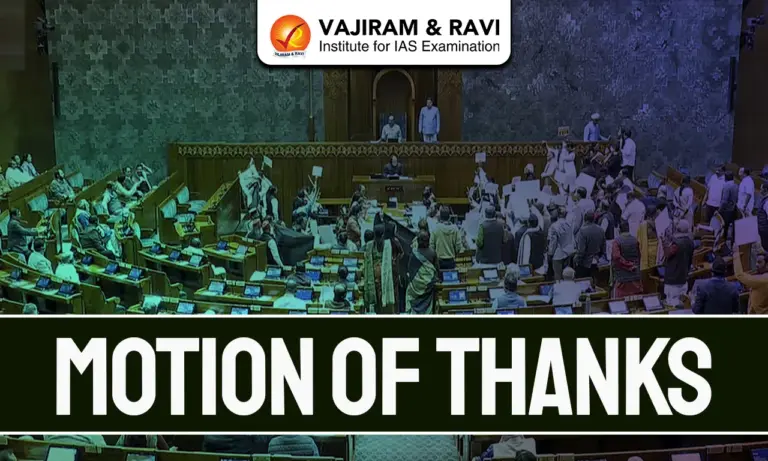
The Motion of Thanks is an important parliamentary procedure in India. After every general election and at the beginning of each financial year, the President addresses both Houses of Parliament. In this speech, the President explains the government’s policies, achievements and future plans. After the address, Members of Parliament discuss it in both Houses through a motion called the Motion of Thanks. This discussion allows MPs to review and debate the government’s performance and priorities.
Motion of Thanks Origin and Background
- The practice of the Motion of Thanks comes from the British parliamentary system (Westminster model), which India adopted after independence and adjusted according to its Constitution.
- The President’s Address is not written by the President personally. It is prepared by the Council of Ministers and approved by the Cabinet, as it reflects the government’s policies and programmes.
- The discussion in Parliament is not held directly on the President’s speech. Instead, Members of Parliament debate it through a formal proposal known as the Motion of Thanks.
- The practice of the President addressing Parliament has its roots in the Government of India Act, 1919.
- After independence, the Constitution clearly provided for Presidential Addresses under Articles 86 and 87.
- Dr Rajendra Prasad gave the first Presidential Address to Parliament in 1950.
Motion of Thanks Constitutional Provisions
Article 86
- Article 86 gives the President the power to address either House of Parliament separately or both Houses together.
- The President can also require the presence of members for this purpose.
- However, this is a discretionary power and has rarely been used in practice.
Article 87 – Special Address
- Article 87 provides for a “Special Address” by the President.
- As per Article 87(1) The President must address both Houses of Parliament assembled together:
- At the beginning of the first session after every general election to the Lok Sabha.
- At the beginning of the first session of every year.
- This Special Address is a constitutional requirement (mandatory). No other business can take place until the President delivers the Address.
Article 87(2)-Discussion through Motion of Thanks
- As per Article 87(2), Parliament must provide time to discuss matters mentioned in the President’s Address.
- This discussion happens through the Motion of Thanks in both Houses.
- Usually, about three days are allotted for debate.





President’s Address
- The Address is prepared by the Council of Ministers and approved by the Cabinet, as it reflects the government’s policies and programmes.
- It reviews the government’s achievements of the previous year.
- It outlines future policies, schemes, legislative proposals and priorities on national and international issues.
Special Situations
- If the Lok Sabha is dissolved at the beginning of the year, the Rajya Sabha can meet without the President’s Address (as happened in 1977 and 1991).
- After a general election, the President addresses both Houses only after the newly elected Lok Sabha members take oath and the Speaker is elected.
Motion of Thanks Features
- The Motion of Thanks is formally moved and seconded by members of the ruling party, who are chosen by the government.
- The discussion on this motion has a very wide scope. Members of Parliament can raise any issue of national or international importance, even if it is not mentioned in the President’s Address.
- Amendments can be proposed, mainly by opposition members. These amendments may express regret over certain issues not being included or not properly addressed in the President’s speech.
- The debate ends with a detailed reply by the Prime Minister, who answers the points raised by members.
- After the Prime Minister’s reply, amendments are put to vote first. Then the main Motion of Thanks is voted upon.
- If amendments are passed, the motion is adopted in its amended form. In India’s history, the Rajya Sabha has passed the Motion of Thanks with amendments only a few times (1980, 1989, 2001, 2015 and 2016). In the Lok Sabha, no amendment has ever been passed.
Procedure of Motion of Thanks
- A ruling party member moves the Motion of Thanks.
- Another member seconds it.
- A detailed discussion takes place on government policies, achievements and future plans.
- The Prime Minister gives a final reply.
- Voting takes place on amendments and then on the main motion.
Motion of Thanks Outcome
- If the Motion of Thanks is passed, it means the House approves the government’s policies and programmes.
- If the motion is defeated, it is treated as a serious political setback and can amount to a loss of confidence in the government and may lead to the resignation of the government or dissolution of the House. It reflects strong opposition to the policies and agenda presented in the President’s Address.
Motion of Thanks Significane
- It is usually the first major debate of the parliamentary year and sets the direction for the Budget Session.
- It ensures parliamentary accountability by allowing members to examine the government’s performance.
- It gives the opposition a constitutional platform to criticise the government.
- It also acts as an indirect test of whether the government enjoys majority support in the House.

 Last updated on March, 2026
→ UPSC Final Result 2025 is now out.
→ UPSC has released UPSC Toppers List 2025 with the Civil Services final result on its official website.
→ Anuj Agnihotri secured AIR 1 in the UPSC Civil Services Examination 2025.
→ UPSC Marksheet 2025 is now out.
→ UPSC Notification 2026 & UPSC IFoS Notification 2026 is now out on the official website at upsconline.nic.in.
→ UPSC Calendar 2026 has been released.
→ Check out the latest UPSC Syllabus 2026 here.
→ UPSC Prelims 2026 will be conducted on 24th May, 2026 & UPSC Mains 2026 will be conducted on 21st August 2026.
→ The UPSC Selection Process is of 3 stages-Prelims, Mains and Interview.
→ Prepare effectively with Vajiram & Ravi’s UPSC Prelims Test Series 2026 featuring full-length mock tests, detailed solutions, and performance analysis.
→ Enroll in Vajiram & Ravi’s UPSC Mains Test Series 2026 for structured answer writing practice, expert evaluation, and exam-oriented feedback.
→ Join Vajiram & Ravi’s Best UPSC Mentorship Program for personalized guidance, strategy planning, and one-to-one support from experienced mentors.
→ Shakti Dubey secures AIR 1 in UPSC CSE Exam 2024.
→ Also check Best UPSC Coaching in India
Motion of Thanks FAQs
Q1. What is the Motion of Thanks?+
Q2. When does the President deliver the Special Address?+
Q3. How is the President’s Address discussed in Parliament?+
Q4. Who prepares the President’s Address?+
Q5. What happens if the Motion of Thanks is defeated?+
Tags: indian polity indian polity notes motion of thanks