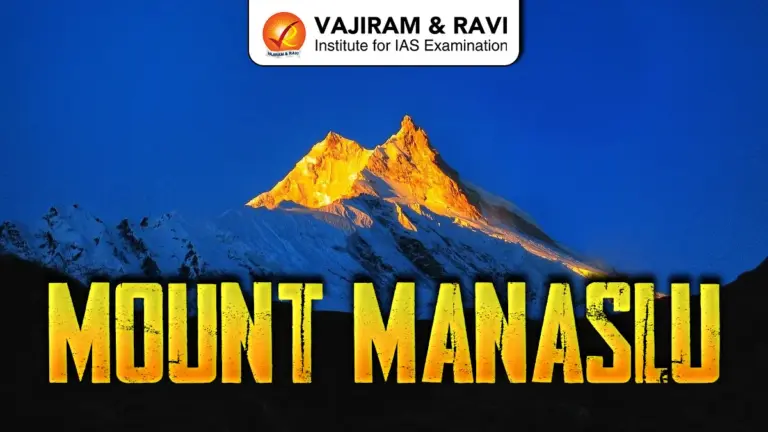
Mount Manaslu is one of the most important high Himalayan peaks of Nepal and holds global geographical, ecological and mountaineering significance. It is the eighth highest mountain in the world and forms a major part of the Mansiri Himal range in west-central Nepal. It is surrounded by glaciers, deep river gorges and remote settlements. Manaslu represents a unique blend of physical geography, biodiversity, human habitation and conservation led development in the central Himalayas.
Mount Manaslu
Mount Manaslu is located in the Gorkha District of Nepal within the northern Himalayan range and stands as the highest peak of the Mansiri Himal massif. Locally, it is known as “Kutang”. The term “Manaslu” is derived from Sanskrit word “manasa” which translates to “Mountain of the Spirit,” reflecting its deep cultural and spiritual symbolism.
Also Read: Ural Mountains
Mount Manaslu Features
Mount Manaslu displays striking physical, climatic and geological features that define its dominance in the central Himalayan landscape. The major features of Manaslu has been highlighted below:
- Height: Mount Manaslu stands at 8,163 metres or 26,781 feet, making it the eighth highest mountain on Earth after Annapurna and before Dhaulagiri.
- Geographical Location: The mountain lies in west-central Nepal, around 64 kilometres east of Annapurna and is bordered by the Budhi Gandaki River gorge to the east.
- Mountain Range: Manaslu forms the highest point of the Mansiri Himal Range, which includes other major peaks like Himalchuli and Ngadi Chuli.
- Topography: The mountain appears as a steep wall of snow and ice with terraced slopes descending into sparsely inhabited agricultural valleys.
- Climatic Zones: The region spans six climatic zones, ranging from tropical foothills at 600 metres to arctic conditions above 4,500 metres near the summit.
- Snow Line: The permanent snow line lies above 5,000 metres, where temperatures remain below freezing throughout the year.
- Temperature Range: Subtropical areas experience summer temperatures up to 34°C, while the arctic zone remains far below zero degrees Celsius.
- Precipitation Pattern: Annual rainfall averages around 1,900 millimetres, mainly during the monsoon season from June to September.
- Surrounding Peaks: Major neighboring peaks include Himalchuli at 7,893 metres and Ngadi Chuli at 7,871 metres.
- Glacial Pass: The Larkya La pass, at 5,106 metres, forms a glacial saddle north of Manaslu and connects the Manaslu and Annapurna regions.
- Human Settlements: The nearest settlement to the peak is Samagaun village, located about 1.9 kilometres from the base camp.
- First Successful Ascent: The peak was first climbed on 9 May 1956 by Toshio Imanishi of Japan and Gyalzen Norbu Sherpa during a Japanese expedition.
- Trekking Corridor: The Manaslu Circuit trek spans about 177 kilometres and follows an ancient salt trading route along the Budhi Gandaki River.
Also Read: Arakan Yoma Mountain





Mount Manaslu Biodiversity
Mount Manaslu lies within a protected conservation landscape that supports rich biodiversity across multiple ecological zones.
- Conservation Area: The Manaslu Conservation Area covers 1,663 square kilometres and was formally declared in 1998 under Nepal’s wildlife protection framework.
- Altitudinal Diversity: The conservation area ranges from 1,400 metres to 8,156 metres, creating diverse habitats from subtropical forests to nival zones.
- Mammalian Species: At least 33 mammal species are found here, including snow leopard, red panda, Himalayan tahr, musk deer and grey wolf.
- Avian Diversity: Over 110 bird species inhabit the region, such as golden eagle, Himalayan griffon, blood pheasant and Himalayan snow cock.
- Plant Wealth: The region supports around 1,500 to 2,000 plant species, including rhododendron forests and Himalayan blue pine.
- Forest Types: Nineteen distinct forest types exist, classified into low hill, middle mountain and high mountain vegetation zones.
- Medicinal Flora: Several medicinal and aromatic plant species grow naturally, supporting traditional healthcare and local livelihoods.
- Community Conservation: Local monasteries have enforced hunting bans, significantly contributing to wildlife protection and ecosystem stability.

 Last updated on April, 2026
→ UPSC Final Result 2025 is now out.
→ UPSC has released UPSC Toppers List 2025 with the Civil Services final result on its official website.
→ Anuj Agnihotri secured AIR 1 in the UPSC Civil Services Examination 2025.
→ UPSC Marksheet 2025 is now out.
→ UPSC Notification 2026 & UPSC IFoS Notification 2026 is now out on the official website at upsconline.nic.in.
→ UPSC Calendar 2026 has been released.
→ Check out the latest UPSC Syllabus 2026 here.
→ UPSC Prelims 2026 will be conducted on 24th May, 2026 & UPSC Mains 2026 will be conducted on 21st August 2026.
→ The UPSC Selection Process is of 3 stages-Prelims, Mains and Interview.
→ Prepare effectively with Vajiram & Ravi’s UPSC Prelims Test Series 2026 featuring full-length mock tests, detailed solutions, and performance analysis.
→ Enroll in Vajiram & Ravi’s UPSC Mains Test Series 2026 for structured answer writing practice, expert evaluation, and exam-oriented feedback.
→ Join Vajiram & Ravi’s Best UPSC Mentorship Program for personalized guidance, strategy planning, and one-to-one support from experienced mentors.
→ Shakti Dubey secures AIR 1 in UPSC CSE Exam 2024.
→ Also check Best UPSC Coaching in India
Mount Manaslu FAQs
Q1. Where is Mount Manaslu located?+
Q2. Why is Mount Manaslu called the “Mountain of the Spirit”?+
Q3. Who was the first person to climb Mount Manaslu?+
Q4. What is the height of Mount Manaslu?+
Q5. Is Mount Manaslu part of a Manaslu Conservation Area?+
Tags: mount manaslu