Mud Volcano Latest News
A mud volcano suddenly erupted in Diglipur, Andaman Islands, recently.
About Mud Volcano
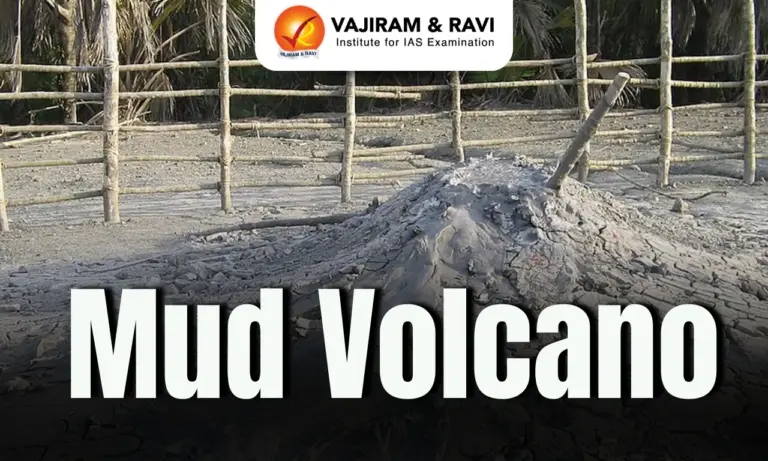
- It is a mound of mud heaved up through overlying sediments.
- The craters are usually shallow and may intermittently erupt mud.
- These eruptions continuously rebuild the cones, which are eroded relatively easily.
- Some mud volcanoes are created by hot-spring activity where large amounts of gas and small amounts of water react chemically with the surrounding rocks and form a boiling mud.
- Variations are the porridge pot (a basin of boiling mud that erodes chunks of the surrounding rock) and the paint pot (a basin of boiling mud that is tinted yellow, green, or blue by minerals from the surrounding rocks).
- Other mud volcanoes, entirely of a nonigneous origin, occur only in oil-field regions that are relatively young and have soft, unconsolidated formations.
- Under compactional stress, methane and related hydrocarbon gases mixed with mud force their way upward and burst through to the surface, spewing mud into a conelike shape.
- Because of the compactional stress and the depth from which the mixture comes, the mud is often hot and may have an accompanying steam cloud.
- Mud volcanoes, also known as “sedimentary volcanoes” or “gas-oil volcanoes,” are close cousins to magmatic volcanoes.
- Like magmatic volcanoes, they can erupt powerfully and hurl flames to great heights, sometimes even several hundred meters.
- Instead of hot lava, it spits out mud, water, and gases from deep inside the Earth.
- Mud volcanoes also exist on the floor of the sea and can form islands and banks that alter the topography and shape of the coastline.
- Approximately 1,000 mud volcanoes have been identified on land and in shallow water.
- In India, the only mud volcano lies in Baratang Island, a part of the Andaman chain of islands.
Source: MC






 Last updated on April, 2026
→ UPSC Final Result 2025 is now out.
→ UPSC has released UPSC Toppers List 2025 with the Civil Services final result on its official website.
→ Anuj Agnihotri secured AIR 1 in the UPSC Civil Services Examination 2025.
→ UPSC Marksheet 2025 is now out.
→ UPSC Notification 2026 & UPSC IFoS Notification 2026 is now out on the official website at upsconline.nic.in.
→ UPSC Calendar 2026 has been released.
→ Check out the latest UPSC Syllabus 2026 here.
→ UPSC Prelims 2026 will be conducted on 24th May, 2026 & UPSC Mains 2026 will be conducted on 21st August 2026.
→ The UPSC Selection Process is of 3 stages-Prelims, Mains and Interview.
→ Prepare effectively with Vajiram & Ravi’s UPSC Prelims Test Series 2026 featuring full-length mock tests, detailed solutions, and performance analysis.
→ Enroll in Vajiram & Ravi’s UPSC Mains Test Series 2026 for structured answer writing practice, expert evaluation, and exam-oriented feedback.
→ Join Vajiram & Ravi’s Best UPSC Mentorship Program for personalized guidance, strategy planning, and one-to-one support from experienced mentors.
→ Shakti Dubey secures AIR 1 in UPSC CSE Exam 2024.
→ Also check Best UPSC Coaching in India
Mud Volcano FAQs
Q1. What is a mud volcano?+
Q2. What is a “porridge pot” in the context of mud volcanoes?+
Q3. Can mud volcanoes occur under the sea?+
Q4. Where is the only mud volcano located in India?+
Tags: mud volcano prelims pointers upsc current affairs upsc prelims current affairs