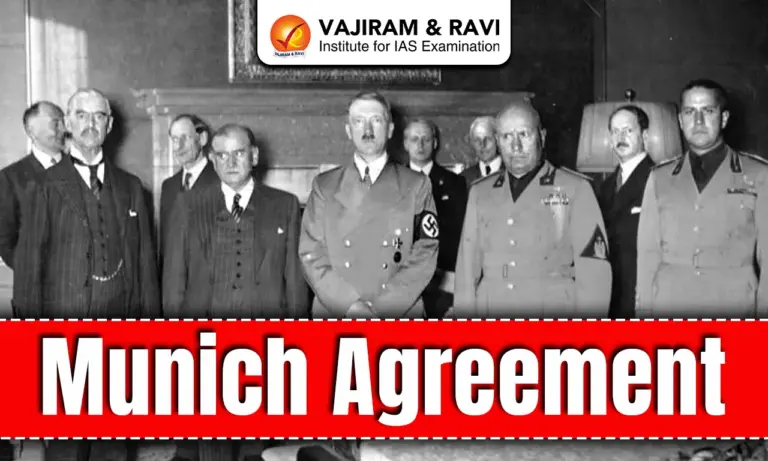
The Munich Agreement of 1938 stands as one of the most significant events in the lead-up to World War II. It was signed between Germany, Britain, France, and Italy. The agreement allowed Nazi Germany to annex the Sudetenland, a region of Czechoslovakia with a majority ethnic German population. Often cited as the prime example of the policy of appeasement, the Munich Agreement aimed to prevent war but ultimately paved the way for further German aggression.
Munich Agreement Background
- By the late 1930s, Adolf Hitler had consolidated power in Germany and pursued an aggressive expansionist policy.
- Hitler aimed to unite all ethnic Germans under the Third Reich and sought territorial expansion in Central Europe.
- The Sudetenland, a border region of Czechoslovakia, had a majority ethnic German population.
- Hitler claimed that Germans in the Sudetenland were being oppressed by the Czechoslovak government.
- The Sudetenland was strategically important, with mountains, fortifications, and industrial resources vital to Czechoslovakia’s defense.
- European powers, especially Britain and France, were wary of another large-scale war after the devastation of World War I.
- Britain and France followed a policy of appeasement, hoping to maintain peace by satisfying Hitler’s demands.
- Czechoslovakia was pressured to cede the Sudetenland to Germany, despite the strategic risk.
- Hitler increased pressure on Czechoslovakia in 1938, threatening military action if his demands were not met.
- Local pro-German groups in Sudetenland agitated for union with Germany, giving Hitler a pretext for annexation.
- Italy, under Mussolini, acted as a mediator along with Britain and France, while Czechoslovakia was excluded from negotiations.
- The main aim of the Munich Agreement was to avoid war by allowing Germany to annex the Sudetenland.
- Western powers believed that satisfying Hitler’s territorial ambitions would prevent further conflict in Europe.
- The background reflects Europe’s struggle between the fear of war and the need to check aggression.
- The Munich Agreement is historically seen as a classic example of failed appeasement that encouraged Hitler’s further expansion, eventually leading to World War II.
Munich Agreement Provisions
The key provisions of the Munich Agreement are:
- Annexation of Sudetenland: Germany was allowed to occupy the Sudetenland, a region with a majority ethnic German population.
- Exclusion of Czechoslovakia: The Czechoslovak government was not consulted or invited to the negotiations.
- Strategic and Industrial Loss: Sudetenland had fortifications, military installations, and industrial resources, which were vital to Czechoslovakia’s defense.
- Guarantee of Peace: The agreement was meant to prevent further German expansion and maintain peace in Europe by satisfying Hitler’s territorial ambitions.
- Role of European Powers: Britain, France, and Italy endorsed the annexation instead of defending Czechoslovakia.
- Temporary Nature: The agreement was intended as a short-term solution, but Hitler violated it within six months by occupying the rest of Czechoslovakia.
- Example of Appeasement: The provisions highlight the policy of appeasement, showing how concessions were made to avoid war.





Munich Agreement Outcome
The outcomes of the Munich Agreement were far-reaching:
- Failure of Appeasement: Rather than curbing Hitler, the agreement encouraged further German expansion, with Hitler violating the agreement by occupying the rest of Czechoslovakia in March 1939.
- Undermining Collective Security: Allowing Germany to annex the Sudetenland weakened the post-World War I security framework in Europe.
- Loss of Credibility: Britain and France’s inability to defend Czechoslovakia damaged their international credibility, making it harder to form alliances against Germany.
- Prelude to World War II: Less than a year later, Germany invaded Poland on September 1, 1939, forcing Britain and France to declare war, marking the beginning of the deadliest conflict in human history.
Munich Agreement Significance
The Munich Agreement holds great historical significance:
- Cautionary Tale of Appeasement: It demonstrated that appeasing aggressive powers can backfire, emboldening them instead of preventing conflict.
- Impact on Smaller Nations: The agreement highlighted the vulnerability of smaller nations like Czechoslovakia when larger powers prioritize peace over justice.
Lessons for Diplomacy: Modern diplomacy often references the Munich Agreement as a lesson in balancing negotiation with deterrence, emphasizing that concessions without enforcement can lead to disaster.

 Last updated on March, 2026
→ UPSC Final Result 2025 is now out.
→ UPSC has released UPSC Toppers List 2025 with the Civil Services final result on its official website.
→ Anuj Agnihotri secured AIR 1 in the UPSC Civil Services Examination 2025.
→ UPSC Marksheet 2025 is now out.
→ UPSC Notification 2026 & UPSC IFoS Notification 2026 is now out on the official website at upsconline.nic.in.
→ UPSC Calendar 2026 has been released.
→ Check out the latest UPSC Syllabus 2026 here.
→ UPSC Prelims 2026 will be conducted on 24th May, 2026 & UPSC Mains 2026 will be conducted on 21st August 2026.
→ The UPSC Selection Process is of 3 stages-Prelims, Mains and Interview.
→ Prepare effectively with Vajiram & Ravi’s UPSC Prelims Test Series 2026 featuring full-length mock tests, detailed solutions, and performance analysis.
→ Enroll in Vajiram & Ravi’s UPSC Mains Test Series 2026 for structured answer writing practice, expert evaluation, and exam-oriented feedback.
→ Join Vajiram & Ravi’s Best UPSC Mentorship Program for personalized guidance, strategy planning, and one-to-one support from experienced mentors.
→ Shakti Dubey secures AIR 1 in UPSC CSE Exam 2024.
→ Also check Best UPSC Coaching in India
Munich Agreement FAQs
Q1. Which countries were part of the Munich Agreement?+
Q2. What did the Munich Agreement allow Germany to do?+
Q3. Why is the Munich Agreement historically important?+
Q4. Did the Munich Agreement prevent World War II?+
Q5. What was the policy of appeasement?+
Tags: munich agreement