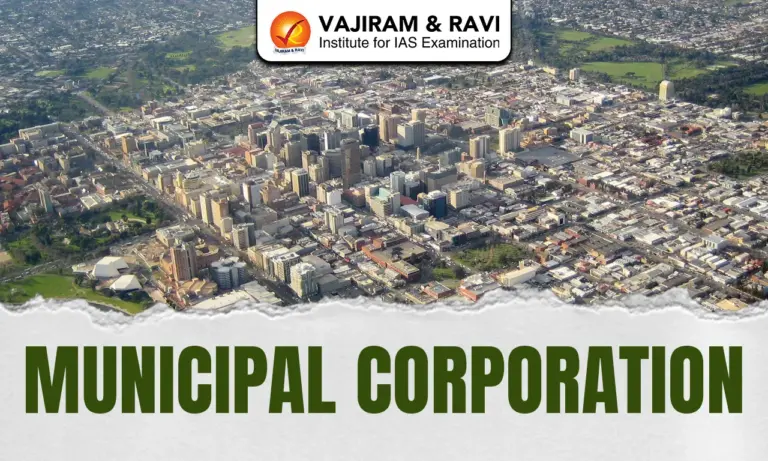
Municipal Corporation is an urban local government body established for the administration of large cities and metropolitan areas. It is responsible for providing essential civic services and ensuring planned urban development. The first municipal corporation in India was set up by the British in Madras in 1688, followed by Bombay and Calcutta in 1726. Across India, municipal corporations are referred to by different names, such as Nagar Nigam, Mahanagar Palika, or other state-specific terms.
Municipal Corporation Constitutional Basis
Municipal Corporations represent the third tier of governance in India. Municipal Corporations derive constitutional status from the 74th Constitutional Amendment Act, 1992. The amendment added Part IX-A to the Constitution, dealing specifically with Urban Local Bodies (ULBs).
Article 243Q provides for the constitution of Municipal Corporations in large urban areas. The Twelfth Schedule lists 18 functional subjects that may be devolved to urban local bodies.
Establishment and Area of Operation
Municipal Corporations are established in the states by the acts of the concerned state legislatures, and in the union territories by the acts of the Parliament of India. There may be one common act for all the municipal corporations in a state or a separate act for each municipal corporation.
Examples include Municipal Corporation of Delhi, Brihanmumbai Municipal Corporation, and Greater Chennai Corporation.





Composition and Structure
A municipal corporation has three authorities, namely, the council, the standing committees and the commissioner.
- The Council is the deliberative and legislative wing of the corporation. It consists of the Councillors directly elected by the people, as well as a few nominated persons having knowledge or experience of municipal administration.
- The Council is headed by a Mayor. He is assisted by a Deputy Mayor. He is elected in a majority of the states for a one-year renewable term. He is basically an ornamental figure and a formal head of the corporation. His main function is to preside over the meetings of the Council.
- The standing committees are created to facilitate the working of the council, which is too large in size. They deal with public works, education, health, taxation, finance and so on. They make decisions in their fields.
- The municipal commissioner is responsible for the implementation of the decisions taken by the council and its standing committees. Thus, he is the chief executive authority of the corporation. He is appointed by the state government and is generally a member of the IAS.
Functions of Municipal Corporations
The functions of Municipal Corporations are derived from the 74th Constitutional Amendment Act, 1992, which inserted Part IX-A into the Constitution. Article 243W empowers state legislatures to endow Municipal Corporations with powers and responsibilities for urban governance.
The Twelfth Schedule lists 18 functional subjects, which form the core functional domain of Municipal Corporations.However, the actual transfer of functions depends on state legislation, leading to variation in practice. Functions of Municipal corporations are as follows:
- Urban Planning and Land-Use Regulation:
- Municipal Corporations are responsible for urban planning, including preparation of master plans and regulation of land use. They grant building permissions and ensure compliance with zoning regulations and building by-laws.
- Water Supply and Sewerage Management:
- Municipal Corporations are entrusted with the responsibility of providing safe and adequate drinking water to urban residents.
- They manage water distribution networks, treatment plants, and storage facilities.
- Sewerage systems, including collection, treatment, and disposal of wastewater, also fall under municipal jurisdiction.
- Public Health and Sanitation:
- Municipal Corporations are responsible for Sanitation and cleanliness, control of communicable diseases, Maintenance of municipal hospitals and dispensaries.
- They implement national health programmes at the city level in coordination with state authorities.
- The COVID-19 pandemic highlighted the frontline role of municipal bodies in urban health governance.
- Solid Waste Management:
- Municipal Corporations are responsible for collection, segregation, transportation, processing, and disposal of solid waste.
- They implement rules under the Solid Waste Management Rules, 2016.
- Roads, Transport, and Urban Infrastructure:
- Municipal Corporations construct and maintain urban roads, footpaths, flyovers, and street lighting.
- They regulate traffic, parking, and sometimes urban transport services.
- Disaster Management:
- Municipal Corporations prepare for and respond to urban disasters such as fires, floods, and building collapses.
- Disaster preparedness includes early warning systems, evacuation planning, and coordination with state agencies.
- Implement Government Schemes:
- For Example, Municipal Corporation implements schemes such as Smart Cities Mission, AMRUT, Swachh Bharat Mission (Urban)
- Regulation of Trade and Economic Activities:
- Municipal Corporations regulate markets, street vending, and trade licenses.They ensure compliance with safety, hygiene, and zoning norms.
Financial Powers and Sources of Revenue
Municipal Corporations have the authority to levy and collect local taxes, subject to state laws. Major sources of revenue include Property tax, Profession tax, Advertisement tax, User charges for services.
They also receive Grants from State Governments, Central Finance Commission and State Finance Commission grants. Despite these sources, many corporations face financial stress and revenue deficits.
Challenges Faced by Municipal Corporations
Despite their importance, Municipal Corporations face several structural challenges:
- Inadequate devolution of powers, with states retaining control over key functions.
- Inadequate financial resources
- Weak political leadership, caused by short mayoral tenures.
- Administrative capacity constraints, including lack of skilled manpower.
- Fragmented urban governance, with multiple parastatal agencies operating outside municipal control.
- Rapid urbanisation has increased pressure on urban infrastructure and basic services.
These challenges often result in inefficient service delivery and citizen dissatisfaction.
Reforms and Way Forward
Strengthening Municipal Corporations is essential for India’s urban transformation. Key reforms include:
- Ensuring full implementation of the 74th Constitutional Amendment in letter and spirit.
- Granting greater financial autonomy through predictable revenue sources.
- Strengthening the office of the Mayor, with longer tenure and executive powers.
- Improving property tax reforms and GIS-based assessment.
- Capacity building of municipal staff and elected representatives.
- Promoting e-governance, citizen participation, and transparency.
Other Forms of Urban Local Government
Apart from Municipal Corporations, there are several other forms of urban local government in India. They are as follows:
- Municipality: Municipalities exist in smaller cities and towns. They are also referred to as municipal councils, municipal committees, or municipal boards, and handle local administration and basic civic amenities.
- Notified Area Committee: Notified area committees are formed for rapidly developing towns or towns that lack basic infrastructure. All members of these committees are nominated by the state government.
- Town Area Committee: Town area committees are found in small towns and are responsible for essential local services such as street lighting, drainage, roads, and sanitation.
- Cantonment Board: Cantonment boards are set up in cantonment areas to manage the civilian population living there. They are created and administered by the central government.
- Township: Townships are established near industrial plants or establishments to provide basic facilities to workers and staff living in the colonies. They do not have elected members and function as an extension of the administrative system.
- Port Trust: Port trusts are formed in major port areas such as Mumbai, Chennai, and Kolkata. They manage port operations and also provide civic amenities to the people living in the port region.
- Special Purpose Agency: Special purpose agencies are created to undertake specific functions or projects assigned to municipal corporations or municipalities.
Conclusion
Municipal Corporations are the backbone of India’s urban governance architecture. As cities become engines of economic growth and social change, empowering Municipal Corporations is no longer optional but essential. A strong, autonomous, and accountable municipal system is crucial for achieving sustainable urbanisation, democratic decentralisation, and inclusive development. For India to manage its urban future effectively, Municipal Corporations must be transformed from weak service providers into robust institutions of self-government.

 Last updated on April, 2026
→ UPSC Final Result 2025 is now out.
→ UPSC has released UPSC Toppers List 2025 with the Civil Services final result on its official website.
→ Anuj Agnihotri secured AIR 1 in the UPSC Civil Services Examination 2025.
→ UPSC Marksheet 2025 is now out.
→ UPSC Notification 2026 & UPSC IFoS Notification 2026 is now out on the official website at upsconline.nic.in.
→ UPSC Calendar 2026 has been released.
→ Check out the latest UPSC Syllabus 2026 here.
→ UPSC Prelims 2026 will be conducted on 24th May, 2026 & UPSC Mains 2026 will be conducted on 21st August 2026.
→ The UPSC Selection Process is of 3 stages-Prelims, Mains and Interview.
→ Prepare effectively with Vajiram & Ravi’s UPSC Prelims Test Series 2026 featuring full-length mock tests, detailed solutions, and performance analysis.
→ Enroll in Vajiram & Ravi’s UPSC Mains Test Series 2026 for structured answer writing practice, expert evaluation, and exam-oriented feedback.
→ Join Vajiram & Ravi’s Best UPSC Mentorship Program for personalized guidance, strategy planning, and one-to-one support from experienced mentors.
→ Shakti Dubey secures AIR 1 in UPSC CSE Exam 2024.
→ Also check Best UPSC Coaching in India
Municipal Corporation FAQs
Q1. What is a Municipal Corporation?+
Q2. What is the constitutional basis of Municipal Corporations?+
Q3. Which is the first Municipal Corporation in India?+
Q4. How is a Municipal Corporation structured?+
Q5. What are the main functions of a Municipal Corporation?+
Tags: indian polity indian polity notes municipal corporation