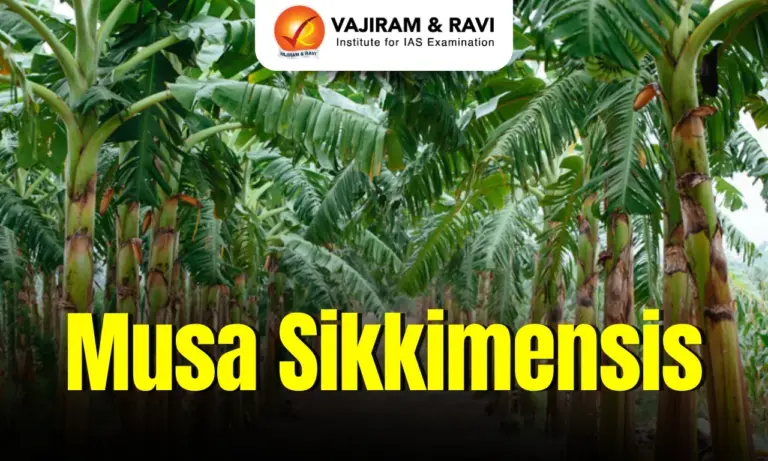
Musa sikkimensis Latest News
Researchers at Nagaland University highlighted genetic richness of wild banana Musa sikkimensis for climate-resilient farming.
About Musa sikkimensis
- It is a wild banana species.
- It is native to the Eastern Himalayas and Northeast India.
- Other Names: It is commonly known as the ‘Darjeeling banana’ or ‘Sikkim banana’.





Features of Musa sikkimensis
- It is a tall, evergreen perennial plant that belongs to the banana family.
- It has large, paddle-shaped leaves that can grow up to 10 feet (3 meters) long and 2 feet (60 cm) wide.
- The plant produces beautiful, pendulous flowers that are a deep maroon color and can grow up to 2 feet (60 cm) long.
- It is not widely cultivated for edible fruit, it plays a crucial role in strengthening crop resilience and ensuring sustainable production.
- Its germplasm exhibits strong adaptive potential across diverse environmental conditions.
- It is a wild-seeded species that serves as a crucial genetic reservoir.
Required Climatic Conditions for Musa sikkimensis
- It prefers high humidity levels, around 50-60%.
- It prefers warm temperatures between 20-30°C.
- It can tolerate cooler temperatures, but not below 10°C.
- Significance: It possesses traits linked to disease resistance, environmental stress tolerance and climate adaptability, making it an invaluable resource for future banana breeding and crop improvement programmes.
Source: DD News

 Last updated on March, 2026
→ UPSC Final Result 2025 is now out.
→ UPSC has released UPSC Toppers List 2025 with the Civil Services final result on its official website.
→ Anuj Agnihotri secured AIR 1 in the UPSC Civil Services Examination 2025.
→ UPSC Marksheet 2025 is now out.
→ UPSC Notification 2026 & UPSC IFoS Notification 2026 is now out on the official website at upsconline.nic.in.
→ UPSC Calendar 2026 has been released.
→ Check out the latest UPSC Syllabus 2026 here.
→ UPSC Prelims 2026 will be conducted on 24th May, 2026 & UPSC Mains 2026 will be conducted on 21st August 2026.
→ The UPSC Selection Process is of 3 stages-Prelims, Mains and Interview.
→ Prepare effectively with Vajiram & Ravi’s UPSC Prelims Test Series 2026 featuring full-length mock tests, detailed solutions, and performance analysis.
→ Enroll in Vajiram & Ravi’s UPSC Mains Test Series 2026 for structured answer writing practice, expert evaluation, and exam-oriented feedback.
→ Join Vajiram & Ravi’s Best UPSC Mentorship Program for personalized guidance, strategy planning, and one-to-one support from experienced mentors.
→ Shakti Dubey secures AIR 1 in UPSC CSE Exam 2024.
→ Also check Best UPSC Coaching in India
Musa sikkimensis FAQs
Q1. What is Musa sikkimensis commonly known as?+
Q2. Where is Musa sikkimensis primarily found?+
Tags: musa sikkimensis prelims pointers upsc current affairs upsc prelims current affairs