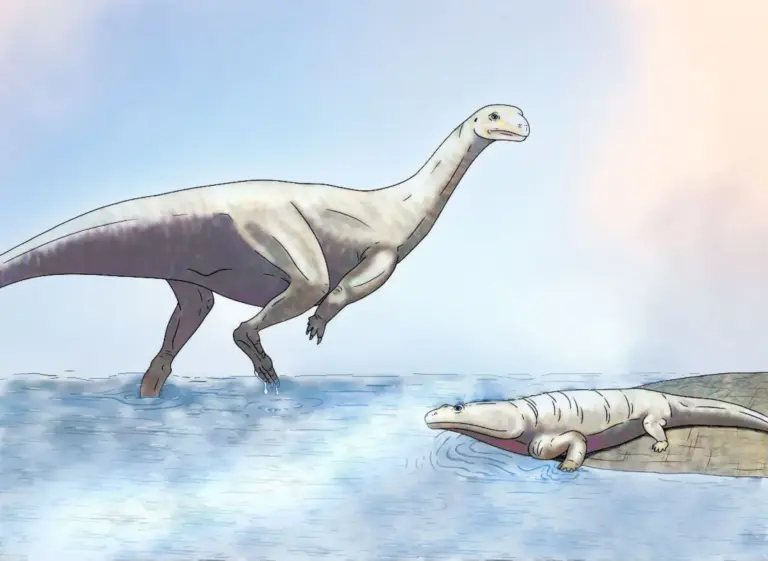
About Musankwa sanyatiensis:
- It is a new dinosaur species which has been identified from fossils discovered along the shores of Lake Kariba in Zimbabwe.
- The dinosaur’s genus name, “Musankwa,” was the name of the houseboat scientists used during their expeditions to the research site.
- In addition, its species name, “sanyatiensis,” alludes to the Sanyati River that flows into Lake Kariba.
- It is the first dinosaur to be named from the Mid-Zambezi Basin of northern Zimbabwein over 50 years.
- Additionally, it is only the fourth dinosaur to be named from Zimbabwe, following the descriptions of “Syntarsus” rhodesiensis in 1969, Vulcanodon karibaensis in 1972, and, most recently, Mbiresaurus raathi in 2022.
- The rocks yielding this new specimen date back to the Late Triassic period, approximately 210 million years ago.
- Musankwa sanyatiensis is represented by the remains of a single hind leg, including its thigh, shin, and ankle bones.
- Evolutionary analysis reveals that it was a member of the Sauropodomorpha, a group of bipedal, long-necked dinosaurs that were widespread during the Late Triassic.
- Interestingly, it appears to be closely related to contemporaries in South Africa and Argentina.
Weighing in at around 390 kg, the plant-eating Musankwa sanyatiensis was one of the larger dinosaurs of its era and mostly lived in swamp areas.
Q1: What is the Triassic period?
The Triassic Period was the first of the three geologic periods of the Mesozoic Era. The Triassic began approximately 252 million years ago at the end of the Permian Period and ended about 201 million years ago at the start of the Jurassic Period. The Triassic Period followed on the heels of the Permian extinction, the largest mass extinction in the history of Earth. The name Triassic derives from the Trias, a sequence of three rock strata, or layers, in Germany that lay above Permian rocks and below Jurassic rocks. The Triassic Period marked the start of major changes that were to take place throughout the Mesozoic Era, particularly in the arrangement of continents, the evolution of life, and the geographic distribution of living things.
Source: Musankwa sanyatiensis, a new dinosaur from Zimbabwe discovered






 Last updated on April, 2026
→ UPSC Final Result 2025 is now out.
→ UPSC has released UPSC Toppers List 2025 with the Civil Services final result on its official website.
→ Anuj Agnihotri secured AIR 1 in the UPSC Civil Services Examination 2025.
→ UPSC Marksheet 2025 is now out.
→ UPSC Notification 2026 & UPSC IFoS Notification 2026 is now out on the official website at upsconline.nic.in.
→ UPSC Calendar 2026 has been released.
→ Check out the latest UPSC Syllabus 2026 here.
→ UPSC Prelims 2026 will be conducted on 24th May, 2026 & UPSC Mains 2026 will be conducted on 21st August 2026.
→ The UPSC Selection Process is of 3 stages-Prelims, Mains and Interview.
→ Prepare effectively with Vajiram & Ravi’s UPSC Prelims Test Series 2026 featuring full-length mock tests, detailed solutions, and performance analysis.
→ Enroll in Vajiram & Ravi’s UPSC Mains Test Series 2026 for structured answer writing practice, expert evaluation, and exam-oriented feedback.
→ Join Vajiram & Ravi’s Best UPSC Mentorship Program for personalized guidance, strategy planning, and one-to-one support from experienced mentors.
→ Shakti Dubey secures AIR 1 in UPSC CSE Exam 2024.
→ Also check Best UPSC Coaching in India