What’s in today’s article?
- Why in news?
- What is a Pressurised Heavy Water Reactor (PHWR)?
- News Summary: Largest indigenously developed N-plant unit in Gujarat starts ops at full capacity
- Significance of Kakrapar-3
Why in news?
- The third unit of the indigenously developed 700-megawatt electric (MWe) nuclear power reactor at the Kakrapar Atomic Power Project (KAPP3) in Gujarat has commenced operations at full capacity.
- The reactor unit had achieved its first criticality – a technical term that signifies the initiation of a controlled, but sustained nuclear fission reaction – in July 2020.
Pressurised Heavy Water Reactor (PHWR)
- About
- The Pressurized Heavy Water Reactor (PHWR) is a type of nuclear reactor used for electricity generation.
- India has been operating several PHWRs for power generation, and these reactors play a significant role in the country’s nuclear power program.
- Design and Technology:
- PHWRs are part of the second generation of nuclear reactors and are considered one of the safest reactor designs.
- It commonly uses unenriched natural uranium as its fuel and heavy water (deuterium oxide D2O) as its coolant and moderator.
- The heavy water coolant is kept under pressure, allowing it to be heated to higher temperatures without boiling, much as in a typical pressurized water reactor.
- While heavy water is significantly more expensive than ordinary light water, it yields greatly enhanced neutron economy.
- It allows the reactor to operate without fuel enrichment facilities and generally enhancing the ability of the reactor to efficiently make use of alternate fuel cycles.
- Hence, it mitigates the additional capital cost of the heavy water.
- Safety Features:
- PHWRs are known for their passive safety features.
- The biggest advantage of the PHWR design being the use of thin walled pressure tubes instead of large pressure vessels used in pressure vessel type reactors.
- This results in a distribution of pressure boundaries to a large number of small diameter pressure tubes.
- This lowers the severity of the consequence of an accidental rupture of the pressure boundary than in a pressure vessel type reactor.
- The 700 MWe PHWR design has enhanced safety through dedicated Passive Decay Heat Removal System.
- This system has the capability of removing decay heat (the heat released as a result of radioactive decay) from the reactor core without requiring any operator actions.
- This is on the lines of similar technology adopted to negate the possibility of a Fukushima type accident that happened in Japan in 2011.
- It is also equipped with a steel-lined containment to reduce any leakages and a containment spray system to reduce the containment pressure in case of a loss of coolant accident.
- PHWR in India
- PHWR technology started in India in the late 1960s with the construction of the first 220 MWe reactor, Rajasthan Atomic Power Station, RAPS-1.
- It was built under the joint Indo-Canadian nuclear co-operation.
- The first two units of PHWR using indigenously developed standardised 220 MWe design were set up at the Narora Atomic Power Station.
- To realise economies of scale, the design of 540 MWe PHWR was subsequently developed, and two such units were built at Tarapur.
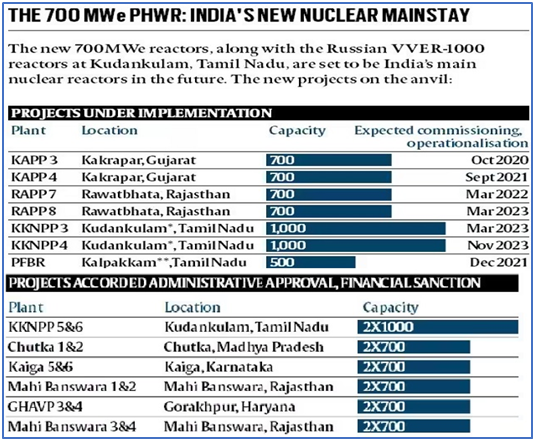
- Four units of the 700MWe reactor are being constructed at Kakrapar (KAPP-3 and 4) and Rawatbhata (RAPS-7 and 8) site in Rajasthan currently.
- A new fleet of 12 reactors got administrative approval and financial sanction in 2017.

- PHWR technology started in India in the late 1960s with the construction of the first 220 MWe reactor, Rajasthan Atomic Power Station, RAPS-1.





News Summary: Largest indigenously developed N-plant unit in Gujarat starts ops at full capacity
Significance of Kakrapar-3
- A landmark event in India’s domestic civilian nuclear programme
- KAPP-3 is the country’s first 700 MWe (megawatt electric) unit, and the biggest indigenously developed variant of the Pressurised Heavy Water Reactor (PHWR).
- Until now, the biggest reactor size of indigenous design was the 540 MWe PHWR, two of which have been deployed in Tarapur, Maharashtra.
- Boost to energy security
- India is working to ramp up its existing nuclear power capacity of 6,780 MWe to 22,480 MWe by 2031.
- In this context, the 700MWe capacity would constitute the biggest component of the expansion plan.
- Currently, nuclear power capacity constitutes around 2 per cent of the total installed capacity of 4,17,668 MW (May 31, 2023).
- Foundation stone for 900 MWe Pressurised Water Reactor (PWR) of indigenous design
- As the civilian nuclear sector gears up for the next frontier — building a 900 MWe Pressurised Water Reactor (PWR) of indigenous design — the experience of executing the larger 700MWe reactor design will come in handy.
- This is true especially with respect to:
- the improved capability of making large-size pressure vessels, and
- India’s own isotope enrichment plants being developed to supply a part of the required enriched uranium fuel to power these new generation reactors.
Q1) What is a nuclear reactor?
A nuclear reactor is a facility that harnesses controlled nuclear fission reactions to generate heat, which is used to produce electricity by heating water to create steam that drives turbines.
Q2) What is heavy water?
Heavy water, also known as deuterium oxide (D2O), is a type of water in which the hydrogen atoms contain one proton and one neutron, instead of just one proton found in regular water (H2O). This makes heavy water denser than ordinary water. It is used in certain types of nuclear reactors as a moderator to slow down and control nuclear reactions, such as in CANDU (Canada Deuterium Uranium) reactors.
Source: Largest indigenously developed N-plant unit in Gujarat starts ops at full capacity | BARC | PIB | Times of India | Indian Express

 Last updated on March, 2026
→ UPSC Final Result 2025 is now out.
→ UPSC has released UPSC Toppers List 2025 with the Civil Services final result on its official website.
→ Anuj Agnihotri secured AIR 1 in the UPSC Civil Services Examination 2025.
→ UPSC Marksheet 2025 is now out.
→ UPSC Notification 2026 & UPSC IFoS Notification 2026 is now out on the official website at upsconline.nic.in.
→ UPSC Calendar 2026 has been released.
→ Check out the latest UPSC Syllabus 2026 here.
→ UPSC Prelims 2026 will be conducted on 24th May, 2026 & UPSC Mains 2026 will be conducted on 21st August 2026.
→ The UPSC Selection Process is of 3 stages-Prelims, Mains and Interview.
→ Prepare effectively with Vajiram & Ravi’s UPSC Prelims Test Series 2026 featuring full-length mock tests, detailed solutions, and performance analysis.
→ Enroll in Vajiram & Ravi’s UPSC Mains Test Series 2026 for structured answer writing practice, expert evaluation, and exam-oriented feedback.
→ Join Vajiram & Ravi’s Best UPSC Mentorship Program for personalized guidance, strategy planning, and one-to-one support from experienced mentors.
→ Shakti Dubey secures AIR 1 in UPSC CSE Exam 2024.
→ Also check Best UPSC Coaching in India