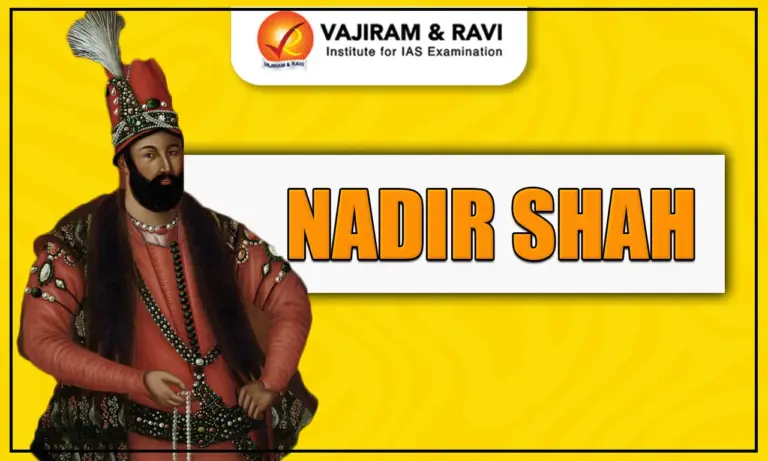
The Afsharid Dynasty of Iran was established in 1736 by one of the powerful monarchs, Nader Shah Afshar. During the Battle of Karnal in 1739, he defeated Mughals then attacked Delhi later. This invasion exposed the decline of the Mughal Empire. Nader Shah seized the imperial treasury, including the famous Koh-i-Noor diamond and the jewel studded Peacock Throne of Shah Jahan.
Nadir Shah Early Life
- Nader Shah Afshar ruled Iran from 1736 to 1747 and founded the Afsharid dynasty.
- He is considered one of the most powerful rulers in Iranian history.
- In 1739, he defeated the Mughal army at the Battle of Karnal.
- Following the victory, he invaded Delhi and launched a violent assault in March 1739.
- The invasion highlighted the Mughal Empire’s weakening control and internal instability.
- Nader Shah looted immense wealth from Delhi, including the Peacock Throne and the Koh-i-Noor diamond.
Afsharid Dynasty
- The Afsharid Dynasty ruled Iran in the mid-18th century.
- It was founded by Nadir Shah in 1736, who came from the Turkoman Afshar clan in Khorasan.
- Nadir Shah overthrew the last Safavid ruler and declared himself the Shah of Iran.
- Under Nadir Shah, Iran reached its largest territorial extent since the Sasanian Empire.
- The empire covered modern-day Iran, Armenia, Georgia, Azerbaijan, parts of the North Caucasus (Dagestan), Afghanistan, Bahrain, Turkmenistan, Uzbekistan, Pakistan, Iraq, Turkey, UAE, and Oman.
- After the death of the Afsharid Dynasty, the power of his empire was divided among the Zands, Durranis, Georgians, and Caucasian khanates.
- The Afsharids were left ruling only a small area in Khorasan.
- The dynasty came to an end in 1796 when Agha Mohammad Khan Qajar established the Qajar dynasty, reclaiming several former provinces.





Invasion of India by Nader Shah
- Nadir Shah ruled Persia from 1736 to 1747 and founded the Afsharid dynasty.
- In 1739, he invaded Delhi after defeating the Mughals at the Battle of Karnal.
- The Mughal Empire was already weakened post-Aurangzeb due to succession struggles and ministerial corruption.
- Nadir Shah started to rise from his origin and saw the decline of the Mughal Empire which he converted into an opportunity to invade India.
- His invasion of India in 1738 was supposedly triggered by an insult to a Persian ambassador at the Mughal court.
- He first captured Ghazni, Kabul, and Lahore, crossing into India through the Khyber Pass.
- The Governor of Punjab warned of the threat, but Emperor Muhammad Shah ignored the alert.
- As Nadir advanced, Mughal generals Khan Dauran and Nizam-ul-Mulk were sent to confront him.
- They were defeated, and Muhammad Shah himself had to lead the army.
- The Mughal army was decisively crushed at Karnal.
- Saadat Khan was captured, Khan Dauran severely wounded, and Mughal morale collapsed.
- Nizam-ul-Mulk tried negotiating with Nadir Shah, offering 20 million rupees for his withdrawal.
- Impressed by Nizam, Muhammad Shah appointed him Prime Minister and gave him the title Amir-Ul-Umra.
- However, Saadat Khan secretly encouraged Nadir to take more, claiming Delhi’s wealth far exceeded the offer.
- Tempted by Delhi’s wealth, Nadir Shah captured the Mughal capital, leading to one of the most brutal battles in history.
Nadir Shah Massacre
- After his entry into Delhi, Nadir Shah was received by a defeated Mughal Emperor.
- The keys to the Red Fort and its treasures had already been surrendered. But then, a rumor spread that Nadir Shah had been killed. Chaos followed.
- Riots broke out, and several Persian soldiers were attacked and murdered in the streets.
- Nadir Shah stormed back into the city and found his men dead across various neighborhoods.
- At the Sunhari Masjid, someone hurled a stone at him, and a gunshot killed one of his troops.
- Enraged, he ordered a brutal massacre wherever Persian bodies had been found.
- On March 11, 1739, Delhi witnessed one of the bloodiest days in its history, an estimated 20,000 to 200,000 people were killed, depending on the account.
Consequences of the Invasion
- Nadir Shah’s army robbed, plundered, and devastated Delhi completely. He took the Peacock Throne built by Shah Jahan and the legendary Koh-i-Noor diamond.
- He also looted 10 million rupees in gold, 600 million in jewellery, and 6 million in cash. His total loot was estimated at 700 million rupees, including:
- 7000 artisans
- 200 carpenters
- 100 stone-cutters
- Thousands of elephants, horses, and camels
- His invasion is remembered for its brutality and unprecedented cruelty towards Delhi’s residents. The Mughal Empire was left shattered and too weak to resist further threats or recover.
- Persian forces seized control of Mughal territories after the invasion.
- Inspired by Nadir Shah, Ahmad Shah Abdali invaded India repeatedly between 1748 and 1767, targeting Delhi multiple times.
Peacock Throne
- Peacock Throne was a throne which served the king who ruled from the Mughal Empire in India.
- During the invasion, the throne was given to the Emperor Shah Jahan in the 17th century in Diwan-i-Khas (Hall of Private Audiences, or Ministers’ Room) of Delhi’s Red Fort.
- It was called the Peacock Throne as two peacocks are visible on the back dancing of the throne, and also had an emerald which depicts the achievements of Shah Jahan.
- It was designed with 116 emerald, 108 rubies and other diamonds, sapphires, and pearls approximately.
- A set of silver stairs led up to a platform measuring 6 feet by 4 feet. This platform stood approximately 25 inches above the ground, supported by four feet encased in gold.
- In 1747, Nadir Shah was assassinated by his own bodyguards. Following his death, Persia descended into chaos. Thieves entered the royal palace and destroyed the legendary Peacock Throne.

 Last updated on April, 2026
→ UPSC Final Result 2025 is now out.
→ UPSC has released UPSC Toppers List 2025 with the Civil Services final result on its official website.
→ Anuj Agnihotri secured AIR 1 in the UPSC Civil Services Examination 2025.
→ UPSC Marksheet 2025 is now out.
→ UPSC Notification 2026 & UPSC IFoS Notification 2026 is now out on the official website at upsconline.nic.in.
→ UPSC Calendar 2026 has been released.
→ Check out the latest UPSC Syllabus 2026 here.
→ UPSC Prelims 2026 will be conducted on 24th May, 2026 & UPSC Mains 2026 will be conducted on 21st August 2026.
→ The UPSC Selection Process is of 3 stages-Prelims, Mains and Interview.
→ Prepare effectively with Vajiram & Ravi’s UPSC Prelims Test Series 2026 featuring full-length mock tests, detailed solutions, and performance analysis.
→ Enroll in Vajiram & Ravi’s UPSC Mains Test Series 2026 for structured answer writing practice, expert evaluation, and exam-oriented feedback.
→ Join Vajiram & Ravi’s Best UPSC Mentorship Program for personalized guidance, strategy planning, and one-to-one support from experienced mentors.
→ Shakti Dubey secures AIR 1 in UPSC CSE Exam 2024.
→ Also check Best UPSC Coaching in India
Nadir Shah FAQs
Q1. Who was Nadir Shah?+
Q2. When did Nadir Shah invade India?+
Q3. What was the Battle of Karnal?+
Q4. Why did Nadir Shah invade India?+
Q5. What was looted by Nadir Shah from India?+
Tags: nadir shah