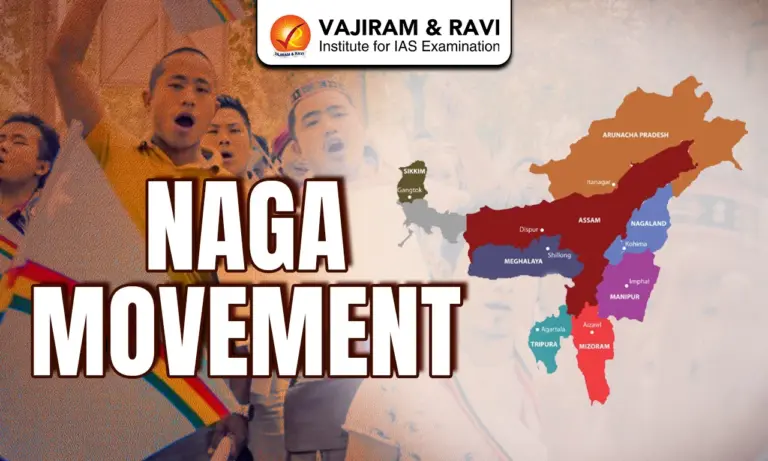
The Naga Movement is a political movement in Northeast India where Naga groups demanded more autonomy and protection of their identity after independence. Over the years, it became an important internal security and peace issue and the government has tried to resolve it through talks and agreements.
About Nagas
- The Nagas are a tribal community mainly living in the hilly and mountainous areas of Northeast India and parts of Myanmar. Their total population is around 2.5 million, with most living in Nagaland and others in Manipur and Arunachal Pradesh.
- They are divided into several major tribes and each tribe has its own name, culture and language. The Nagas are considered an indigenous group of the region and it is generally believed that they belong to the Indo-Mongoloid group who migrated to this area many centuries ago.
Naga Movement History
The history of the Naga Movement can be understood in different phases over time. It began before independence and later developed into an armed struggle after 1947. The main events and developments of the movement are discussed below.
Pre-Independence Phase of the Naga Movement
- The British took control of Assam in 1826, and later, in 1881, the Naga Hills also became part of British India.
- In 1918, Naga leaders formed the Naga Club to unite different Naga tribes and protect their interests. In 1929, the Club submitted a memorandum to the Simon Commission, requesting that Naga areas should not be merged with the rest of India and should be allowed to remain separate.
- In 1946, the Naga Club developed into the Naga National Council (NNC), which aimed at the social and political progress of the Nagas. After the return of Angami Zapu Phizo in 1947, the demand for complete independence became stronger.
- On 14 August 1947, under Phizo’s leadership, the NNC declared Nagaland as an independent state. In 1951, it conducted a referendum claiming support for a sovereign Nagaland.
- Earlier, in June 1947, Assam Governor Sir Akbar Hydari had signed the Nine-Point Agreement with moderate Naga leaders, offering some autonomy. However, Phizo rejected this agreement as he wanted full independence.
Post-Independence Phase & Peace Process
- After independence, the Naga National Council (NNC) started an armed movement in the 1950s demanding sovereignty. In 1952, A.Z. Phizo formed the underground Naga Federal Government (NFG) and its armed wing, the Naga Federal Army (NFA).
- To control the insurgency, the Government of India sent the Army and enacted the Armed Forces (Special Powers) Act (AFSPA) in 1958.
- In 1960, a 16-Point Agreement was signed with moderate Naga leaders, which led to the creation of the state of Nagaland in 1963. However, violence continued. A Peace Mission was started in 1964, but talks failed by 1967.
- Shillong Accord (1975)
- In 1975, the Shillong Accord was signed between the Government of India and a section of NNC leaders. They agreed to give up violence and accept the Indian Constitution.
- However, this agreement was strongly opposed by leaders like Thuingaleng Muivah and Isak Swu. In 1980, they formed the National Socialist Council of Nagaland (NSCN).
- Later, in 1988, the NSCN split into:
- NSCN (IM) led by Isak and Muivah
- NSCN (K) led by Khaplang
- Over time, the NNC became weaker, and NSCN (IM) emerged as the main Naga insurgent group.
- Demand for Greater Nagaland
- Under the leadership of NSCN (IM), many Naga groups demanded the creation of a larger Naga homeland, often called Greater Nagalim.
- One idea was to form a completely independent country that would include present-day Nagaland and all Naga-inhabited areas of Manipur and even parts of Myanmar.
- Another demand was to bring together all Naga-inhabited districts of Manipur and merge them with Nagaland, but within the framework of the Indian Constitution.
- This demand has been a major issue in peace talks because it involves changing state boundaries in the Northeast.





Naga Peace Accord (2015)
The Naga Peace Accord, also called the Framework Agreement, was signed on 3 August 2015 between the Government of India and the NSCN (IM). Its main aim was to end the long-running Naga insurgency and find a peaceful solution to the Naga issue.
- Background & Outcomes: Since 1997, the NSCN (IM) had been in ceasefire and peace talks with the Government of India. After many years of discussions, both sides signed the Framework Agreement in 2015 and the key outcomes are:
- The full details of the agreement were not made public, but some broad ideas were discussed:
- More powers could be given to Nagaland under Article 371(A) of the Constitution.
- NSCN (IM) cadres could be adjusted into a new security force.
- More autonomy could be given to Naga areas in Manipur.
- However, there would be no change in state boundaries (no physical integration of all Naga areas).
- The agreement was only a basic framework. A final detailed settlement is still pending.
- Major Issues in the Peace Talks
- Issue of Sovereignty
- The agreement mentions “sharing sovereign power.”
- NSCN (IM) says this means Nagas should retain some form of sovereignty.
- The Government of India does not accept separate sovereignty.
- Separate Flag and Constitution
- NSCN (IM) demands a separate Naga flag and constitution (Yezabo).
- The Centre has not agreed to this demand.
- Vague Language of the Agreement
- The wording of the Framework Agreement is unclear, leading to different interpretations by both sides.
- Role of Other Naga Groups (NNPGs)
- Smaller Naga groups were also included in talks.
- This created tension, as NSCN (IM) considers itself the main representative of Naga interests.
- Trust Issues
- Differences arose between NSCN (IM) and the government’s interlocutor (R.N. Ravi), leading to a trust deficit.
- Issue of Sovereignty

 Last updated on March, 2026
→ UPSC Final Result 2025 is now out.
→ UPSC has released UPSC Toppers List 2025 with the Civil Services final result on its official website.
→ Anuj Agnihotri secured AIR 1 in the UPSC Civil Services Examination 2025.
→ UPSC Marksheet 2025 is now out.
→ UPSC Notification 2026 & UPSC IFoS Notification 2026 is now out on the official website at upsconline.nic.in.
→ UPSC Calendar 2026 has been released.
→ Check out the latest UPSC Syllabus 2026 here.
→ UPSC Prelims 2026 will be conducted on 24th May, 2026 & UPSC Mains 2026 will be conducted on 21st August 2026.
→ The UPSC Selection Process is of 3 stages-Prelims, Mains and Interview.
→ Prepare effectively with Vajiram & Ravi’s UPSC Prelims Test Series 2026 featuring full-length mock tests, detailed solutions, and performance analysis.
→ Enroll in Vajiram & Ravi’s UPSC Mains Test Series 2026 for structured answer writing practice, expert evaluation, and exam-oriented feedback.
→ Join Vajiram & Ravi’s Best UPSC Mentorship Program for personalized guidance, strategy planning, and one-to-one support from experienced mentors.
→ Shakti Dubey secures AIR 1 in UPSC CSE Exam 2024.
→ Also check Best UPSC Coaching in India
Naga Movement FAQs
Q1. What is the Naga Movement?+
Q2. Who are the Nagas?+
Q3. What was the Shillong Accord (1975)?+
Q4. What is Greater Nagalim?+
Q5. What is the Naga Peace Accord (2015)?+
Tags: internal security Naga Movement