Nalsarovar Bird Sanctuary Latest News
Nalsarovar Bird Sanctuary has recorded over five lakh birds across 200 species in its latest census, a sharp 21% jump from 4.12 lakh in 2024, largely due to the absence of boating, reduced tourist movement, and minimal noise pollution over the past two years.
About Nalsarovar Bird Sanctuary
- It is located approximately 64 km west of Ahmedabad in Gujarat.
- Nal Sarovar literally translates to ‘Tap Lake’.
- It is a natural lake with shallow waters and muddy lagoons, dotted by 36 islets.
- Spread over an area of 120.82 sq.km., this sanctuary is a paradise for bird watchers and nature enthusiasts.
- The history of Nalsarovar dates back to the 15th century, when the lake was created as a result of the construction of a check dam across the Sabarmati River.
- The lake was initially used for irrigation and as a source of drinking water for nearby villages.
- Over time, the lake became an important habitat for a variety of bird species, and local communities recognized its ecological significance.
- In the early 20th century, the British colonial administration recognized the importance of Nalsarovar as a wetland ecosystem and established it as a protected area.
- In 1969, the Gujarat government declared Nalsarovar a bird sanctuary to primarily protect its bird population.
- It was declared as a Ramsar site on 24 September 2012.
- Flora:
- The sanctuary area has 48 species of algae and 72 species of flowering plants.
- The common aquatic plants are Cyperus sp., Scirpus sp., Typha ungustata, Eleocharis palustris, Ruppia, Potamogeton, Vallisnaria, Naias, Chara, etc.
- It also includes locally famous ‘pilu’ trees which harbor a red berry type edible fruit.
- Fauna:
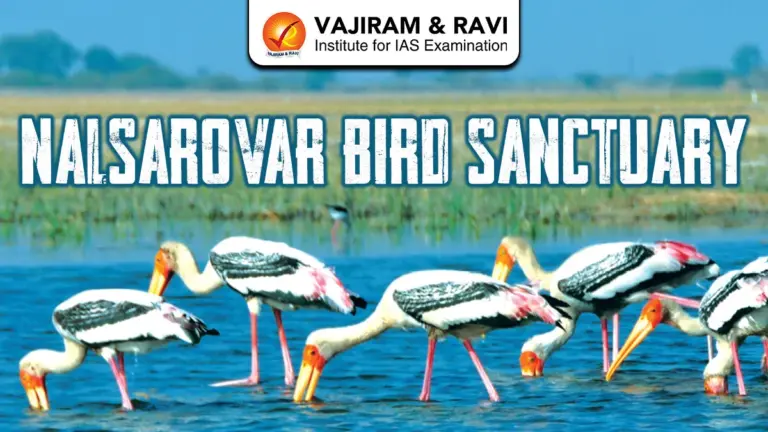
- It’s home to over 250 species of birds, including beautiful migratory birds that travel from places as far away as Europe and Siberia.
- Apart from these, typical species like pelicans, ducks, herons, and storks can be found easily.
- Other animals: On southern or southwestern fringes, small herds of wild ass can be seen. Mongoose, jungle cat, Indian fox, jackal, wolf, and hyena are also there.
Source: TOI






 Last updated on April, 2026
→ UPSC Final Result 2025 is now out.
→ UPSC has released UPSC Toppers List 2025 with the Civil Services final result on its official website.
→ Anuj Agnihotri secured AIR 1 in the UPSC Civil Services Examination 2025.
→ UPSC Marksheet 2025 is now out.
→ UPSC Notification 2026 & UPSC IFoS Notification 2026 is now out on the official website at upsconline.nic.in.
→ UPSC Calendar 2026 has been released.
→ Check out the latest UPSC Syllabus 2026 here.
→ UPSC Prelims 2026 will be conducted on 24th May, 2026 & UPSC Mains 2026 will be conducted on 21st August 2026.
→ The UPSC Selection Process is of 3 stages-Prelims, Mains and Interview.
→ Prepare effectively with Vajiram & Ravi’s UPSC Prelims Test Series 2026 featuring full-length mock tests, detailed solutions, and performance analysis.
→ Enroll in Vajiram & Ravi’s UPSC Mains Test Series 2026 for structured answer writing practice, expert evaluation, and exam-oriented feedback.
→ Join Vajiram & Ravi’s Best UPSC Mentorship Program for personalized guidance, strategy planning, and one-to-one support from experienced mentors.
→ Shakti Dubey secures AIR 1 in UPSC CSE Exam 2024.
→ Also check Best UPSC Coaching in India
Nalsarovar Bird Sanctuary FAQs
Q1. Where is Nalsarovar Bird Sanctuary located?+
Q2. What type of water body is Nalsarovar Bird Sanctuary?+
Q3. When was Nalsarovar designated as a Ramsar site?+
Tags: nalsarovar bird sanctuary prelims pointers upsc current affairs upsc prelims current affairs