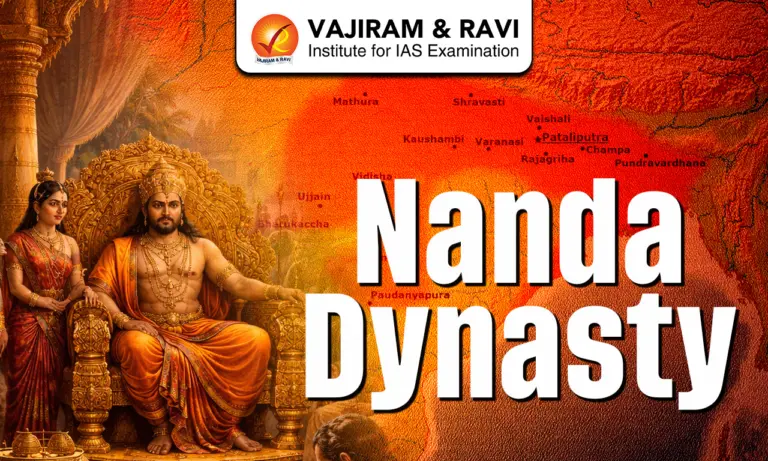
The Nanda Dynasty was one of the most powerful dynasties of ancient India, ruling the kingdom of Magadha between 343 BCE and 321 BCE. It marked a significant phase in Indian history by establishing a strong centralized empire with immense wealth and military strength. The Nandas expanded upon the foundations laid by earlier dynasties and played a key role in the transition toward the rise of the Mauryan Empire.
Nanda Dynasty Origin
The Nanda Dynasty originated in the powerful kingdom of Magadha during the 4th century BCE and marked a major turning point in ancient Indian political history. It came to power after overthrowing the Shishunaga Dynasty, establishing one of the first large and centralized empires in northern India.
- Founded around 343–345 BCE in Magadha.
- Capital city was Pataliputra (modern Patna).
- Founder Mahapadma Nanda is said to be the son of the last Shishunaga ruler and a Shudra woman.
- Considered the first non-Kshatriya dynasty to rule a large empire in India.
- Rise supported by a strong army, efficient taxation system, and centralized administration.
- Mentioned in Buddhist, Jain texts, and Sanskrit literature like Mudrarakshasa.
- Played a key role in unifying northern India, paving the way for the Mauryan Empire.
Founder Mahapadma Nanda
Mahapadma Nanda was the founder of the Nanda Dynasty and is regarded as one of the earliest empire builders in ancient India. He established his rule in Magadha during the 4th century BCE after overthrowing the last ruler of the Shishunaga Dynasty.
- Considered the first powerful ruler who built a large empire in northern India.
- According to the Puranas, he was the son of King Mahanandin and a Shudra woman, indicating a non-Kshatriya origin.
- Known by titles like “Ekarat” (sole ruler) and “Sarva-Kshatriyantaka” (destroyer of Kshatriyas).
- Expanded the empire from Kuru region to the Godavari Valley and up to the Narmada region.
- Ruled for about 28 years, strengthening the political and administrative structure of Magadha.
- Ended the dominance of several traditional ruling families and unified large parts of northern India.
Mahapadma Nanda’s rule laid the strong foundation for a centralized empire, which later influenced the rise of the Mauryan Empire.





Last Ruler Dhana Nanda
Dhana Nanda was the last ruler of the Nanda Dynasty, known for his immense wealth and powerful army in Magadha. However, his harsh policies and heavy taxation made him unpopular, leading to the downfall of the dynasty.
- Known as Agrammes or Xandrames in Greek accounts.
- Inherited a vast treasury, making him one of the richest rulers of ancient India.
- Maintained a massive army:
- 200,000 infantry
- 20,000 cavalry
- 3,000 elephants
- 2,000 chariots
- Ruled during the time of Alexander the Great.
- Introduced a system called Nandos Pakraman (a form of measurement).
- Became unpopular due to heavy taxation and strict governance.
- Faced opposition from both common people and elites.
- Overthrown by Chandragupta Maurya, guided by Chanakya, around 321 BCE.
Administration under the Nanda Dynasty
The administration of the Nanda Dynasty was highly centralized, with the king exercising absolute authority over the empire. Ruling from Pataliputra, the Nandas developed an efficient system of governance that helped them control a vast territory.
- Centralized Monarchy: The king was the supreme authority, often referred to as Ekarat (sole ruler).
- Strong Bureaucracy: Officials were appointed to manage revenue, military, and administration.
- Efficient Tax System: Heavy taxes were collected from agriculture, trade, and professions.
- Unified Empire: As per Puranic sources, the empire was governed as a single political unit rather than small kingdoms.
- Strategic Capital Location: Pataliputra was located near the Ganga and Son rivers, aiding administration and trade.
- Control over Resources: The state maintained strict control over land, trade routes, forests, and elephants.
- Law and Order: Strict rules and punishments ensured stability across the empire.
- Economic Administration: Introduction of currency and systematic revenue collection strengthened governance.
Society and Culture under the Nandas
The society under the Nanda Dynasty saw significant changes, especially with the rise of rulers from a non-Kshatriya background in Magadha. Although the Nandas focused more on administration and expansion, their period influenced social structure and religious developments.
- Social Structure Change: Rise of non-Kshatriya rulers challenged the traditional varna system.
- Low Social Origin of Rulers: The Nandas were often criticized in texts for their Shudra background, leading to opposition from elites.
- Urban Growth: Cities like Pataliputra developed as major political and economic centers.
- Religious Diversity: Coexistence of multiple religions such as Hinduism, Buddhism, Jainism, and Ajivika sect.
- Religious Tolerance: No strong evidence of forced conversions or discrimination among religions.
- Decline of Brahmanical Influence: Reduced royal patronage led to weakening of Vedic Brahmanism.
- Rise of New Religions: Jainism and Buddhism gained importance in the Magadha region.
- Limited Cultural Contributions: Compared to later dynasties, fewer developments in art, architecture, and literature.
- Influence of Ministers: Some officials, like Sthulabhadra, were associated with Jainism, reflecting religious shifts.
Alexandar and Nanda Dynasty
The interaction between Alexander the Great and the Nanda Dynasty is an important episode in ancient Indian history, highlighting the power and reputation of the Nanda rulers, especially Dhana Nanda.
When Alexander invaded north-western India in 326 BCE, the Nanda Empire in Magadha was at its peak under Dhana Nanda. However, Alexander could not advance into the Gangetic plains due to the fear of the massive Nanda army and resistance from his own troops.
- Time Period: Alexander invaded India around 326 BCE, during the rule of Dhana Nanda.
- Extent of Invasion: He conquered regions in north-western India but did not reach Magadha.
- Fear of Nanda Power: Reports of a huge army (lakhs of soldiers, elephants, chariots) discouraged further advance.
- Army Resistance: Alexander’s soldiers refused to march further east beyond the Beas River due to exhaustion and fear.
- Strategic Strength of Nandas: Their strong military and vast resources made them a formidable power.
- Indirect Impact: Although Alexander did not fight the Nandas directly, his invasion weakened north-western regions.
- Opportunity for Mauryas: This situation later helped Chandragupta Maurya rise to power and overthrow the Nandas.
Decline of the Nanda Dynasty
The decline of the Nanda Dynasty was mainly due to its unpopular rule, heavy taxation, and lack of support from both common people and elites. The rulers, especially Dhana Nanda, were seen as harsh and arrogant, which led to widespread dissatisfaction. Taking advantage of this situation, Chandragupta Maurya, guided by Chanakya, organized a revolt against the Nandas. Around 321 BCE, Dhana Nanda was defeated, marking the end of the dynasty and the rise of the Mauryan Empire.

 Last updated on April, 2026
→ UPSC Final Result 2025 is now out.
→ UPSC has released UPSC Toppers List 2025 with the Civil Services final result on its official website.
→ Anuj Agnihotri secured AIR 1 in the UPSC Civil Services Examination 2025.
→ UPSC Marksheet 2025 is now out.
→ UPSC Notification 2026 & UPSC IFoS Notification 2026 is now out on the official website at upsconline.nic.in.
→ UPSC Calendar 2026 has been released.
→ Check out the latest UPSC Syllabus 2026 here.
→ UPSC Prelims 2026 will be conducted on 24th May, 2026 & UPSC Mains 2026 will be conducted on 21st August 2026.
→ The UPSC Selection Process is of 3 stages-Prelims, Mains and Interview.
→ Prepare effectively with Vajiram & Ravi’s UPSC Prelims Test Series 2026 featuring full-length mock tests, detailed solutions, and performance analysis.
→ Enroll in Vajiram & Ravi’s UPSC Mains Test Series 2026 for structured answer writing practice, expert evaluation, and exam-oriented feedback.
→ Join Vajiram & Ravi’s Best UPSC Mentorship Program for personalized guidance, strategy planning, and one-to-one support from experienced mentors.
→ Shakti Dubey secures AIR 1 in UPSC CSE Exam 2024.
→ Also check Best UPSC Coaching in India
Nanda Dynasty FAQs
Q1. Who founded the Nanda Dynasty?+
Q2. Who was the last ruler of the Nanda Dynasty?+
Q3. What was the capital of the Nanda Dynasty?+
Q4. Why was the Nanda Dynasty unpopular?+
Q5. Who defeated the Nanda Dynasty?+
Tags: geography geography notes nanda dynasty