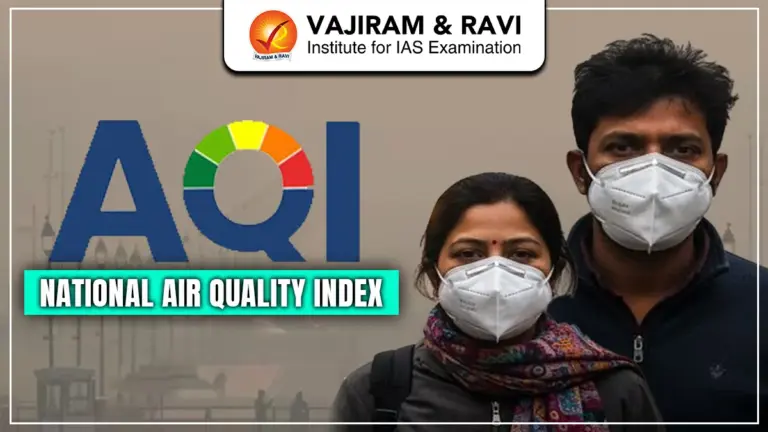
Air pollution has emerged as a major public health and environmental challenge, especially in rapidly urbanising regions. Communicating complex air pollution data to the public in a simple and meaningful manner is essential for awareness, prevention, and policy response. To address this need, an index based system was developed that converts multiple pollutant concentrations into a single understandable number, enabling citizens, administrators, and health agencies to assess air quality conditions quickly and make informed decisions.
National Air Quality Index
The National Air Quality Index is a standardized tool introduced in India to present real time air quality information in an easily interpretable form. It was launched nationally in September 2014 and follows the principle of “one number, one colour, one description” to communicate pollution levels and associated health risks. It integrates scientific monitoring with public communication, supporting clean air initiatives and environmental governance across urban and semi urban regions.
Also Read: Air Pollution
Air Quality Index (AQI)
Air Quality Index is a numerical scale that represents overall air pollution levels by converting measured concentrations of multiple air pollutants into a single value.
- Purpose of AQI: It simplifies large volumes of air quality data into a single index value to improve public understanding and risk communication.
- Health Based Framework: AQI values are linked with epidemiological evidence to reflect potential short term health impacts of pollutant exposure.
- Colour and Category System: Each AQI range is associated with a specific colour and descriptor indicating pollution severity and health concern levels.
- Short Term Exposure Focus: AQI primarily reflects short term exposure risks using 24 hour averages, ensuring relevance for daily public health advisories.
- Global Practice: Different countries adopt AQI systems aligned with their national air quality standards, though pollutants and breakpoints vary.





National Air Quality Index Pollutants
The National Air Quality Index is based on eight key pollutants with established short term National Ambient Air Quality Standards.
- PM 10: Coarse particulate matter below 10 micrometres originates from dust, construction, and natural sources, causing respiratory irritation on prolonged exposure.
- PM 2.5: Fine particulate matter below 2.5 micrometres penetrates deep into lungs and bloodstream, significantly increasing cardiovascular and respiratory disease risks.
- Nitrogen Dioxide (NO₂): Emitted mainly from vehicle exhaust and power plants, it worsens asthma and contributes to ground level ozone formation.
- Sulphur Dioxide (SO₂): Released from coal based power generation and smelting, it irritates airways and contributes to acid deposition.
- Carbon Monoxide (CO): A toxic gas from incomplete fuel combustion that reduces oxygen delivery in the bloodstream, affecting vital organs.
- Ozone (O₃): A secondary pollutant formed by photochemical reactions, causing chest discomfort and lung inflammation during high exposure periods.
- Ammonia (NH₃): Predominantly from agricultural activities, it contributes to secondary particulate formation and respiratory irritation.
- Lead (Pb): A neurotoxic heavy metal affecting cognitive development, especially harmful to children, sourced from smelters and battery manufacturing.
Also Read: Environmental Pollution
National Air Quality Index Range
The National Air Quality Index classifies air quality into six health based categories using numerical ranges and pollutant concentration thresholds.
- Good (0 to 50): Air quality poses minimal health risk, with pollutant concentrations well within national standards.
- Satisfactory (51 to 100): Minor breathing discomfort may occur among unusually sensitive individuals.
- Moderately Polluted (101 to 200): Increased respiratory discomfort observed in children, elderly, and people with lung or heart conditions.
- Poor (201 to 300): Prolonged exposure can cause breathing difficulty and aggravate existing respiratory and cardiovascular diseases.
- Very Poor (301 to 400): Extended exposure significantly increases risk of respiratory illness, particularly in vulnerable populations.
- Severe (401 to 500): Even healthy individuals experience adverse health impacts, while those with existing diseases face serious complications.
National Air Quality Index Calculation
The National Air Quality Index is computed using pollutant wise sub indices derived from monitored concentrations and predefined health breakpoints.
- Sub Index Calculation: Each pollutant’s measured concentration is converted into a sub index using a linear interpolation based on health based breakpoint ranges.
- Worst Pollutant Principle: The highest sub index among all monitored pollutants determines the overall National Air Quality Index value for that location.
- Data Averaging Period: Most pollutants use 24 hour average concentrations, while carbon monoxide and ozone use 8 hour average values.
- Minimum Data Requirement: AQI is calculated only when data for at least three pollutants is available, including either PM 2.5 or PM 10 compulsorily.
- Real Time Dissemination: Continuous monitoring stations generate AQI automatically using running averages without manual intervention.
- Manual Monitoring Support: An AQI calculator allows manual data entry for locations lacking continuous analysers to generate standardized AQI values.
National Air Quality Index Limitation
Despite its effectiveness, the National Air Quality Index has technical and operational limitations affecting accuracy and continuity.
- Sensor Dependency: AQI accuracy depends on analyser calibration, sensor reliability, and uninterrupted power supply at monitoring stations.
- Data Gaps: Power outages, internet failures, and maintenance issues can disrupt continuous data transmission and AQI dissemination.
- Preliminary Data Use: Real time AQI uses raw analyser data without validation, making it unsuitable for regulatory or legal enforcement.
- Limited Coverage: Continuous real time monitoring is operational only in selected cities, leaving many regions dependent on manual stations.
- Pollutant Exclusion: Several harmful air pollutants lack defined AQI sub indices and are therefore excluded from public reporting.

 Last updated on March, 2026
→ UPSC Final Result 2025 is now out.
→ UPSC has released UPSC Toppers List 2025 with the Civil Services final result on its official website.
→ Anuj Agnihotri secured AIR 1 in the UPSC Civil Services Examination 2025.
→ UPSC Marksheet 2025 is now out.
→ UPSC Notification 2026 & UPSC IFoS Notification 2026 is now out on the official website at upsconline.nic.in.
→ UPSC Calendar 2026 has been released.
→ Check out the latest UPSC Syllabus 2026 here.
→ UPSC Prelims 2026 will be conducted on 24th May, 2026 & UPSC Mains 2026 will be conducted on 21st August 2026.
→ The UPSC Selection Process is of 3 stages-Prelims, Mains and Interview.
→ Prepare effectively with Vajiram & Ravi’s UPSC Prelims Test Series 2026 featuring full-length mock tests, detailed solutions, and performance analysis.
→ Enroll in Vajiram & Ravi’s UPSC Mains Test Series 2026 for structured answer writing practice, expert evaluation, and exam-oriented feedback.
→ Join Vajiram & Ravi’s Best UPSC Mentorship Program for personalized guidance, strategy planning, and one-to-one support from experienced mentors.
→ Shakti Dubey secures AIR 1 in UPSC CSE Exam 2024.
→ Also check Best UPSC Coaching in India
National Air Quality Index FAQs
Q1. What is the National Air Quality Index?+
Q2. When was the National Air Quality Index launched in India?+
Q3. How many pollutants are included in the National Air Quality Index?+
Q4. Which pollutant decides the final AQI value?+
Q5. Is National Air Quality Index data used for legal action?+
Tags: national air quality index