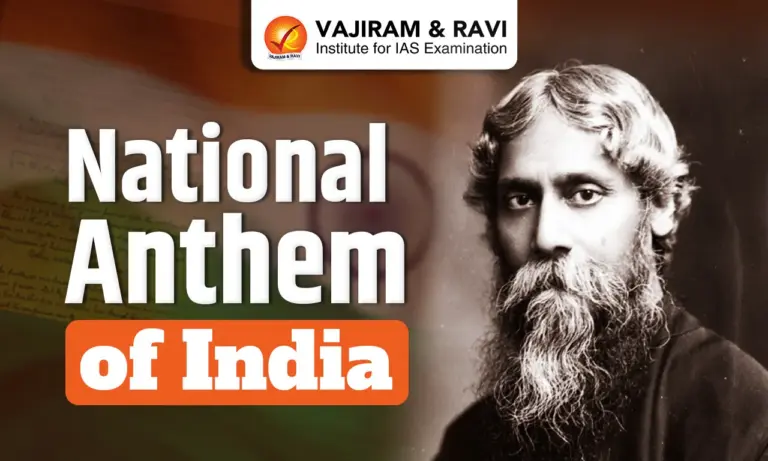
The National Anthem of India, Jana Gana Mana, holds a deep place in the nation’s collective consciousness. It stands not merely as a song but as a symbol of unity, diversity, national identity and respect for our democracy. Adopted officially on 24 January 1950, the anthem is more than lyrics and melody: it reflects India’s plural heritage, cultural unity, and aspirations.
National Anthem of India
The National Anthem of India is the first stanza (and lines) of the larger hymn titled Bharoto Bhagyo Bidhata, composed by Rabindranath Tagore on December 11, 1911. The words are in highly Sanskritised Bengali, and the official Hindi version is used for national purposes.
The anthem celebrates India’s geographical spread, cultural diversity, and spiritual unity by invoking the names of regions, rivers and mountains. It is meant to be sung standing, with respect, and evokes a sense of national pride. Also official government documentation lists how and when it must be played or sung.
National Anthem of India Historical Background
The National Anthem of India, Jana Gana Mana, reflects unity, pride, and patriotism, evolving through history and legal recognition.
- Composition and Origin
- Composed by Rabindranath Tagore in Bengali on December 11, 1911.
- It was part of a five-stanza Brahmo hymn titled “Bharoto Bhagyo Bidhata”
- It was first sung at the Indian National Congress session in Calcutta, performed by Tagore’s niece, Sarala Devi Chowdhurani, and other students on December 27, 1911.
- Official Adoption
- Adopted as the National Anthem on January 24, 1950, by the Constituent Assembly after independence.
- The anthem’s authorized Hindi version retains Tagore’s poetic essence.
- The duration is officially fixed at 52 seconds when sung in full.
- Legal and Constitutional Recognition
- Governed under the Prevention of Insults to National Honour Act, 1971, ensuring respect for the anthem.
- Violations such as mocking or disrupting its performance attract legal consequences.
- National Anthem in Cinemas (Supreme Court Directive)
- In November 2016, the Supreme Court mandated the playing of the anthem before all movie screenings.
- The rule aimed to instill respect and unity among citizens.
- In January 2018, the Court revised the order, making the practice optional, but urged audiences to stand as a mark of respect.





National Anthem of India Lyrics
The official lyrics of the National Anthem of India consist of the first stanza of Jana Gana Mana composed by Rabindranath Tagore.
Full version (52 seconds):
“Jana-gana-mana-adhinayaka jaya hey, Bharata-bhagya-vidhata;
Panjaba-Sindhu-Gujarata-Maratha, Dravida-Utkala-Banga;
Vindhya-Himachala-Yamuna-Ganga, Ucchala-Jaladhi-Taranga;
Tava Shubha Name Jage, Tava Shubha Ashisa Mage, Gahe Tava Jaya-Gatha;
Jana-gana-mangala-dayaka jaya hey, Bharata-bhagya-vidhata;
Jaya hey, Jaya hey, Jaya hey, Jaya Jaya Jaya Jaya hey.”
Short version (for selected occasions, 20 seconds):
“Jana-gana-mana-adhinayaka jaya hey,
Bharata-bhagya-vidhata;
Jaya hey, Jaya hey, Jaya hey, Jaya Jaya Jaya Jaya hey.”
National Anthem of India Meaning
The lyrics of ‘Jana Gana Mana’ contain deep meaning and symbolism. The first stanza refers to India (Bharat) by invoking different regions (Punjab, Sindh, Gujarat, Maratha, Dravid, Utkala) and physical features (Vindhya, Himachal, Yamuna, Ganga, waves of the sea).
The National Anthem of India addresses “Thou art the Ruler of the Minds of all people, Thou Dispenser of India’s Destiny”. It acknowledges the varied regions and peoples of India and unites them in one expression of hope, destiny and victory. Language Features of National Anthem of India:
- The song was originally written in the Bengali language in a highly Sanskritized dialect (Sadhu Bhasha), giving it a pan-Indian tone rather than being regional.
- Every state and region is explicitly mentioned, signifying unity in diversity.
- Musical composition: The melody is based on the Hindustani classical raga Alhaiya Bilaval.
National Anthem of India Code of Conduct
The Government of India has laid down clear guidelines for performing the national anthem to ensure respect and decorum.
- Everyone present must stand at attention when the anthem is sung or played.
- The anthem may be sung in any location- indoors or outdoors, but it must be the original version without any addition or omission.
- The full version (~52 seconds) is played at formal state occasions; a shorter version (~20 seconds) may be used for other events.
- It should not be used for commercial purposes or mis-appropriated so as to demean its dignity.
National Anthem of India Case Laws
The National Anthem of India has been the subject of several important judicial interpretations that define the duties, rights, and limits of citizens concerning respect and freedom of expression. Indian courts have consistently emphasized that showing respect to the National Anthem is a constitutional duty under Article 51A(a), yet individuals cannot be forced to participate in ways that violate personal beliefs or freedoms.
- Bijoe Emmanuel vs. State of Kerala (1986)
- Three school students belonging to the Jehovah’s Witnesses faith were expelled for not singing the National Anthem, though they stood respectfully during it.
- The Supreme Court ruled in their favor, holding that freedom of conscience and religion (Article 25) protects individuals from being compelled to sing the anthem.
- The Court clarified that standing in respect is sufficient and that refusal to sing does not amount to disrespect.
- Shyam Narayan Chouksey vs. Union of India (2016-2018)
- A petition sought mandatory playing of the anthem in cinema halls before every movie screening.
- In 2016, the Supreme Court directed all theaters to play the National Anthem and required the audience to stand in respect.
- However, in 2018, the Court modified its order, making it optional and allowing the government to frame suitable guidelines instead.
- The judgement emphasized voluntary patriotism over enforced nationalism.
National Anthem of India Significance
The cultural and political significance of the National Anthem of India has been discussed below:
- Unity, Diversity and Identity: The national anthem is a powerful expression of India’s unity in diversity: by referencing every major geographical and cultural region, it highlights that though Indians differ in language, faith and region, they share a single national identity.
- Freedom Movement & Symbolism: While Vande Mataram played a key role during India’s freedom struggle, Jana Gana Mana became an inclusive anthem suited for a plural nation. The anthem is played at schools, stadiums, public events and international forums, reinforcing national pride.
- International Use: The Indian anthem is used at international sporting events, diplomatic ceremonies and missions abroad to signal India’s identity. For example, Indian embassies use the anthem in their pages and videos.
- Symbol of Sovereignty: The anthem embodies India’s independence, Constitution and democratic identity.
- Nation-Building Tool: It fosters respect for national symbols and creates a shared sense of belonging.
- Cultural Soft Power: At global events, the anthem projects India’s identity and values.
- Educational Role: At schools and institutions, it serves as a daily reminder of civic responsibility.
National Anthem of India Criticism
In contemporary India, National Anthem of India faces several backlashes for:
- Inclusivity and Representation: Though the anthem explicitly mentions many regions, the reference to Sindh (now in Pakistan) is sometimes discussed in debates. Yet the anthem continues to be seen as all-India inclusive.
- Obligatory Nature and Debate: Recent government directives in states (e.g., Rajasthan) mandating anthem singing in schools stirred debate on balance between patriotism, freedom and discipline.
- Digital Age Usage: The anthem is used widely online, in videos and social media, raising questions about proper use, copyright, and respect. Official portals provide authorized versions for download.
National Anthem of India Status in Present Day
The National Anthem of India continues to be deeply relevant in India’s evolving context. With digital media, mass participation campaigns and usage at global events, Jana Gana Mana remains a living symbol of national cohesion. In 2023-24, over millions of students in schools across India sang the anthem every morning.
Amid social change, the anthem keeps reminding us of our collective identity and the values of the Indian Republic. It remains central to public ceremonies, educational rituals and national expressions. The Government of India launched campaigns encouraging mass singing of the national anthem. For example, in 2020 the Ministry of Culture invited citizens to sing Jana Gana Mana together, which broke records and galvanized national sentiment.
National Anthem of India UPSC
The National Anthem of India, Jana Gana Mana, is far more than a melody; it is the voice of the nation. It encapsulates India’s diversity, history, aspirations and unity in one elegant hymn. From its origin in 1911 to formal adoption in 1950, from classrooms to stadiums, the anthem remains a unifying force for over a billion Indians. As India marches ahead into the future, the anthem will continue to echo in our hearts, inspiring respect, patriotism and pride.

 Last updated on March, 2026
→ UPSC Final Result 2025 is now out.
→ UPSC has released UPSC Toppers List 2025 with the Civil Services final result on its official website.
→ Anuj Agnihotri secured AIR 1 in the UPSC Civil Services Examination 2025.
→ UPSC Marksheet 2025 is now out.
→ UPSC Notification 2026 & UPSC IFoS Notification 2026 is now out on the official website at upsconline.nic.in.
→ UPSC Calendar 2026 has been released.
→ Check out the latest UPSC Syllabus 2026 here.
→ UPSC Prelims 2026 will be conducted on 24th May, 2026 & UPSC Mains 2026 will be conducted on 21st August 2026.
→ The UPSC Selection Process is of 3 stages-Prelims, Mains and Interview.
→ Prepare effectively with Vajiram & Ravi’s UPSC Prelims Test Series 2026 featuring full-length mock tests, detailed solutions, and performance analysis.
→ Enroll in Vajiram & Ravi’s UPSC Mains Test Series 2026 for structured answer writing practice, expert evaluation, and exam-oriented feedback.
→ Join Vajiram & Ravi’s Best UPSC Mentorship Program for personalized guidance, strategy planning, and one-to-one support from experienced mentors.
→ Shakti Dubey secures AIR 1 in UPSC CSE Exam 2024.
→ Also check Best UPSC Coaching in India
National Anthem of India FAQs
Q1. When was the National Anthem of India Jana Gana Mana composed and by whom? +
Q2. When was it officially adopted as the National Anthem of India? +
Q3. What is the duration of the full National Anthem of India? +
Q4. What is the language of the National Anthem of India? +
Q5. On what occasions is the full version of National Anthem of India played? +
Tags: national anthem of india