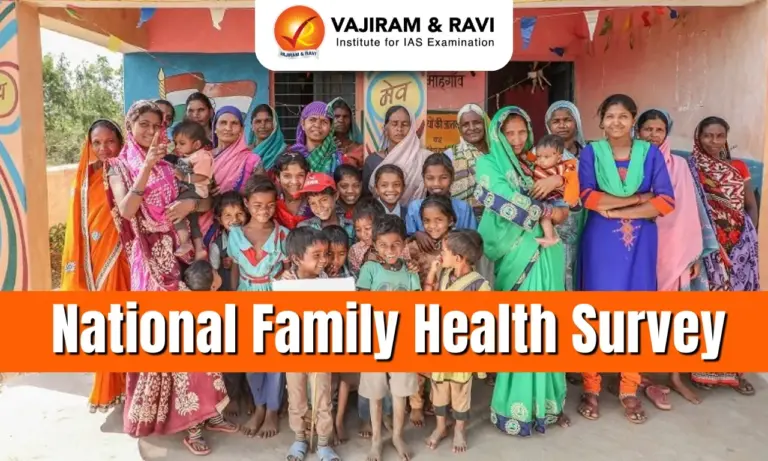
The National Family Health Survey (NFHS) is India’s most comprehensive and regularly conducted household survey that provides reliable, comparable and large scale data on population, health and nutrition indicators. Conducted by the Ministry of Health and Family Welfare with the International Institute for Population Sciences as the nodal agency, NFHS tracks fertility, mortality, family planning, maternal and child health, nutrition and emerging health issues. Since its launch in 1992, NFHS has become a critical evidence base for policy formulation, programme evaluation and monitoring of national and global development goals across states and districts in India.
National Family Health Survey Objectives
The National Family Health Survey aims to generate high quality, comparable health and demographic data to support evidence based policymaking and programme evaluation.
- Policy Support: NFHS provides updated fertility, mortality and health indicators to guide national and state level health and family welfare policies effectively.
- Programme Monitoring: The survey measures the reach and impact of government programmes like institutional delivery, immunization and nutrition initiatives over time.
- Equity Assessment: NFHS data helps identify regional, gender, caste and wealth based disparities in health outcomes across India.
- Emerging Issues: Each round introduces new topics such as disability, death registration, or nutrition risks to address changing public health priorities.
- Trend Analysis: Comparable multi round data allows tracking long term changes in population dynamics, fertility decline and child survival indicators.
National Family Health Survey Historical Background
The National Family Health Survey evolved over three decades, expanding scope, methodology and scale to reflect India’s changing health priorities.
- Launch in 1992-93: NFHS began as India’s first DHS linked survey to generate nationally comparable data on fertility, mortality and family planning.
- Early Expansion (1998-99): NFHS-2 broadened focus to reproductive health quality, women’s autonomy and domestic violence, reflecting social dimensions of health.
- Gender Inclusion (2005-06): NFHS-3 introduced men’s questionnaires, recognizing male roles in contraception, maternal care and reproductive decision making.
- District Level Shift (2015-16): NFHS-4 expanded sample size six-fold, enabling district estimates and transforming NFHS into a planning tool for local governance.
- Digital Transformation: Tablet based CAPI data collection replaced paper forms, improving speed, accuracy and real time quality checks nationwide.
- New Health Domains (2019-21): NFHS-5 added disability and death registration indicators, aligning survey outputs with SDGs and MPI requirements.





National Family Health Survey List
Successive NFHS rounds document India’s demographic transition, improved service coverage and persistent regional and social health disparities.
- NFHS-1 (1992-93): Established baseline data on fertility, infant mortality and contraception, covering around 88,000 households across major states.
- Highlighted high fertility and low contraceptive use in several northern and central states.
- Provided first nationally comparable maternal and child health indicators.
- NFHS-2 (1998-99): Captured improvements in family planning uptake and maternal care access since the early 1990s.
- Identified wide interstate gaps in immunization and antenatal care.
- Documented early evidence of declining fertility in southern and western India.
- NFHS-3 (2005-06): Revealed accelerated fertility decline and improved child survival outcomes nationwide.
- Reported rising institutional deliveries linked to expanding public health programmes.
- Introduced data on domestic violence and HIV awareness.
- NFHS-4 (2015-16): Provided district level benchmarks for nutrition, sanitation and maternal health indicators.
- Showed sharp increase in toilet access following sanitation drives.
- Identified persistent stunting and undernutrition among children in poorer districts.
- NFHS-5 (2019-21): Marked achievement of replacement level fertility with TFR at 2.0 children per woman.
- Recorded institutional births at 88.6 percent and full immunization at 76.6 percent.
- Showed declines in neonatal, infant and under five mortality across most states.
- NFHS-6 (2023-24): Designed to track post pandemic recovery and long term health transitions at district level.
- Focuses on fertility, mortality and service utilization trends over time.
- Removes anaemia biomarkers to address measurement concerns and methodological debates
National Family Health Survey-6
NFHS-6, conducted during 2023-24, represents a new phase with full national ownership and refined survey design.
- Implementation: NFHS-6 is conducted entirely under the Ministry of Health and Family Welfare, funded solely by the Government of India.
- Nodal Agency: For the first time, the International Institute for Population Sciences, Mumbai, independently coordinated all survey activities.
- Coverage: Like previous rounds, NFHS-6 provides national and district level estimates on fertility, mortality and family welfare indicators.
- Questionnaire Changes: Questions on anaemia biomarkers and disability have been removed following measurement controversies and expert recommendations.
- Data Status: While fieldwork is complete, NFHS-6 results are awaited, though questionnaires have been released publicly.
National Family Health Survey Process
The NFHS follows a rigorous, scientifically designed process to ensure representative, reliable and comparable health data.
- Sampling Design: NFHS uses multi stage stratified sampling, selecting villages and urban blocks through probability-proportional-to-size methods.
- Household Selection: From each selected cluster, 22 households are randomly chosen to ensure equal selection probability.
- Survey Teams: Each team includes female and male interviewers, health investigators for biomarker data and a supervisor for quality checks.
- Digital Data Collection: Since NFHS-4, data is collected using Computer Assisted Personal Interviewing on tablets, reducing manual errors.
- Questionnaires: Separate household, women’s, men’s and biomarker questionnaires capture socio-economic, reproductive and health information.
- Scale: NFHS-5 covered over 600,000 households, 700,000 women aged 15-49 and 100,000 men aged 15-54 across India.
National Family Health Survey Criticism
Despite its scale and importance, NFHS data has faced methodological and interpretation related criticisms from experts.
- Sample Size Issues: Expansion in NFHS-4 raised concerns about comparability with earlier rounds and potential non sampling errors.
- Sex Ratio Findings: NFHS-5 reported 1,020 females per 1,000 males, conflicting with census projections and NSS estimates.
- Immunization Fluctuations: Unexplained variations in vaccination coverage and zero-dose children suggest possible data quality issues.
- Anaemia Measurement: Use of capillary blood samples may overestimate anaemia prevalence compared to venous sampling methods.
- Interview Duration: Faster interviews by private agencies have raised concerns, though digital tools and skip patterns may explain reduced time

 Last updated on April, 2026
→ UPSC Final Result 2025 is now out.
→ UPSC has released UPSC Toppers List 2025 with the Civil Services final result on its official website.
→ Anuj Agnihotri secured AIR 1 in the UPSC Civil Services Examination 2025.
→ UPSC Marksheet 2025 is now out.
→ UPSC Notification 2026 & UPSC IFoS Notification 2026 is now out on the official website at upsconline.nic.in.
→ UPSC Calendar 2026 has been released.
→ Check out the latest UPSC Syllabus 2026 here.
→ UPSC Prelims 2026 will be conducted on 24th May, 2026 & UPSC Mains 2026 will be conducted on 21st August 2026.
→ The UPSC Selection Process is of 3 stages-Prelims, Mains and Interview.
→ Prepare effectively with Vajiram & Ravi’s UPSC Prelims Test Series 2026 featuring full-length mock tests, detailed solutions, and performance analysis.
→ Enroll in Vajiram & Ravi’s UPSC Mains Test Series 2026 for structured answer writing practice, expert evaluation, and exam-oriented feedback.
→ Join Vajiram & Ravi’s Best UPSC Mentorship Program for personalized guidance, strategy planning, and one-to-one support from experienced mentors.
→ Shakti Dubey secures AIR 1 in UPSC CSE Exam 2024.
→ Also check Best UPSC Coaching in India
National Family Health Survey FAQs
Q1. What is the National Family Health Survey (NFHS)?+
Q2. Which institution conducts the National Family Health Survey?+
Q3. When was the first National Family Health Survey conducted?+
Q4. What is the importance of National Family Health Survey data?+
Q5. Which is the latest round of the National Family Health Survey?+
Tags: national family health survey