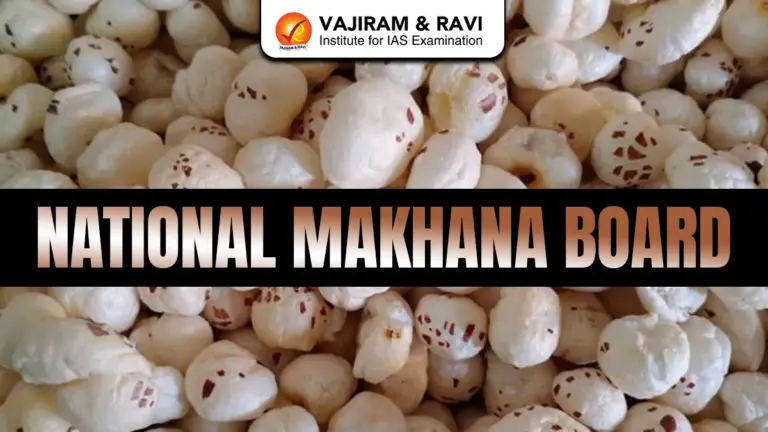
The National Makhana Board marks a significant institutional step to strengthen India’s makhana sector, a traditional aquatic crop deeply rooted in eastern India. Makhana, botanically known as Euryale ferox, is grown in freshwater ponds and wetlands and is popularly called the “Black Diamond” in its raw form. Bihar produces nearly 90% of India’s makhana, with Mithila Makhana receiving a Geographical Indication tag in 2022. Makhana being nutritionally rich, culturally significant, and economically vital, supports thousands of small farmers, especially the Mallah Community, making it a strategic crop for inclusive rural development.
National Makhana Board
The National Makhana Board was inaugurated by Prime Minister Narendra Modi in Purnea, Bihar, on 15 September 2025, following the announcement in the Union Budget 2025-26. Headquartered in Purnea, the Board has been established with a government-approved development package of Rs 476.03 crore. Its core mandate is to strengthen production, processing, value addition, and exports of makhana across India, with special emphasis on Bihar, which cultivates makhana over nearly 15,000 hectares and produces about 10,000 tonnes of popped makhana annually. The Board aims to correct regional imbalances, as major exports currently occur from states with better processing and logistics infrastructure rather than from production hubs.
National Makhana Board Objectives
The National Makhana Board aims to modernize makhana cultivation, improve farmer incomes, and establish India as a global hub for premium fox nut production.
- Raise production standards through improved cultivation practices
- Promote adoption of high-yield varieties like Swarna Vaidehi and Sabour Makhana-1
- Improve post-harvest management to reduce losses
- Encourage value addition through processing and packaging
- Build strong domestic and international marketing and export linkages
- Support farmer-producer organizations and cooperatives
- Facilitate access to government schemes and institutional credit





National Makhana Board Features
The National Makhana Board integrates agriculture, food processing, exports, and rural livelihoods through a focused institutional framework.
- Rs 475 crore development package for sector-wide growth
- Headquarters in Purnea, close to major production clusters
- Emphasis on research, innovation, and technology transfer
- Promotion of mechanization in harvesting and processing
- Development of national branding for Indian and Mithila Makhana
- Public-private partnerships in processing, logistics, and exports
- Alignment with GI-tagged Mithila Makhana for quality assurance
National Makhana Board Impact
The National Makhana Board is expected to generate economic, social, and regional development benefits, especially for Bihar and eastern India. The establishment is expected to result in:
- Enhanced farmer incomes through better pricing and reduced intermediaries
- Socio-economic upliftment of the Mallah community traditionally engaged in makhana cultivation
- Market expansion for GI-tagged Mithila Makhana as a premium global product
- Improved productivity through better seeds and cultivation methods
- Growth of food processing and agri-export infrastructure in Bihar
- Reduction in regional disparity as exports shift closer to production zones
- Employment generation across farming, processing, packaging, and logistics
National Makhana Board Challenges
Despite its potential, the National Makhana Board faces structural and operational challenges that must be addressed for long-term success.
- Low productivity due to labor-intensive traditional farming practices
- Slow adoption of high-yield and improved seed varieties
- Limited local processing and grading units in Bihar
- Inadequate cargo facilities and export hubs near production areas
- Dependence on other states for large-scale processing and exports
- Fragmented landholdings and small farmer capacity constraints
- Need for sustainable wetland management amid climate pressures
National Makhana Board Recent Developments
National Makhana Board held its first meeting in New Delhi, starting nationwide plans for scientific, market-linked growth of the makhana sector. The key highlights of this meeting are:
- Meeting chaired by Agriculture Secretary Dr Devesh Chaturvedi at Krishi Bhawan to operationalize the Board and central scheme.
- States and research bodies presented annual plans; budgets were approved for research, training, infrastructure and market development.
- Seed needs of states will be pooled and supplied by SAU Sabour and CAU Samastipur, Bihar for current and next seasons.
- Focus areas include better farming techniques, grading, drying, popping, packaging, branding, value addition and export readiness.
- The meeting created a clear roadmap for coordinated, science-based and income-focused expansion of makhana cultivation across India.

 Last updated on March, 2026
→ UPSC Final Result 2025 is now out.
→ UPSC has released UPSC Toppers List 2025 with the Civil Services final result on its official website.
→ Anuj Agnihotri secured AIR 1 in the UPSC Civil Services Examination 2025.
→ UPSC Marksheet 2025 is now out.
→ UPSC Notification 2026 & UPSC IFoS Notification 2026 is now out on the official website at upsconline.nic.in.
→ UPSC Calendar 2026 has been released.
→ Check out the latest UPSC Syllabus 2026 here.
→ UPSC Prelims 2026 will be conducted on 24th May, 2026 & UPSC Mains 2026 will be conducted on 21st August 2026.
→ The UPSC Selection Process is of 3 stages-Prelims, Mains and Interview.
→ Prepare effectively with Vajiram & Ravi’s UPSC Prelims Test Series 2026 featuring full-length mock tests, detailed solutions, and performance analysis.
→ Enroll in Vajiram & Ravi’s UPSC Mains Test Series 2026 for structured answer writing practice, expert evaluation, and exam-oriented feedback.
→ Join Vajiram & Ravi’s Best UPSC Mentorship Program for personalized guidance, strategy planning, and one-to-one support from experienced mentors.
→ Shakti Dubey secures AIR 1 in UPSC CSE Exam 2024.
→ Also check Best UPSC Coaching in India
National Makhana Board FAQs
Q1. What is the National Makhana Board?+
Q2. When and where was the National Makhana Board inaugurated?+
Q3. Why is Bihar central to the National Makhana Board?+
Q4. What financial support is provided to the Board?+
Q5. How will the National Makhana Board benefit farmers?+
Tags: national makhana board