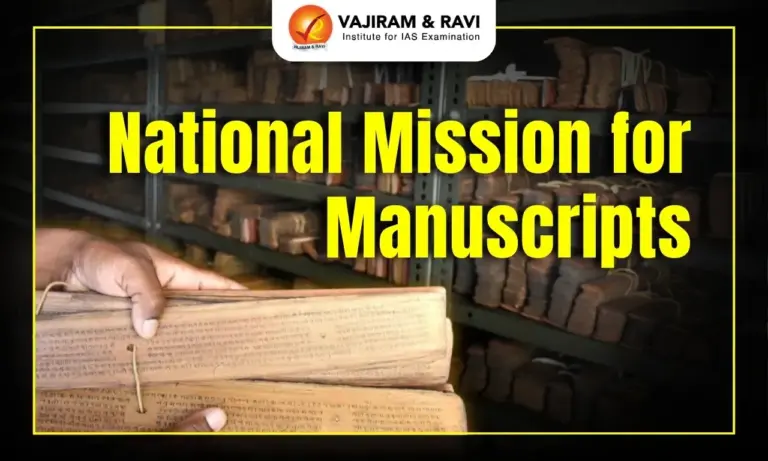
National Mission for Manuscripts is a union government initiative which is renamed as Gyan Bharatam Mission for the period 2024-2031 with a total budget of ₹482.85 crores. The mission is dedicated to the documentation, digitization, and promotion of Indian manuscripts, ensuring their preservation and accessibility. Keep reading the article to know the objectives, key features, significance, and achievements in safeguarding India’s rich cultural heritage.
National Mission for Manuscripts Overview
To preserve the manuscript heritage in India as they hold cultural heritage, the Government of India has introduced the National Mission for Manuscripts (NMM). The initiative was launched to safeguard the textual tradition in India by documenting and digitizing manuscripts across India. Check out the table below, National Mission for Manuscripts Overview to get the insights regarding the initiative:
|
National Mission for Manuscripts Overview |
|
|
Restructured As |
Gyan Bharatam Mission |
|
Established |
2003 (Restructured in 2025) |
|
Ministry |
Ministry of Culture, Government of India |
|
Nodal Agency |
Indira Gandhi National Centre for the Arts (IGNCA) |
|
Objectives |
Survey and Documentation, Conservation and Preservation, Digitization, Publication and Research, Capacity Building, Outreach and Awareness |
|
Period |
2024-31 |
|
Budget |
₹482.85 crores |
|
Manuscript Estimates |
Approximately 10 million manuscripts in India, covering various themes, languages, and scripts |
|
Conservation Centers |
49 Manuscript Conservation Centers (MCCs) across the country |
|
Resource Centers |
54 Manuscript Resource Centers (MRCs) |
|
Significance |
Aims to connect India’s past with its future by preserving its rich manuscript heritage |
National Mission for Manuscripts Features
The National Mission for Manuscripts (NMM) was established in February 2003, has been restructured as the “Gyan Bharatam Mission” for the period 2024-2031.
- For the period decided, the mission has a budget of ₹482.85 crore aiming to enhance its efforts in manuscript digitization, conservation, and public outreach.
- Key focus areas include the digitization of rare and fragile manuscripts ensuring their preservation.
- Significant contributions are planned in states like Uttar Pradesh through documentation, conservation workshops, and research collaborations.
- The mission also emphasizes collaboration with educational institutions, libraries, and researchers.





National Mission for Manuscripts Objectives
The National Mission for Manuscripts (NMM) is introduced to preserve rich manuscript heritage of India through its key objectives:
- Conducting nationwide surveys to identify and register manuscripts, ensuring better conservation and public access.
- Using scientific preservation techniques to preserve manuscripts for future generations.
- Developing a National Digital Manuscripts Library to provide online access for scholars and the public.
- Promoting research and publication of unpublished manuscripts, encouraging advanced studies in manuscriptology.
- Offering training programs in manuscriptology and conservation to nurture a new generation of experts.
- Organizing exhibitions and outreach initiatives to enhance public interest and appreciation of India’s manuscript heritage.
Indian Manuscripts Significance
Indian Manuscripts offer valuable insights of the country’s cultural, historical, and scholarly heritage. They reflect ancient traditions, document key historical events, and serve as primary sources for research in fields like literature, religion, and art. Other than preservation of the languages, these manuscripts also support interdisciplinary studies, contributing to a deeper understanding of India’s civilization and its enriching legacy.
National Mission for Manuscripts Achievements
The National Mission for Manuscripts (NMM) has made remarkable progress in preserving the manuscript heritage of India. Key National Mission for Manuscripts Achievements include:
- Over 5.2 million manuscripts have been documented across the country.
- Collaboration with institutions has led to the establishment of Manuscript Resource Centers (MRCs) and Manuscript Conservation Centers (MCCs) in various states.
- Approximately 3.5 lakh manuscripts have been digitized, with ongoing efforts to expand digital access.
- Specialized training programs have equipped scholars and archivists with expertise in manuscript conservation.
- More than 1,35,000 manuscripts are now available online, offering free access to researchers and the public.

 Last updated on April, 2026
→ UPSC Final Result 2025 is now out.
→ UPSC has released UPSC Toppers List 2025 with the Civil Services final result on its official website.
→ Anuj Agnihotri secured AIR 1 in the UPSC Civil Services Examination 2025.
→ UPSC Marksheet 2025 is now out.
→ UPSC Notification 2026 & UPSC IFoS Notification 2026 is now out on the official website at upsconline.nic.in.
→ UPSC Calendar 2026 has been released.
→ Check out the latest UPSC Syllabus 2026 here.
→ UPSC Prelims 2026 will be conducted on 24th May, 2026 & UPSC Mains 2026 will be conducted on 21st August 2026.
→ The UPSC Selection Process is of 3 stages-Prelims, Mains and Interview.
→ Prepare effectively with Vajiram & Ravi’s UPSC Prelims Test Series 2026 featuring full-length mock tests, detailed solutions, and performance analysis.
→ Enroll in Vajiram & Ravi’s UPSC Mains Test Series 2026 for structured answer writing practice, expert evaluation, and exam-oriented feedback.
→ Join Vajiram & Ravi’s Best UPSC Mentorship Program for personalized guidance, strategy planning, and one-to-one support from experienced mentors.
→ Shakti Dubey secures AIR 1 in UPSC CSE Exam 2024.
→ Also check Best UPSC Coaching in India
National Mission for Manuscripts FAQs
Q1. What is the role of the National Mission for Manuscripts?+
Q2. Which ministry has the National Mission for Manuscripts?+
Q3. What are manuscripts in UPSC?+
Q4. What is the mission of manuscript conservation?+
Q5. What is the purpose of a manuscript?+
Tags: National Mission for Manuscripts