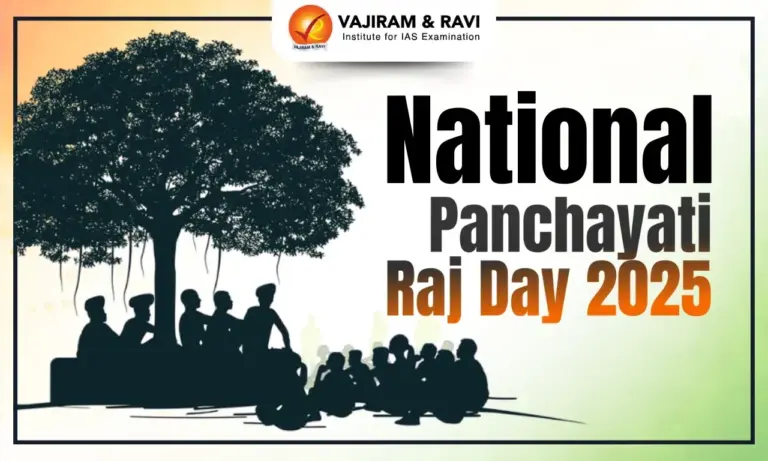
National Panchayati Raj Day 2025 is celebrated on 24th April every year all over India. The day is observed to spread awareness about the establishment of Panchayati Raj Institution in India. The day is celebrated by spreading grassroots democracy, strengthening local governance and empowering rural communities. In this article, we are going to cover about the national panchayati raj day, its importance and celebrations.
National Panchayati Raj Day 2025
National Panchayati Raj Day is celebrated every year on 24th April, embarking the enactment of 73rd Constitutional Amendment Act 1993. The act provides constitutional status to the Panchayati Raj system in India and the government and various other organisations celebrate the day to spread awareness about local governance.
|
Overview of National Panchayati Raj Day 2025 |
|
|
Date |
24th April 2025 |
|
Organized by |
Ministry of Panchayati Raj |
|
Theme |
Yet to be announced by the Ministry |
|
History |
The then PM of India declared this date as the National Panchayati Raj Day in 2010 |
|
Significance |
Marks the enactment of the 73rd Constitutional Amendment Act |
|
Awards |
National Panchayat Awards |
|
Celebrations |
Award ceremonies, workshops, seminars, and interactions between Panchayat members and national leaders. |
Panchayati Raj System in India Evolution
The Panchayati Raj System in India has evolved from ancient times to the present times. Here is the chronological order of how the Evolution of Panchayati Raj System in India has taken place:
|
Period |
Development/Significance |
|
Ancient Times |
Village Councils called ‘Panchayats’ used to take care of the local administration |
|
Early British Rule |
The traditional Panchayat system was disrupted and was replaced with a new system of taxation. |
|
1870 |
Lord Mayo’s Resolution introduced the concept of elected representatives in urban municipalities. |
|
1882 |
Lord Ripon’s Resolution of 1882 is also known as the “Magna Carta of Local Self-Government” in India. It aimed to transfer some administrative and financial responsibilities from the provincial government to newly formed local bodies. |
|
Post Independence |
The first two Five-Year Plans focused more on the development of rural areas. |
|
1957 |
The Balwantrai Mehta Committee was constituted, which recommended a three-tier system of rural governance – Gram Panchayat, Panchayat Samiti, Zila Parishad. |
|
1959 |
The first Gram Panchayat was established on 2nd October 1959 at Nagaur, Rajasthan, followed by Andhra Pradesh on 11th October 1959. |
|
1992 |
The 73rd Constitutional Amendment Act was enacted, which granted constitutional status to Panchayati Raj Institutions in India. |




The 73rd Constitutional Amendment Act 1992
The 73rd Amendment to the Indian Constitution, enacted in December 1992 and implemented on 24th April 1993, marked a transformative moment in India’s democratic journey. It granted constitutional status to Panchayati Raj Institutions (PRIs), laying the foundation for a three-tier system of local self-governance:
- Gram Panchayat at the village level
- Panchayat Samiti at the block level
- Zila Parishad at the district level
- This landmark amendment introduced key provisions such as:
Mandatory elections every five years
Reservation of seats for Scheduled Castes, Scheduled Tribes, and women
Establishment of State Election Commissions to oversee fair elections
Creation of State Finance Commissions for equitable financial devolution
To honour this historic step towards decentralised governance, the Government of India declared 24th April as National Panchayati Raj Day in 2010—celebrating the spirit of democracy empowered from the grassroots.
National Panchayati Raj Day 2025 Significance
National Panchayati Raj Day 2025 is a powerful reminder of India’s commitment to decentralization and democratic participation at the grassroots level. The Panchayati Raj system plays a vital role in empowering rural communities and promoting inclusive governance. Its significance lies in the following key areas:
- Strengthening Grassroots Democracy:
Panchayati Raj Institutions (PRIs) enable citizens to engage directly in decisions that affect their daily lives. This bottom-up approach ensures governance is tailored to local needs, cultures, and priorities.
- Fostering Inclusive Participation:
With mandated reservations for women, Scheduled Castes, and Scheduled Tribes, PRIs have become one of the largest platforms for inclusive governance. Today, over 1.4 million women representatives actively shape policy and leadership in rural India
- Accelerating Rural Development:
PRIs act as key implementers of various government schemes related to health, education, sanitation, and rural employment. They serve as a critical link between the state and village, making development more targeted and efficient.
- Enhancing Accountability and Transparency:
Through mechanisms like Gram Sabhas, social audits, and grievance redressal systems, Panchayats promote transparent governance. These forums ensure local voices are heard, budgets are discussed, and schemes are monitored by the people they’re meant to serve.
As we mark this day, we celebrate the spirit of participatory democracy that lies at the heart of the Panchayati Raj system—empowering India, one village at a time.
National Panchayat Awards 2025
Every year, on the occasion of National Panchayati Raj Day, the Government of India confers the National Panchayat Awards to recognize and celebrate the outstanding contributions of Panchayati Raj Institutions (PRIs). These awards acknowledge innovative, sustainable, and impactful initiatives undertaken by Gram Panchayats, Block Panchayats, and Zila Parishads across the country.
Award Categories include:
- Deen Dayal Upadhyay Panchayat Satat Vikas Puraskar (DDUPSVP)
- Nanaji Deshmukh Sarvottam Panchayat Satat Vikas Puraskar
Special Awards:
- Gram Urja Swaraj Vishesh Panchayat Puraskar
- Carbon Neutral Vishesh Panchayat Puraskar
- Panchayat Kshamta Nirmaan Sarvottam Sansthan Puraskar

 Last updated on March, 2026
→ UPSC Final Result 2025 is now out.
→ UPSC has released UPSC Toppers List 2025 with the Civil Services final result on its official website.
→ Anuj Agnihotri secured AIR 1 in the UPSC Civil Services Examination 2025.
→ UPSC Marksheet 2025 Will be out soon.
→ UPSC Notification 2026 & UPSC IFoS Notification 2026 is now out on the official website at upsconline.nic.in.
→ UPSC Calendar 2026 has been released.
→ Check out the latest UPSC Syllabus 2026 here.
→ UPSC Prelims 2026 will be conducted on 24th May, 2026 & UPSC Mains 2026 will be conducted on 21st August 2026.
→ The UPSC Selection Process is of 3 stages-Prelims, Mains and Interview.
→ Prepare effectively with Vajiram & Ravi’s UPSC Prelims Test Series 2026 featuring full-length mock tests, detailed solutions, and performance analysis.
→ Enroll in Vajiram & Ravi’s UPSC Mains Test Series 2026 for structured answer writing practice, expert evaluation, and exam-oriented feedback.
→ Join Vajiram & Ravi’s Best UPSC Mentorship Program for personalized guidance, strategy planning, and one-to-one support from experienced mentors.
→ Shakti Dubey secures AIR 1 in UPSC CSE Exam 2024.
→ Also check Best UPSC Coaching in India
National Panchayat Raj Day 2025 FAQs
Q1. What is the theme of National Panchayati Raj Day 2025?+
Q2. Why is 24 April Panchayati Raj Day?+
Q3. What is the slogan of Panchayati Raj Day?+
Q4. What is 73rd Amendment Act in Indian Constitution?+
Q5. When is Panchayati Raj Day celebrated?+
Tags: national panchayati raj day 2025