India follows a vibrant multi-party democratic system where political parties act as the primary link between citizens and governance. To ensure fairness and uniformity in elections, the Election Commission of India regulates the registration and recognition of political parties. Based on electoral performance and geographical presence, parties are recognised as national parties or state parties. National parties play a decisive role in shaping national policies, forming governments, influencing federal relations, and representing India’s diverse political ideologies at the central level.
National Party in India
A National Party in India is a political party recognised by the Election Commission of India due to its significant electoral presence across multiple states or at the national level. Such recognition provides exclusive privileges, including a reserved election symbol throughout the country, free airtime on public broadcasters, and consultation rights on electoral reforms. As of March 2024, India has six recognised national parties, reflecting the competitive and plural nature of Indian democracy across regions and ideologies. Although in 1952, India had 14 National Political Parties, which later lost their status for several reasons.
National Party in India Criteria
A National Party in India is recognised by fulfilling at least one of the officially prescribed electoral conditions. The criteria for a party to be recognised as national party include:
- Securing at least 6% valid votes in Lok Sabha or Assembly elections in four states and winning four Lok Sabha seats
- Winning a minimum of 2% Lok Sabha seats from at least three different states
- Being recognised as a state party in four or more states
- Recognition is reviewed periodically after two consecutive elections, not after every election




National Party in India List
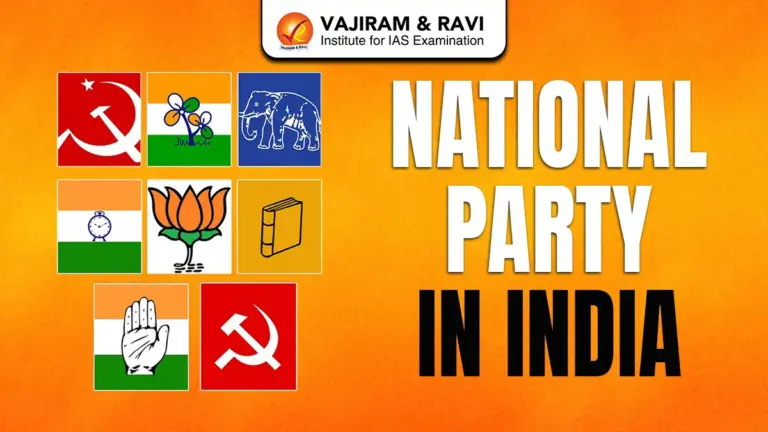
Currently there are six recognised National Party in India as per Election Commission notifications. Together, these parties represent diverse ideological positions ranging from left-wing socialism to right-wing nationalism. The recognised National Political Parties in India are:
- Aam Aadmi Party
- Bahujan Samaj Party
- Bharatiya Janata Party
- Communist Party of India (Marxist)
- Indian National Congress
- National People’s Party
Aam Aadmi Party
Aam Aadmi Party emerged as a reform-oriented political force focused on governance, transparency, and welfare delivery. The election symbol of the party is “broom”:

- Founded on 26 November 2012 under the leadership of Arvind Kejriwal
- Originated from the anti-corruption movement advocating institutional accountability
- Recognised as a national party after electoral success in multiple states
- The party currently governs the state of Punjab
- Ideology combines welfare governance, Indian nationalism, populism, and secularism
Bahujan Samaj Party
Bahujan Samaj Party represents political mobilisation of historically marginalised communities. The election symbol of the party is “elephant”:

- Founded on 14 April 1984 by Kanshi Ram, currently led by Mayawati
- Ideology rooted in Ambedkarism, social justice, and self-respect movements
- Played a major role in Uttar Pradesh politics, including forming state governments
- Retains national party status despite limited recent electoral presence
- Holds representation mainly in state legislatures with minimal parliamentary seats
- Focuses on political empowerment of Scheduled Castes and backward communities
Bharatiya Janata Party
Bharatiya Janata Party is India’s largest political party in terms of representation and governance. The election symbol of the party is “Lotus”:

- Established on 6 April 1980, led by J. P. Nadda
- Ideology includes Hindutva, conservatism, nationalism, and economic reforms
- Currently leads the Union government and governs a majority of Indian states
- Dominant force in coalition politics and policy formulation
- Strong organisational structure with nationwide presence and cadre-based mobilization
Communist Party of India (Marxist)
Communist Party of India (Marxist) represents left-wing ideology within India’s parliamentary democracy. The election symbol of the party is “Hammer, Sickle and Star”:

- Formed on 7 November 1964 after a split in the Communist movement
- Ideology based on Marxism-Leninism, socialism, and secularism
- Strong historical presence in West Bengal and Tripura
- Currently governs Kerala and Tamil Nadu, maintaining relevance through social welfare policies
- Holds limited parliamentary representation
- Focuses on labour rights, land reforms, and public sector expansion
Indian National Congress
Indian National Congress is the oldest political party in India and a foundational force in nation-building. The election symbol of the party is “Palm”:

- Founded on 28 December 1885, currently led by Mallikarjun Kharge
- Played a central role in India’s freedom struggle and constitutional development
- Ideology includes secularism, social democracy, liberalism, and inclusive growth
- Has governed India for several decades after independence
- Continues to be a principal opposition party at the national level
National People’s Party
National People’s Party is a regional-origin party with national recognition. The election symbol of the party is “Book”:

- Founded on 6 January 2013 by P. A. Sangma, currently under Conrad Sangma
- Ideology blends conservatism, regional aspirations, and decentralisation
- Recognised as a national party due to state-level presence in multiple regions
- Governs Meghalaya and participates in coalition governments
- Holds representation in Rajya Sabha and several state assemblies
- Reflects growing political assertion of the North-East in national politics
National Party in India Significance
National Party in India recognition gives political parties uniform symbols, wider visibility, official privileges, and stronger participation in election processes across India. The benefits and significance of the recognition of National Political Party Status are:
- National parties get one permanently reserved election symbol usable across all states, even where they do not contest elections.
- Recognised parties receive free broadcast time on state-run television and radio, helping them reach voters equally.
- National parties can appoint up to 40 star campaigners, double the limit given to unrecognised political parties.
- They get access to electoral rolls and are consulted while fixing election dates and framing electoral rules.

 Last updated on March, 2026
→ UPSC Final Result 2025 is now out.
→ UPSC has released UPSC Toppers List 2025 with the Civil Services final result on its official website.
→ Anuj Agnihotri secured AIR 1 in the UPSC Civil Services Examination 2025.
→ UPSC Marksheet 2025 is now out.
→ UPSC Notification 2026 & UPSC IFoS Notification 2026 is now out on the official website at upsconline.nic.in.
→ UPSC Calendar 2026 has been released.
→ Check out the latest UPSC Syllabus 2026 here.
→ UPSC Prelims 2026 will be conducted on 24th May, 2026 & UPSC Mains 2026 will be conducted on 21st August 2026.
→ The UPSC Selection Process is of 3 stages-Prelims, Mains and Interview.
→ Prepare effectively with Vajiram & Ravi’s UPSC Prelims Test Series 2026 featuring full-length mock tests, detailed solutions, and performance analysis.
→ Enroll in Vajiram & Ravi’s UPSC Mains Test Series 2026 for structured answer writing practice, expert evaluation, and exam-oriented feedback.
→ Join Vajiram & Ravi’s Best UPSC Mentorship Program for personalized guidance, strategy planning, and one-to-one support from experienced mentors.
→ Shakti Dubey secures AIR 1 in UPSC CSE Exam 2024.
→ Also check Best UPSC Coaching in India
National Party in India FAQs
Q1. What is a National Party in India?+
Q2. How many National Parties are there in India currently?+
Q3. Who grants the status of National Party in India?+
Q4. What are the main benefits of being a National Party in India?+
Q5. Can a National Party in India lose its status?+
Tags: national party national party in india