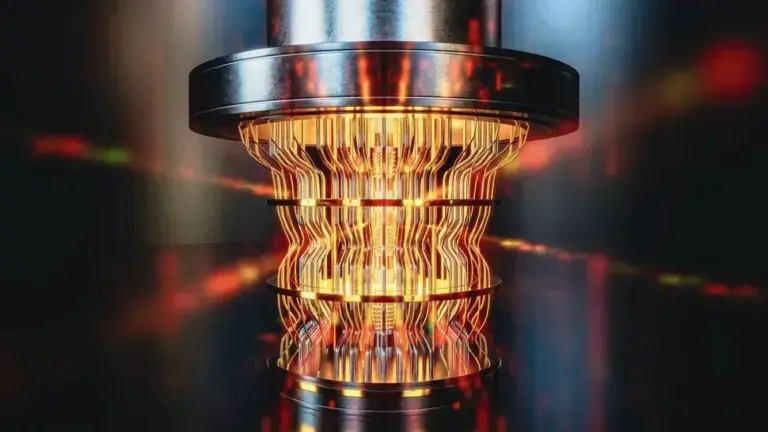
- Objective: After a delay of nearly four years, the National Quantum Mission is set to advance India’s quantum technologies across four key verticals—quantum computing, communication, measurement, and sensing.
- Funding & Structure: The mission has been allocated nearly ₹6,000 crore, with plans to establish four Section 8 companies under the aegis of premier institutions like IITs and IISc.
- These companies will spearhead activities across the identified verticals.
About National Quantum Mission (NQM):
The National Quantum Mission (NQM) is a visionary initiative (2023) led by the Department of Science and Technology (DST)to fortify India’s research and development in the quantum domain.
- Over the next eight years (2023-2031), the mission aims to pioneer the development of intermediate-scale quantum computers with 50-1000 physical qubits using cutting-edge platforms like superconducting and photonic technology.
- Quantum communication: Additionally, the mission seeks to establish satellite-based secure quantum communications spanning a range of 2000 km within India and extending to other countries.
- It also helps to develop highly sensitive magnetometers in atomic systems and precision atomic clocks for timing, communications, and navigation.
- Quantum materials development: Moreover, the mission will provide crucial support for the design and synthesis of quantum materials such as superconductors, novel semiconductor structures, and topological materials to fabricate advanced quantum devices.
- Thematic Hubs (T-Hubs): To catalyze research and development, four T-Hubs will be instituted in premier academic and national research and development institutes, with a focus on igniting new knowledge through fundamental and applied research, as well as driving R&D activities forward.
- Applications: The extensive applications of the mission will find utility across diverse sectors including healthcare, diagnostics, defence, energy, and data security.
How do quantum computers work?
- Quantum computing uses the qubit as the basic unit of information rather than the conventional bit.
The main characteristic of this alternative system is that it permits the coherent superposition of ones and zeros, the digits of the binary system around which all computing revolves.
Q1. What is quantum sensing?
Quantum Sensing is an advanced sensor technology that analyzes changes in motion, and electric and magnetic fields at the atomic level. lt uses “quantum resources” to measure changes in atoms with a higher degree of precision.





 Last updated on March, 2026
→ UPSC Final Result 2025 is now out.
→ UPSC has released UPSC Toppers List 2025 with the Civil Services final result on its official website.
→ Anuj Agnihotri secured AIR 1 in the UPSC Civil Services Examination 2025.
→ UPSC Marksheet 2025 is now out.
→ UPSC Notification 2026 & UPSC IFoS Notification 2026 is now out on the official website at upsconline.nic.in.
→ UPSC Calendar 2026 has been released.
→ Check out the latest UPSC Syllabus 2026 here.
→ UPSC Prelims 2026 will be conducted on 24th May, 2026 & UPSC Mains 2026 will be conducted on 21st August 2026.
→ The UPSC Selection Process is of 3 stages-Prelims, Mains and Interview.
→ Prepare effectively with Vajiram & Ravi’s UPSC Prelims Test Series 2026 featuring full-length mock tests, detailed solutions, and performance analysis.
→ Enroll in Vajiram & Ravi’s UPSC Mains Test Series 2026 for structured answer writing practice, expert evaluation, and exam-oriented feedback.
→ Join Vajiram & Ravi’s Best UPSC Mentorship Program for personalized guidance, strategy planning, and one-to-one support from experienced mentors.
→ Shakti Dubey secures AIR 1 in UPSC CSE Exam 2024.
→ Also check Best UPSC Coaching in India