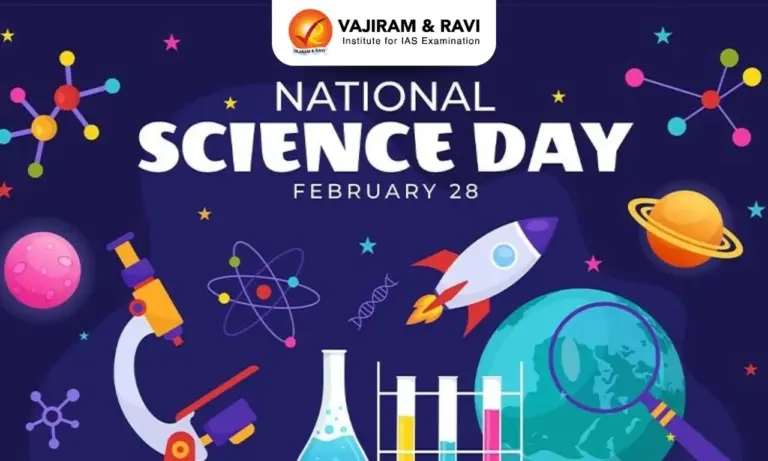
National Science Day 2026 is celebrated on 28 February every year. This year the theme is “Women in Science: Catalyzing Viksit Bharat.” The day aims to honour scientific achievements like “Raman Effect” and inspire innovation among young minds. This article delves into the Significance of the day along with the Contributions of Women in the field of Science and Technology.
National Science Day 2026
National Science Day 2026 is the day when the Raman Effect was discovered by Sir C.V. Raman in 1928. The goal is to promote science and technology, scientific thinking skills through conducting various events like debates, exhibitions, quizzes, and seminars. The day highlights the scientific advancements and inspires future generations to take up careers in science.
The key highlights of the National Science Day 2026 has been tabulated below:
| National Science Day 2026 Overview | |
| Aspect | Description |
|
Date |
Saturday, 28th February 2026 |
|
History |
In 1986, NCSTC proposed the designation of February 28 as National Science Day |
|
Purpose |
Promotes scientific temper, awareness, and the importance of science in everyday life. |
|
Theme |
“Women in Science: Catalyzing Viksit Bharat” |
|
Organizers |
Ministry of Science and Technology |
|
Activities |
Lectures, seminars, workshops, exhibitions, discussions. |
National Science Day 2026 Theme
National Science Day is celebrated every year with a new unique theme. The theme for the National Science Day 2026 is “Women in Science: Catalyzing Viksit Bharat.” The theme perfectly aligns with the seminars and discussions to be held at the Vigyan Bhawan under the Department of Science and Technology (DST) of Ministry of Science and Technology, Government of India. The theme for 2026 highlights and honors the contribution of Women in Science and Technology.





National Science Day History
The National Science Day was observed for the first time in 1987, proposed by the National Council for Science and Technology and Communications. The proposal was accepted by the government and 28th February was declared National Science Day to highlight the discovery of Raman Effect. India celebrates the day annually to honor the importance of science in progressing the society and serving a reminder of Indian scientific heritage and the contributions of scientists in global knowledge.
What is the Raman Effect?
The Raman Effect was founded by C.V Raman and K.S. Krishnan in 1928. Under the Raman Effect, the light underwent a shift in wavelength when interacting the molecules of substances. In this discovery, the effect demonstrated that light can be scattered, carrying valuable information about molecular vibrations. Ever since the discovery, this discovery has become an important tool in medicine, chemistry, physics and material composition and properties. This discovery helped him win the Nobel Prize in Physics in 1930.
Who Was C.V. Raman?
Sir Chandrasekhara Venkata Raman, also known as C.V. Raman was an Indian physicist who made big contributions to spectroscopy and optics. He won a Nobel prize in 1930 for the discovery of the Raman Effect. He is the first Indian scientist to receive a Nobel Prize in Physics and laid the foundation of modern spectroscopy. The Raman Research Institute was founded in 1948 and he also served as the Director of the Indian Institute of Science, Bangalore.
C.V. Raman’s Contributions
Sir C.V. Raman made groundbreaking contributions to physics and scientific research, leaving a lasting impact across multiple domains:
- Raman Effect (1928): Explained the scattering of light and its interaction with molecules, earning him the Nobel Prize in Physics (1930).
- Acoustics: Conducted in-depth studies on musical instruments and wave propagation.
- Molecular Structure: Advanced the understanding of crystals and liquid structures.
- Diamonds & Iridescent Substances: Researched the structure of diamonds and the optical properties of iridescent materials.
- Literary Contributions: Authored key works, including Molecular Diffraction of Light, Acoustical Memoirs, and Why the Sky is Blue (co-authored).
- Institution Building: Founded the Raman Research Institute to foster scientific progress in India.
National Science Day 2026 Significance
National Science Day 2026 is a key event in fostering scientific awareness and innovation in India. Here’s why it matters:
- Honoring Scientific Excellence: Celebrates the contributions of Indian scientists, especially C.V. Raman.
- Inspiring Scientific Curiosity: Encourages students to explore science and research.
- Advancing Science & Technology: Showcases breakthroughs across various fields.
- Connecting Science & Society: Enhances public understanding of scientific progress.
- Strengthening Research & Education: Motivates young minds to pursue STEM careers.
Role of Women in Science and Technology
Women have significantly shaped the progress of Science in India in the below highlighted manner. The National Science Day 2026 honors these kind of contributions of Women in the field of Science and Technology. The major contributions of women are:
- The Prime Minister highlighted major contributions of women scientists and engineers in the successful Chandrayaan 3 mission.
- Under Chandrayaan 2 Mission, it was for the first time, a space mission of Indian Space Research Organisation was led by two women scientists.
- Key contributors of Indian Space Technology include Missile Woman of India Tessy Thomas, Rocket Woman of India Ritu Karidhal, and Deputy Project Director Kalpana K.
- Global Gender Gap Report 2023 by the World Economic Forum states women form 27% of India’s STEM workforce, compared to 32% in non-STEM sectors.
- According to World Bank data, only 33% of researchers worldwide are women.
- Globally, just 18% of girls pursue higher-level STEM education, while 35% of boys opt for STEM streams.
- Women represent only 22% of AI professionals and 28% of engineering graduates, indicating a technology leadership gap.
- Equal workforce participation could raise India’s GDP by 10% as estimated by scholars.
- Government initiatives such as Science, Technology and Innovation policy of DST, Indo-US Fellowship for Women in STEMM, Vigyan Jyoti, GATI, KIRAN, and CURIE promote mentoring, institutional reforms, and research participation.
- Higher female participation improves diversity, decision-making, SDG 5 achievement, targeted interventions, and ensures science benefits society inclusively.

 Last updated on April, 2026
→ UPSC Final Result 2025 is now out.
→ UPSC has released UPSC Toppers List 2025 with the Civil Services final result on its official website.
→ Anuj Agnihotri secured AIR 1 in the UPSC Civil Services Examination 2025.
→ UPSC Marksheet 2025 is now out.
→ UPSC Notification 2026 & UPSC IFoS Notification 2026 is now out on the official website at upsconline.nic.in.
→ UPSC Calendar 2026 has been released.
→ Check out the latest UPSC Syllabus 2026 here.
→ UPSC Prelims 2026 will be conducted on 24th May, 2026 & UPSC Mains 2026 will be conducted on 21st August 2026.
→ The UPSC Selection Process is of 3 stages-Prelims, Mains and Interview.
→ Prepare effectively with Vajiram & Ravi’s UPSC Prelims Test Series 2026 featuring full-length mock tests, detailed solutions, and performance analysis.
→ Enroll in Vajiram & Ravi’s UPSC Mains Test Series 2026 for structured answer writing practice, expert evaluation, and exam-oriented feedback.
→ Join Vajiram & Ravi’s Best UPSC Mentorship Program for personalized guidance, strategy planning, and one-to-one support from experienced mentors.
→ Shakti Dubey secures AIR 1 in UPSC CSE Exam 2024.
→ Also check Best UPSC Coaching in India
National Science Day FAQs
Q1. Why was 28 February declared as National Science Day?+
Q2. What is the theme for National Science Day 2026?+
Q3. Why is World Science Day celebrated?+
Q4. Who launched National Science Day?+
Q5. Who is known as the Father of Modern Science in India?+
Tags: important days in 2026 National Science Day