Sports Governance Latest News
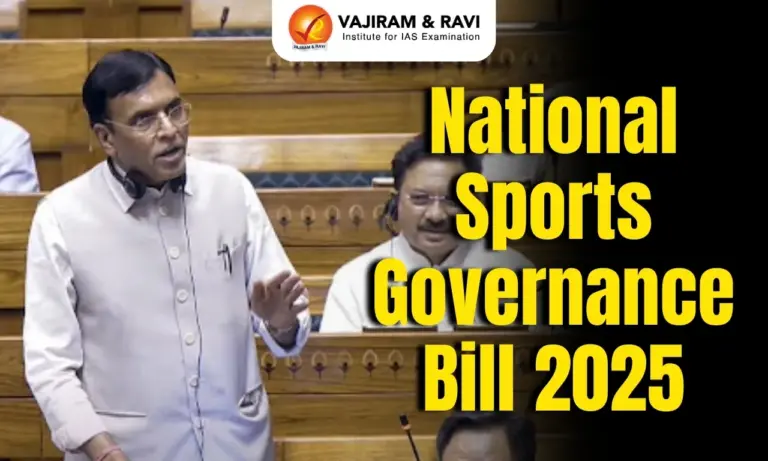
- The Lok Sabha has passed the National Sports Governance Bill 2025 and the National Anti-Doping (Amendment) Bill 2025.
Introduction
- The Lok Sabha has passed two landmark legislations, the National Sports Governance Bill 2025 and the National Anti-Doping (Amendment) Bill 2025, marking a major overhaul of India’s sports governance and anti-doping framework.
- Union Sports Minister Mansukh Mandaviya described the reforms as the “single biggest sports reform since independence”, underscoring their role in building a transparent, accountable, and high-performance sports ecosystem as India prepares to bid for the 2036 Summer Olympics.






About the National Sports Governance Bill 2025
- The National Sports Governance Bill seeks to transform India’s sports administration through the establishment of New Bodies:
- National Olympic Committee
- National Paralympic Committee
- National and Regional Sports Federations for designated sports
- Creation of the National Sports Board (NSB):
- The NSB will grant recognition to national sports bodies, register affiliated units, and monitor compliance. It will have power to de-recognise federations that fail to conduct fair elections, mismanage funds, or commit gross irregularities.
- National Sports Tribunal:
- A judicial body with civil court powers to resolve disputes involving selection, elections, or governance of federations. Tribunal decisions can only be challenged in the Supreme Court.
- Accountability and Transparency Measures:
- All recognised national sports bodies receiving government funding will fall under the Right to Information (RTI) Act, with some exceptions, such as the BCCI, which remains outside RTI unless substantially funded by the government.
- Leadership Provisions:
- Administrators aged between 70 and 75 can contest elections if permitted under international federation rules, a relaxation from the earlier age cap of 70 years.
About the National Anti-Doping (Amendment) Bill 2025
- This amendment aligns India’s anti-doping laws with World Anti-Doping Agency (WADA) requirements:
- Operational Independence for NADA: The National Anti-Doping Agency will function without direct government oversight to address WADA’s concerns over autonomy.
- Changes in the National Anti-Doping Board: The Board remains but without powers to oversee NADA or influence its operations, ensuring compliance with global anti-doping norms.
- Alignment with UNESCO Convention: Strengthens India’s commitment to international anti-doping standards while protecting athlete rights and ensuring fair play.
Significance of the Reforms
- Olympics 2036 Preparation: The legislation is part of India’s roadmap to bid for the Summer Olympics, requiring compliance with the Olympic Charter and international best practices.
- Addressing Long-standing Gaps: Efforts to create a robust sports governance law date back to 1975, with multiple failed attempts due to political hurdles. This Bill finally delivers on decades of unfinished reforms.
- Promoting Gender Inclusion: Provisions ensure greater participation of women in sports federations and leadership roles.
- Enhancing Performance: By enforcing accountability and reducing political interference, the Bills aim to improve India’s performance in global sports events.
Future Outlook
- The reforms are expected to:
-
- Streamline governance in sports federations
- Build stronger anti-doping mechanisms
- Boost India’s medal prospects in international competitions
- Lay the institutional foundation for India’s Olympic bid
- However, successful implementation will depend on effective enforcement, autonomy for sports bodies, and sustained investment in athlete development.

 Last updated on March, 2026
→ UPSC Final Result 2025 is now out.
→ UPSC has released UPSC Toppers List 2025 with the Civil Services final result on its official website.
→ Anuj Agnihotri secured AIR 1 in the UPSC Civil Services Examination 2025.
→ UPSC Marksheet 2025 is now out.
→ UPSC Notification 2026 & UPSC IFoS Notification 2026 is now out on the official website at upsconline.nic.in.
→ UPSC Calendar 2026 has been released.
→ Check out the latest UPSC Syllabus 2026 here.
→ UPSC Prelims 2026 will be conducted on 24th May, 2026 & UPSC Mains 2026 will be conducted on 21st August 2026.
→ The UPSC Selection Process is of 3 stages-Prelims, Mains and Interview.
→ Prepare effectively with Vajiram & Ravi’s UPSC Prelims Test Series 2026 featuring full-length mock tests, detailed solutions, and performance analysis.
→ Enroll in Vajiram & Ravi’s UPSC Mains Test Series 2026 for structured answer writing practice, expert evaluation, and exam-oriented feedback.
→ Join Vajiram & Ravi’s Best UPSC Mentorship Program for personalized guidance, strategy planning, and one-to-one support from experienced mentors.
→ Shakti Dubey secures AIR 1 in UPSC CSE Exam 2024.
→ Also check Best UPSC Coaching in India
Sports Governance FAQs
Q1. What is the National Sports Governance Bill 2025?+
Q2. How does the Bill address transparency?+
Q3. What changes does the National Anti-Doping (Amendment) Bill 2025 bring?+
Q4. Why are these reforms significant for India’s Olympics bid?+
Q5. Will the BCCI be covered under RTI after the Bill’s passage?+
Tags: mains articles sports governance upsc current affairs upsc mains current affairs