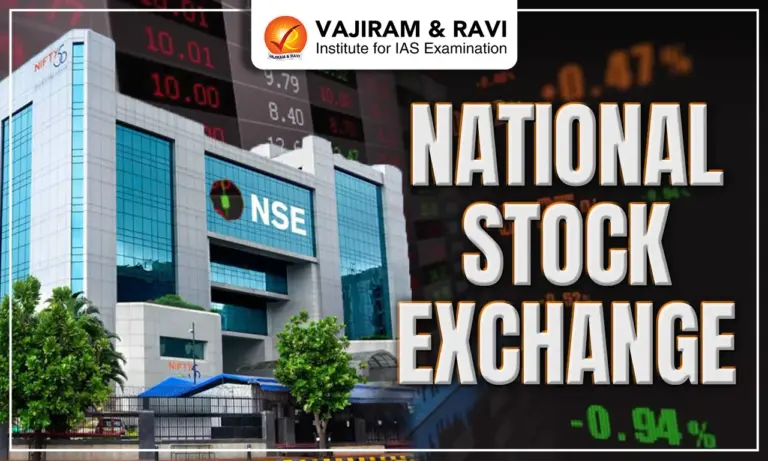
The National Stock Exchange of India (NSE) stands as the foremost stock exchange in India and a key component of its financial architecture. Established in 1992 and beginning operations in 1994, NSE was created to bring transparency, efficiency and nationwide access to stock trading. Headquartered in Mumbai, the NSE introduced an automated, screen‐based trading system, replacing the out-dated manual processes of the past. By mobilising capital, offering investment opportunities and enabling corporate growth, NSE plays a pivotal role in India’s economic development.
National Stock Exchange
The NSE is a regulated stock exchange, officially recognised under the Securities Contracts (Regulation) Act, 1956. It provides a platform for trading in equities (shares), derivatives (futures, options), currency & commodity products, and debt (securities). The NSE is owned by major financial institutions, banks and insurers, and is regulated by the Securities and Exchange Board of India (SEBI). Its mission is to ensure transparent, fair, efficient and robust markets, accessible to both retail and institutional investors.
National Stock Exchange Structure
The structure for the organization and regulation of the National Stock Exchange has been listed below:
- Shareholders include major institutions such as Life Insurance Corporation (LIC), State Bank of India (SBI), ICICI Bank, GIC etc.
- Managed by a Board of Directors, executive leadership and key functional departments (trading, clearing, settlement, surveillance).
- Regulated by SEBI under multiple statutes: Companies Act, SEBI Act, Securities Contract (Regulation) Act, Depositories Act.
- The Clearing and Settlement is handled by NSE Clearing Limited while depository services are through National Securities Depository Limited (NSDL).
- The functioning of NSE is governed by:
- Securities Contracts (Regulation) Act, 1956
- Companies Act, 2013
- SEBI Act, 1992
- Depositories Act, 1996





National Stock Exchange Market Segments
The major segments of the National Stock Exchange Market has been listed below:
Capital Market (Equities)
Investors buy and sell shares of listed companies. NSE lists over 2,200 companies (as of 2024-25) making it India’s largest exchange by listing numbers and trade volume.
Derivatives Market
NSE is the world’s largest derivatives exchange (by number of contracts traded) according to its 2022-23 annual report. Products include index futures, index options, stock futures, stock options, currency futures & options.
Currency & Debt Market
NSE offers currency derivatives (since 2008) and a wholesale debt market (WDM) for trading in government securities and corporate bonds.
Other Services
The NSE also provides infrastructure for mutual funds via Mutual Fund Service System (MFSS), SME listing platform (NSE EMERGE), corporate bonds platform, and foreign investor access via FPI routes.
National Stock Exchange Features
Key features of the NSE has been listed below:
- Fully automated, screen-based trading system connecting brokers across India, ensuring equal access.
- Nationwide network (via remote terminals) allows even smaller towns to participate.
- Rapid clearing and settlement, advanced infrastructure via NSE Clearing.
- Risk management and surveillance systems to monitor trading anomalies, reduce fraud & insider trading.
- Innovation in technology: co-location centres, high-frequency trading infrastructure, internet-based trading, mobile platforms. For instance, NSE expanded its co-location data centre to over 1,200 racks as of January 2025, making it one of the largest globally.
- Transition to T+1 settlement cycle (from earlier T+2) enhances efficiency and reduces counter-party risk.
National Stock Exchange Indices
The performance is analysed through the indices as given below:
- NIFTY 50: Flagship index tracking 50 large-cap stocks across 13 sectors.
- NIFTY Next 50: 50 companies next in line after NIFTY 50.
- Sectoral indices such as NIFTY Bank, NIFTY IT, NIFTY FMCG, NIFTY Auto provide focus on specific industries.
- Midcap and Smallcap indices broaden investor access to smaller companies and growth sectors.
National Stock Exchange Role in Indian Economy
NSE has several impact on the Indian Economy with respect to the financial mobilisation, liquidity, investment, etc as discussed here:
- Capital mobilisation: Companies raise equity (and sometimes debt) via NSE, supporting expansion and economic growth.
- Savings channel: Enables retail and institutional savings to enter productive investment through shares and derivatives.
- Liquidity & price discovery: Large trading volumes ensure ease of entry/exit, efficient pricing and appropriate returns.
- Employment & supporting services: Brokers, analysts, IT infrastructure, clearing & settlement services generate jobs.
- Foreign investment: NSE helps attract Foreign Portfolio Investors (FPIs) enabling inflow of global capital; data on FII/FPI flows show significant activity.
National Stock Exchange Recent Developments
NSE has shown a great extent of advancement in the recent days as discussed here:
- T+1 Settlement Cycle: From 27 January 2023, all equities on NSE moved to a T+1 rolling settlement cycle, reducing the time between trade execution and settlement from T+2 to T+1. This faster settlement reduces risk of non-payment/delivery and improves liquidity.
- Digital & Market Infrastructure Reforms: In its July 2024 report, NSE noted that “Indian capital markets: transformative shifts achieved … including ASBA for secondary market, T+1 settlement, shorter MF redemption, faster IPO listing” could yield about INR 3,900 crore efficiency savings.
- Increased Retail Participation: As of July 2025, NSE reported unique trading accounts crossing 23 crore (230 million) in three months, indicating rapid growth of retail investor participation.
- Global Rankings: According to a 2023 futures industry review, the NSE Group processed over 84.8 billion contracts, ranking it #1 globally in derivatives by volume.
- Cybersecurity and Infrastructure: NSE faces significant cybersecurity challenges, with reports of up to 170 million daily cyber-attacks targeting it in late 2025, prompting continuous investment in cybersecurity and digital resilience. This underscores the importance of robust tech infrastructure.
National Stock Exchange Challenges
Despite of various advancements and development, NSE faces several backlashes, criticism and challenges for the following reasons:
- Market Competition & Evolution: With rising fintech platforms, alternative trading venues and global competition, NSE must continuously innovate to retain leadership.
- Cybersecurity & Technological Risks: The magnitude of cyber-attacks (about 170 million daily) highlights vulnerabilities in critical infrastructure. Ensuring uninterrupted service and data safety remains a key priority.
- Market Volatility & Systemic Risk: High volumes in derivatives markets make exchanges vulnerable to systemic risk. For instance, after a regulatory suspension of a major trading firm, derivative volumes slumped ~17% on NSE.
- Regulation & Transparency Issues: The NSE has faced scrutiny over co-location facilities and algorithmic trading, which raise concerns of fair access.
- Inclusion & Access: Despite high volumes, investor participation remains uneven across socio-economic strata and regions. Ensuring financial literacy, regional access and inclusion remains a challenge.
Way Forward:
- Strengthening Technology & Resilience: Invest further in cybersecurity, cloud infrastructure and real-time monitoring to counter attacks and operational risk.
- Enhancing Market Access & Inclusion: Expand investor education via NSE Academy, targeted programmes for Tier-II and Tier-III regions, and mobile/internet trading access.
- Diversifying Products & Services: Expand green-finance products, ESG-linked derivatives, digital assets, and platform for start-ups & SMEs.
- Promoting Settlement Efficiency: Moving towards optional T+0 settlement for certain securities, which would further speed up transactions.
- Regulatory & Transparency Reforms: Clearer guidelines for co-location, fair access to algorithmic trading, and ensuring equitable opportunities for smaller brokers.
- Regional Integration & Globalization: Collaborate with IFSC-GIFT City and other global exchanges to integrate Indian capital markets with global capital flows.
- Sustainable Growth Focus: Position India’s capital markets to handle increasing volumes while maintaining integrity, to support the vision of India as a $10 trillion economy.
National Stock Exchange Achievements
Some of the major achievements of NSE include:
- First exchange in India to introduce a nationwide electronic trading system.
- Launch of NIFTY 50 Index in 1996.
- Establishment of NSCCL for clearing and settlement.
- Introduction of Internet-based trading in 2000.
- Launch of Currency Derivatives in 2008.
- Ranked among the top 5 exchanges globally by number of trades in equity derivatives (as per World Federation of Exchanges, 2023).
National Stock Exchange UPSC
As of 2025, NSE continues to dominate India’s capital markets. It lists over 2,200 companies, processes millions of trades daily across asset classes, and serves as a barometer of India’s economic health. With advanced technology, strong regulatory backing, and large retail participation (23 crore+ accounts in 2025), it remains a preferred platform for domestic and international investors alike. Its global ranking as the world’s largest derivatives exchange and third largest by equity market size reinforces its stature. While challenges persist, the NSE is well-positioned to lead India’s financial system into the future.
- NSE founded in 1992, recognised in 1993, started operations in 1994.
- NSE’s 2022-23 Annual Report: “Third largest stock exchange in the world; largest in India; world’s largest derivatives exchange.”
- Settlement cycle changed to T+1 from January 2023.
- Futures industry review: NSE Group 84.8 billion contracts in 2023.
- Retail investor accounts crossed 23 crore by July 2025.

 Last updated on March, 2026
→ UPSC Final Result 2025 is now out.
→ UPSC has released UPSC Toppers List 2025 with the Civil Services final result on its official website.
→ Anuj Agnihotri secured AIR 1 in the UPSC Civil Services Examination 2025.
→ UPSC Marksheet 2025 is now out.
→ UPSC Notification 2026 & UPSC IFoS Notification 2026 is now out on the official website at upsconline.nic.in.
→ UPSC Calendar 2026 has been released.
→ Check out the latest UPSC Syllabus 2026 here.
→ UPSC Prelims 2026 will be conducted on 24th May, 2026 & UPSC Mains 2026 will be conducted on 21st August 2026.
→ The UPSC Selection Process is of 3 stages-Prelims, Mains and Interview.
→ Prepare effectively with Vajiram & Ravi’s UPSC Prelims Test Series 2026 featuring full-length mock tests, detailed solutions, and performance analysis.
→ Enroll in Vajiram & Ravi’s UPSC Mains Test Series 2026 for structured answer writing practice, expert evaluation, and exam-oriented feedback.
→ Join Vajiram & Ravi’s Best UPSC Mentorship Program for personalized guidance, strategy planning, and one-to-one support from experienced mentors.
→ Shakti Dubey secures AIR 1 in UPSC CSE Exam 2024.
→ Also check Best UPSC Coaching in India
National Stock Exchange (NSE) FAQs
Q1. What is the National Stock Exchange (NSE)? +
Q2. What are the main indices of NSE? +
Q3. Who regulates the National Stock Exchange? +
Q4. How many companies are listed on NSE? +
Q5. Why is NSE important for India’s economy? +
Tags: national stock exchange