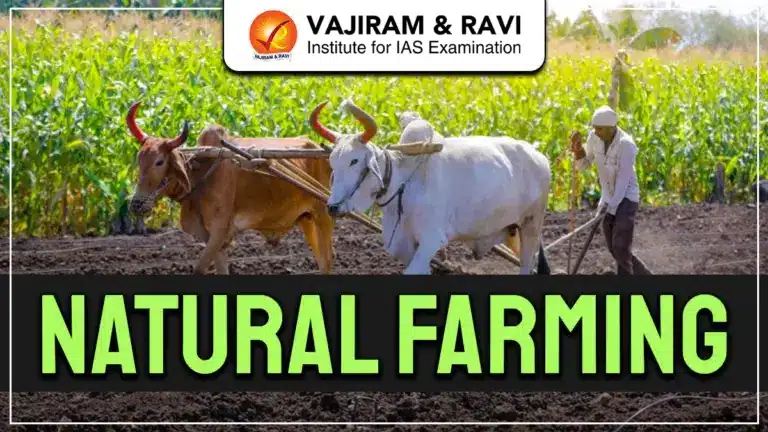
Natural Farming in India is an eco-friendly method of agriculture that avoids chemical fertilisers and pesticides, relying on natural processes and farm-made inputs. It helps improve soil health, reduces farming costs, and produces safe, chemical-free food. Farmers benefit from lower financial risk and sustainable crop yields, but challenges like limited awareness, initial yield fluctuations, and market development remain.
Natural Farming
Natural Farming is a way of growing crops without using chemical fertilizers, pesticides, or herbicides. It relies on natural processes, local resources, and farm-made inputs like cow dung, cow urine, and plant-based preparations. This method focuses on improving soil health, conserving water, and producing safe, chemical-free food.
Read About: Agriculture in India
What is Zero Budget Natural Farming?
Zero Budget Natural Farming (ZBNF) is a method of chemical-free farming that aims to reduce the cost of cultivation to almost zero by using locally available, on-farm inputs instead of purchased fertilisers and pesticides. It was popularised by Subhash Palekar and is based on the idea that healthy soil and crops can be maintained through natural biological processes, especially using indigenous cow-based formulations like Jeevamrit and Beejamrit.





Components of Zero-Budget Natural Farming (ZBNF)
Zero-Budget Natural Farming (ZBNF) is built on four core pillars that restore soil fertility and plant health naturally:
- Jeevamrit: A fermented microbial culture prepared using cow dung, cow urine, jaggery, pulse flour, soil, and water. It enhances soil microbial activity and nutrient availability.
- Beejamrit: A natural seed treatment solution that protects seeds from soil-borne and seed-borne diseases, improving germination and early plant growth.
- Mulching (Acchadana): Covering soil with organic matter such as crop residue or dry leaves to conserve moisture, regulate soil temperature, and prevent weed growth.
- Waaphasa (Soil Aeration): Maintaining a balance of air and moisture in the soil to support root respiration and microbial activity, avoiding excessive irrigation.
Natural Farming Benefits
Natural farming is a simple and eco-friendly way of farming that reduces the use of chemicals and supports healthy soil and crops. It helps farmers lower costs while protecting nature and human health.
- Low Cost of Cultivation: Eliminates the need for expensive chemical fertilizers, pesticides, and hybrid seeds, significantly reducing farmers’ input costs.
- Improved Soil Health: Enhances soil organic carbon, microbial activity, and natural nutrient cycling, leading to long-term fertility.
- Chemical-Free Food: Produces safe, residue-free, and nutritious food, improving public health outcomes.
- Water Conservation: Improves soil moisture retention and reduces irrigation needs, making it suitable for water-scarce regions.
- Climate Resilience: Reduces greenhouse gas emissions and helps crops withstand droughts, floods, and temperature stress.
- Biodiversity Conservation: Encourages beneficial insects, earthworms, and soil microorganisms, restoring ecological balance.
- Sustainable Yields: Ensures stable crop productivity over time without degrading natural resources.
- Farmer Empowerment: Reduces dependence on credit and external inputs, lowering the risk of debt and crop failure.
Government Initiatives to Promote Natural Farming
The Government of India has taken several steps to mainstream natural farming in India. They are:
1. National Mission on Natural Farming (NMNF)
- Budget of ₹2,481 crore to promote natural farming in 15,000 clusters covering 7.5 lakh hectares and benefit about 1 crore farmers.
- Establishes 10,000 Bio‑Input Resource Centres to provide easy access to natural farming inputs like Jeevamrit and Beejamrit.
- Includes 2,000 model demonstration farms and deployment of trained Krishi Sakhis for farmer training and awareness.
2. Bharatiya Prakritik Krishi Paddhati (BPKP)
- Focuses on indigenous farming methods using on-farm inputs and excludes all chemical fertilisers and pesticides.
- Provides financial assistance of ₹12,200 per hectare for three years for cluster formation, training, and certification.
- Targets 12 lakh hectares in 600 major blocks across multiple states for large-scale adoption.
3. State-Level Natural Farming Initiatives
- Andhra Pradesh Community-Managed Natural Farming (APCNF) has expanded to over 1 million farmers and 500,000 hectares since 2016.
- Other states like Himachal Pradesh, Gujarat, Karnataka, and Kerala provide subsidies, training, and input support to promote natural farming.
- Emphasis on community participation, farmer collectives, and farmer-to-farmer knowledge sharing for large-scale adoption.
Natural Farming vs Organic Farming
Natural farming and organic farming both promote chemical-free agriculture, but they differ in their approach and input use. The difference between natural farming and organic farming has been tabulated below.
| Natural Farming vs Organic Farming | |
| Organic Farming | Natural Farming |
|
Allows the use of off-farm organic and biological inputs such as bio-fertilisers and bio-pesticides |
Does not allow any external inputs; only on-farm inputs like Desi cow–based preparations (Jeevamrit, Beejamrit, Ghanajeevamrit) and biomass mulching are used |
|
Permits correction of micronutrient deficiencies through approved minerals and organic supplements |
Does not allow compost, vermicompost, or mineral supplements; soil fertility is maintained naturally through microbial activity |
|
Well-established and widely accepted in the global market, with a market size of about US$132 billion |
Still in the developing stage, with dedicated markets and pricing systems yet to be fully established |
|
An input-based approach focusing on organic substitutes for chemicals |
Process-based approach focusing on natural soil and ecological processes |
|
Certification is mandatory for domestic and export marketing |
Certification is generally not required |
|
Higher cost of production due to purchased inputs and certification expenses |
Very low cost of production as all inputs are farm-made |
Read About: Farming System
Natural Farming Challenges
- Initial Yield Reduction: During the transition from chemical farming to natural farming, crop yields may fall in the first few seasons, which can discourage farmers.
- Knowledge and Skill Intensive: Natural farming requires proper understanding of soil health, crop cycles, and preparation of natural inputs, which many farmers may lack initially.
- Limited Awareness: A large number of farmers are still unaware of natural farming methods and their long-term benefits.
- Lack of Scientific Validation: In some regions, there is limited region-specific research data to convince farmers and policymakers.
- Market Limitations: There are no well-developed markets or premium pricing systems for natural farming produce.
- Transition Period Risk: Farmers do not receive sufficient support or compensation during the early transition years.
- Labour Requirement: Practices like mulching and preparation of bio-inputs require more manual labour.
- Availability of Desi Cows: ZBNF depends on indigenous cows, which are not easily available to all farmers.
- Policy and Implementation Gaps: Different states follow different models, leading to uneven adoption and outcomes.
Sustainable Practices for Natural Farming
Mixed Cropping or Diverse Cropping
- In mixed cropping, two or more crops are grown simultaneously in the same field. If one crop fails, the other crops reduce the risk of total loss.
- Usually, a long-duration crop is grown with a short-duration crop to optimize nutrient use and soil resources.
- Often, a leguminous crop is intercropped with the main crop to naturally fix nitrogen in the soil.
Strip Farming
- Crops are planted in rows with alternate spaces filled by another crop, ensuring full ground cover.
- Slows down water flow, allowing it to soak into the soil and reduce erosion.
Crop Rotation (Multiple or Multi-Cropping)
- Involves growing different crops in succession on the same field within a year.
- Helps control pests and diseases, improve soil fertility, and reduce soil erosion.
- Continuous monocropping exhausts certain nutrients and encourages pests; rotating crops prevents nutrient imbalance.
- Including a leguminous crop like green gram improves nitrogen levels and reduces chemical fertilizer use.
Soil Management
- Healthy soil reduces crop susceptibility to pests and diseases.
- Practices include cover crops, composting, reduced tillage, and mulching to conserve moisture and nutrients.
Vermicomposting
- Uses earthworms to recycle crop residues, animal waste, and agro-industrial waste into nutrient-rich compost.
- Suitable materials include animal waste, poultry/dairy waste, sugarcane bagasse, sericulture waste, and weeds.
Nutrient Management
Plants generally need 16 essential nutrients:
-
- From air: Carbon and Oxygen
- From water: Hydrogen and Oxygen
- From soil:
-
- Macronutrients (large quantity): Nitrogen, Phosphorus, Potassium, Calcium, Magnesium, Sulphur
- Micronutrients (small quantity): Iron, Manganese, Boron, Zinc, Copper, Molybdenum, Chlorine
Way Forward
- Strengthen farmer training through regular awareness programs, field demonstrations, and continuous guidance at the village level.
- Provide financial and risk support to farmers during the transition period when yields may fluctuate.
- Promote scientific research and region-specific studies to build confidence in natural farming practices.
- Develop dedicated markets, branding, and fair pricing systems for natural farming produce.
- Encourage community-based models such as farmer groups and FPOs for collective learning and marketing.
- Ensure better coordination between central and state policies for smooth and uniform implementation.

 Last updated on March, 2026
→ UPSC Final Result 2025 is now out.
→ UPSC has released UPSC Toppers List 2025 with the Civil Services final result on its official website.
→ Anuj Agnihotri secured AIR 1 in the UPSC Civil Services Examination 2025.
→ UPSC Marksheet 2025 is now out.
→ UPSC Notification 2026 & UPSC IFoS Notification 2026 is now out on the official website at upsconline.nic.in.
→ UPSC Calendar 2026 has been released.
→ Check out the latest UPSC Syllabus 2026 here.
→ UPSC Prelims 2026 will be conducted on 24th May, 2026 & UPSC Mains 2026 will be conducted on 21st August 2026.
→ The UPSC Selection Process is of 3 stages-Prelims, Mains and Interview.
→ Prepare effectively with Vajiram & Ravi’s UPSC Prelims Test Series 2026 featuring full-length mock tests, detailed solutions, and performance analysis.
→ Enroll in Vajiram & Ravi’s UPSC Mains Test Series 2026 for structured answer writing practice, expert evaluation, and exam-oriented feedback.
→ Join Vajiram & Ravi’s Best UPSC Mentorship Program for personalized guidance, strategy planning, and one-to-one support from experienced mentors.
→ Shakti Dubey secures AIR 1 in UPSC CSE Exam 2024.
→ Also check Best UPSC Coaching in India
Natural Farming FAQs
Q1. What is natural farming?+
Q2. Is natural farming the same as organic farming?+
Q3. Does natural farming reduce crop yield?+
Q4. Is natural farming suitable for small farmers?+
Q5. Are natural farming products safe to eat?+
Tags: natural farming in india