What’s in today’s article?
- Why in news?
- What is Geosynchronous Satellite Launch Vehicle (GSLV)?
- What is GSLV MKIII (now known as Launch Vehicle Mark-III, LVM3)?
- News Summary: GSLV rocket nicknamed naughty boy
- Why GSLV was known as naughty boy?
- What is the challenge associated with GSLV?
- Indigenous cryogenic technology
Why in news?
- Recently, the Indian Space Research Organisation (ISRO) launched a new-generation meteorological satellite, INSAT-3DS.
- INSAT-3DS is meant to carry out enhanced monitoring of the Earth’s surface, atmosphere, oceans and environment.
- It will boost India’s weather and climate prediction services, early warnings, and disaster management services.
- But more than the satellite, it was the rocket that was the focus of attention of this launch.
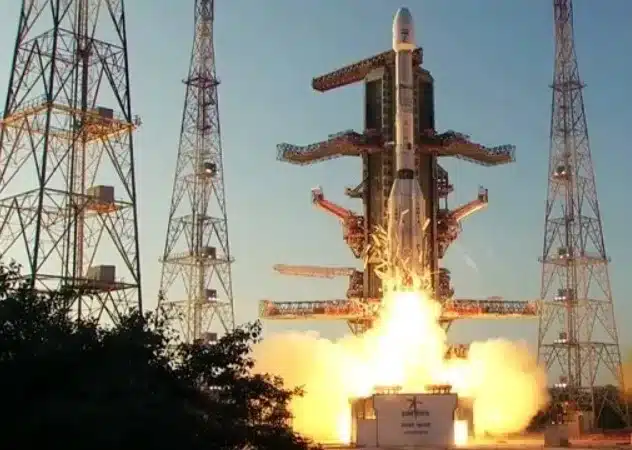
- The INSAT-3DS satellite rode on the GSLV-F14 rocket to reach its intended geostationary orbit.
- GSLV has had a rather patchy track record thus far, because of which it has been described as the ‘naughty boy’.


Geosynchronous Satellite Launch Vehicle (GSLV)
- It is a space launch vehicle designed, developed and operated by the ISRO to launch satellites and other space objects into Geosynchronous Transfer Orbits (GTO).
- A satellite in the GTO, orbits (at an altitude of ~37,000 km) the Earth once per day, keeping the satellite in roughly the same area over the ground.
- GSLV has the capability to put a heavier payload (up to 5,000 kg up to 37,000 km) in orbit than the Polar Satellite Launch Vehicle (PSLV can carry up to 2000 kg into space up to 600-900 km).
- PSLV is designed mainly to deliver earth observation or remote sensing satellites, whereas GSLV has been designed for launching communication satellites.
- GSLV delivers satellites into a higher elliptical orbit – GTO.
- GSLV is a 3-stage launcher with strap-on motors.
- The first stage – uses the solid rocket motor with four liquid engine strap-on motors. This stage generates maximum thrust.
- The second stage uses a liquid rocket engine which is known as Vikas engine.
- The third stage uses a Cryogenic engine, which uses liquefied oxygen and hydrogen as fuel.
- GSLV-D5 – launched in 2014 – was the first successful flight of the GSLV using the indigenous cryogenic engine (CE-7.5).
GSLV MKIII (now known as Launch Vehicle Mark-III, LVM3)
- GSLV MKIII Project was approved in 2002, with a mandate of achieving the capability to launch a 4-ton (4000 kg) class satellite to Geo-Synchronous orbit, by realizing an indigenously developed launch vehicle.
- GSLV MKIII is configured as a 3-stage vehicle with two solid strap-on motors (S200, among the largest in the world), one liquid core stage and a high thrust Cryogenic Upper Stage (CUS).

- Characteristics of GSLV MKIII:
- Performance capability of 4.3 ton to GTO
- Payload capability to support 10 ton to LEO missions
- Cost effective
- Improved reliability, operability and redundancy management
- Future growth potential of payload with minimal design changes
- To support manned missions (like Gaganyaan mission) of Indian Space Programme
- The maiden operational flight of GSLV MKIII has successfully launched Chandrayaan-2 spacecraft into the Super Geo-Synchronous Transfer Orbit in 2019.

News Summary: GSLV rocket nicknamed naughty boy
Why GSLV was known as naughty boy?
- GSLV had flown 15 times before the recent launch, and four of these had been unsuccessful, a very high failure rate for any rocket.
- PSLV, the rocket that ISRO has used the maximum number of times, has failed only twice in its 60 launches.
- The LVM3 rocket has flown seven times and never failed.
- GSLV’s most recent failure was in August 2021, when it was attempting to carry an earth observation satellite EOS-03 into space.
- It did have a successful launch after that, in May last year, but the uncertainty over its performance had not dissipated completely.
What is the challenge associated with GSLV?
- The problems of GSLV have mainly been with the cryogenic engine that powers the third and final stage of the flight.
- Cryogenics is the science relating to the behaviour of materials at very low temperatures.
- Cryogenic engines use liquid hydrogen as the main fuel.
- Hydrogen, the most efficient rocket fuel, is very difficult to handle in its natural gaseous form, but manageable in liquid state.
- However, it liquifies only at very low temperatures, nearly 250 degrees Celsius below zero.
- The oxygen that is needed to burn this fuel also needs to be in liquid form. Oxygen is in liquid state at about 90 degrees Celsius below zero.
- The GSLV uses a cryogenic engine that is reverse-engineered on a Russian design.
- It is this reverse-engineered engine, used in the GSLV rockets, that has caused a few headaches for ISRO.
Indigenous cryogenic technology
- India has managed to develop its own cryogenic engine as well, a result of decades of research and development.
- This engine has an entirely Indian design, developed within ISRO, and uses a different process to burn the fuel.
- This indigenously developed cryogenic engine is deployed in Launch Vehicle Mark-III(LVM3).
- LVM3 is ISRO’s most powerful rocket so far, which carried the Chandrayaan-2 and Chandrayaan-3 missions, among others.
- LVM3 has had seven flights till now, without any trouble.
- ISRO scientists have a much better grip on this home-grown technology.
Q1) What is geosynchronous transfer orbit (GTO)?
A geosynchronous transfer orbit (GTO) is a type of geocentric orbit that satellites use as a temporary step to reach their final orbit.
Q2) What is cryogenic engine?
A cryogenic engine is a rocket engine that uses liquefied gasses as fuel and oxidizers. The gasses are stored at very low temperatures, below -150 degrees Celsius.
Source: ISRO’s latest launch: Why is the GSLV rocket nicknamed ‘naughty boy’? | ISRO | ABP Live

 Last updated on Oct, 2026
→ UPSC 2027 Notification will be released on 13 January 2027 at upsconline.nic.in.
→ Check Nobel Prize 2026 Winners List here.
→ Download PIB PRiSM Monthly Magazine 2026 here.
→ Check UPSC Monthly Current Affairs Magazine The Recitals here.
→ Check out the latest UPSC Syllabus here.
→ Download UPSC Model Answers for Mains 2026
→ UPSC Mains Question Paper 2026 is out now for Essay & GS Paper 1, 2, 3 & 4.
→ UPSC Calendar 2027 has been released.
→ Enroll in Vajiram & Ravi’s UPSC Mains Test Series 2027 for structured answer writing practice, expert evaluation, and exam-oriented feedback.
→ Join Vajiram & Ravi’s UPSC Mentorship Program 2027 for personalized guidance, strategy planning, and one-to-one support from experienced mentors.
→ Go through the UPSC Mains Previous Year Papers to enhance your preparation.
→ UPSC has released UPSC Toppers List 2025 with the Civil Services final result on its official website.
→ Also check Best UPSC Coaching in India