Neanderthal Spear Tip Discovery Latest News
An international archaeological team has unearthed the oldest known spear tip in Europe, crafted not by Homo sapiens, but by Neanderthals.
Where and How Was It Found?
- The spear tip was discovered in a cave in the North Caucasus region of Russia, embedded in a sediment layer.
- The findings were published in the Journal of Archaeological Science and are based on materials excavated in 2003 but studied in-depth only recently.
- It was found along with animal bones and the remains of a campfire, indicating habitation by prehistoric hominins.
- The team employed spectroscopy, computed tomography (CT scans), and microscopy techniques to analyse the artefact in high detail.
- Key Features of the Spear Tip
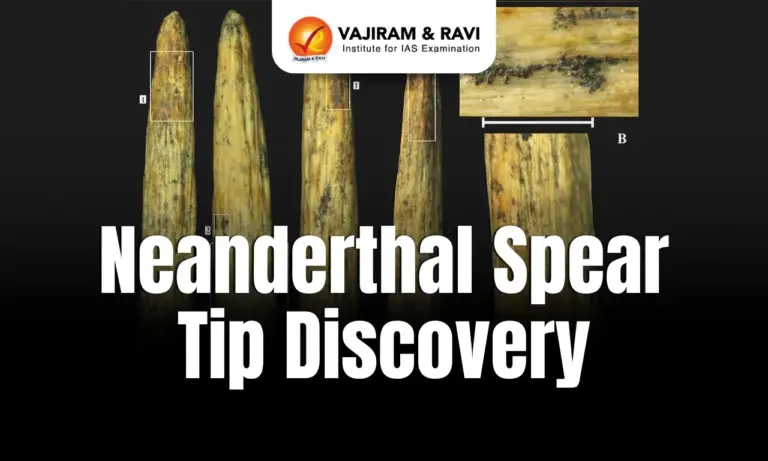
- The spear tip is approximately 9 cm long.
- It was made from animal bone, most likely from a bison.
- It had been shaped using stone tools and affixed to a wooden shaft using natural tar—a sign of planned construction.
- Micro-cracks on the tip suggest that it struck a hard target, implying use in hunting or combat.
- Lack of wear and tear indicates the spear was likely used successfully shortly after it was crafted.
- Dating and Attribution: The artefact dates back to 70,000–80,000 years ago, which is much earlier than the arrival of modern humans in Europe (~45,000 years ago). This confirms that the tool was created by Neanderthals, not Homo sapiens.





About Neanderthals (Homo neanderthalensis)
- Neanderthals were an extinct species of archaic humans, closely related to modern humans.
- They inhabited Europe, Central Asia, and parts of the Middle East.
- Genetic evidence shows that modern humans and Neanderthals diverged about 500,000 years ago.
- The last known Neanderthals died out ~40,000 years ago, shortly after Homo sapiens migrated deeper into Europe.
- Modern humans carry 1–2% Neanderthal DNA, proving interbreeding occurred.
Neanderthal Physical and Cultural Traits
- Robust bodies adapted for cold climates: shorter, stockier, and extremely muscular.
- Skull characteristics: Large middle face, projecting nose, angled cheekbones, and receding chin.
- Brain size comparable to or larger than modern humans, relative to body size.
- Expert hunters: They used sophisticated stone and bone tools, controlled fire, made clothing, and lived in structured shelters.
- Practised symbolic behaviour: Made ornaments, and deliberately buried their dead, sometimes with funerary offerings—a practice unmatched by any earlier hominin.
Source: PHY

 Last updated on April, 2026
→ UPSC Final Result 2025 is now out.
→ UPSC has released UPSC Toppers List 2025 with the Civil Services final result on its official website.
→ Anuj Agnihotri secured AIR 1 in the UPSC Civil Services Examination 2025.
→ UPSC Marksheet 2025 is now out.
→ UPSC Notification 2026 & UPSC IFoS Notification 2026 is now out on the official website at upsconline.nic.in.
→ UPSC Calendar 2026 has been released.
→ Check out the latest UPSC Syllabus 2026 here.
→ UPSC Prelims 2026 will be conducted on 24th May, 2026 & UPSC Mains 2026 will be conducted on 21st August 2026.
→ The UPSC Selection Process is of 3 stages-Prelims, Mains and Interview.
→ Prepare effectively with Vajiram & Ravi’s UPSC Prelims Test Series 2026 featuring full-length mock tests, detailed solutions, and performance analysis.
→ Enroll in Vajiram & Ravi’s UPSC Mains Test Series 2026 for structured answer writing practice, expert evaluation, and exam-oriented feedback.
→ Join Vajiram & Ravi’s Best UPSC Mentorship Program for personalized guidance, strategy planning, and one-to-one support from experienced mentors.
→ Shakti Dubey secures AIR 1 in UPSC CSE Exam 2024.
→ Also check Best UPSC Coaching in India
Neanderthal Spear Tip Discovery FAQs
Q1. What was discovered about Neanderthals?+
Q2. Where was this spear tip found?+
Tags: neanderthal spear tip discovery prelims pointers upsc prelims current affairs