Neglected Tropical Diseases Latest News
As of May 2025, 56 countries have successfully eliminated at least one NTD – demonstrating significant progress towards WHO’s global target of 100 countries reaching elimination by 2030.
About Neglected Tropical Diseases
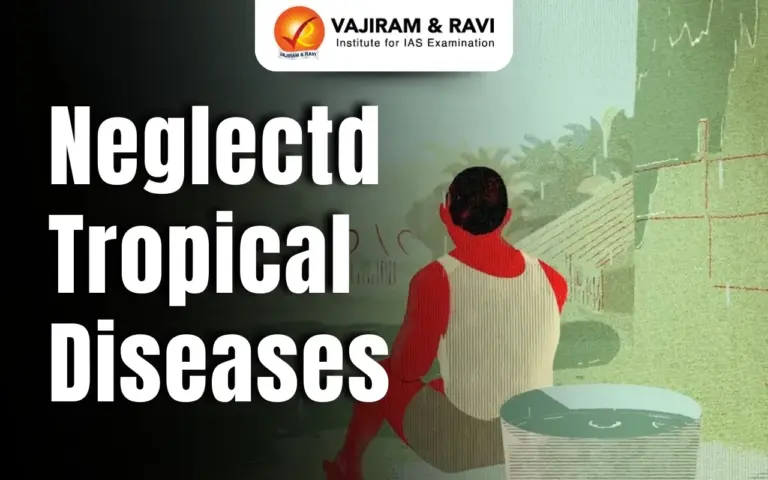
- NTDs are a diverse group of conditions caused by a variety of pathogens (including viruses, bacteria, parasites, fungi, and toxins) and associated with devastating health, social, and economic consequences.
- NTDs are mainly prevalent among impoverished communities in tropical areas, although some have a much larger geographical distribution.
- They are widespread where people in vulnerable situations live, where water safety, sanitation, and access to health care are inadequate or suboptimal.
- These diseases are called “neglected” because they have historically ranked very low on the global health agenda, when they have appeared at all, receiving little attention and funding.
- NTDs include Guinea worm, Chikungunya, Dengue, Kala Azar (Visceral Leishmaniasis), and Elephantiasis (Lymphatic Filariasis), among others. India is home to about 12 NTDs.
- The epidemiology of NTDs is complex; some have animal and/or human reservoirs, many are vector-borne, and most are associated with intricate life cycles. Preventing or eliminating NTDs is therefore challenging.
- It is estimated that NTDs affect more than 1 billion people, while the number of people requiring NTD interventions (both preventive and curative) is 1.5 billion.
- Every year on 30th January, the global community comes together to mark World NTDs Day and renew its commitment to eliminating its burden worldwide.





Neglected Tropical Diseases FAQs
Q1: Why are Neglected Tropical Diseases referred to as “neglected”?
Ans: Because they have historically received little global attention and funding.
Q2: What is the primary reason NTDs are difficult to eliminate?
Ans: They often have complex life cycles, vectors, and reservoirs.
Q3: When is World Neglected Tropical Diseases Day observed globally?
Ans: 30th January
Source: WHO

 Last updated on April, 2026
→ UPSC Final Result 2025 is now out.
→ UPSC has released UPSC Toppers List 2025 with the Civil Services final result on its official website.
→ Anuj Agnihotri secured AIR 1 in the UPSC Civil Services Examination 2025.
→ UPSC Marksheet 2025 is now out.
→ UPSC Notification 2026 & UPSC IFoS Notification 2026 is now out on the official website at upsconline.nic.in.
→ UPSC Calendar 2026 has been released.
→ Check out the latest UPSC Syllabus 2026 here.
→ UPSC Prelims 2026 will be conducted on 24th May, 2026 & UPSC Mains 2026 will be conducted on 21st August 2026.
→ The UPSC Selection Process is of 3 stages-Prelims, Mains and Interview.
→ Prepare effectively with Vajiram & Ravi’s UPSC Prelims Test Series 2026 featuring full-length mock tests, detailed solutions, and performance analysis.
→ Enroll in Vajiram & Ravi’s UPSC Mains Test Series 2026 for structured answer writing practice, expert evaluation, and exam-oriented feedback.
→ Join Vajiram & Ravi’s Best UPSC Mentorship Program for personalized guidance, strategy planning, and one-to-one support from experienced mentors.
→ Shakti Dubey secures AIR 1 in UPSC CSE Exam 2024.
→ Also check Best UPSC Coaching in India
Tags: neglected tropical diseases prelims pointers upsc current affairs upsc prelims current affairs