Nepal Gen Z protests Latest News
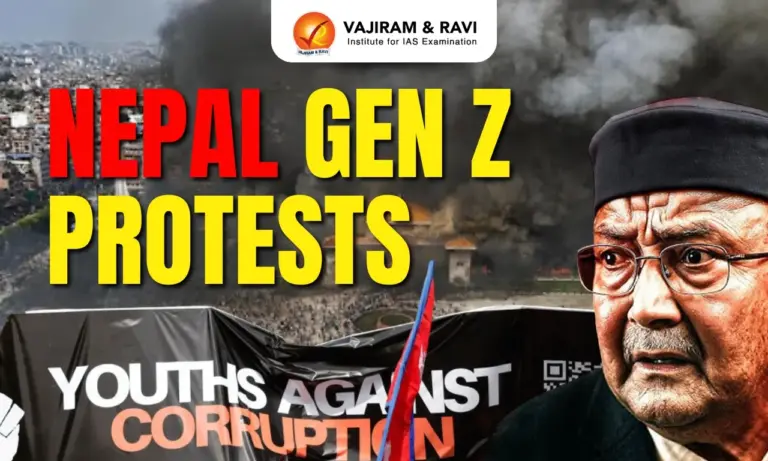
- Unprecedented protests erupted across Nepal on September 8, 2025, after the government banned major social media platforms.
- What began as peaceful demonstrations by thousands of youth soon turned violent, with at least 19 dead and over 400 injured.
- Protesters stormed Parliament and targeted politicians’ homes, prompting curfews in Kathmandu and other cities.
- As the Gen Z-led agitation intensified for a second day, Prime Minister K.P. Sharma Oli resigned, his secretariat confirming the decision amidst mounting pressure.
Protesters on Nepal’s Streets and the Reasons Behind Their Anger
- The protesters are primarily Generation Z youth — those born between 1996 and 2012.
- With the age group of 16-25 years, Gen Z youths accounted for 20.8 per cent of total population and 90 per cent of its 30 million people using the internet.
- Teens and young adults, frustrated with politics and governance, have taken to the streets in large numbers.
Corruption and Nepotism
- Gen Z has expressed deep anger at Nepal’s entrenched corruption and the impunity enjoyed by politicians since the republic’s formation in 2008.
- The extravagant lifestyles of politicians’ children, mocked as “Nepo Babies” and “Nepo Kids,” became a flashpoint of resentment online.
Immediate Trigger: Social Media Ban
- The government’s decision to ban 26 major social media platforms, including Facebook, WhatsApp, Instagram, X, and YouTube, cut off Gen Z’s primary platform for expression and solidarity.
- Authorities accused these platforms of failing to register with Nepali regulators and of being misused for hate speech, misinformation and fraud.
- TikTok was the only major platform to comply and remains accessible.
- This aggravated their frustration.
Protests and Violence
- The discontent culminated in mass protests on Monday. Police and security forces opened fire, killing 19 and injuring hundreds.
- The unrest represented the most forceful youth uprising in years.
- While the protesters had no detailed charter, they demanded lifting of the social media ban, which was fulfilled.
- More broadly, they sought an end to corruption, social inequality, and lack of job opportunities.





India’s Concerns Over Nepal’s Crisis
- India is closely watching Nepal’s turmoil with concern, mindful of its sensitive political alignments in the country.
- Having once lost goodwill with the monarchy and Nepali Congress by backing Maoists, New Delhi now faces a delicate balancing act.
- Recently, PM Modi chaired a Cabinet Committee on Security meeting to assess the situation, stressing that the violence was “heart-rending” and reaffirming that Nepal’s stability, peace, and prosperity remain of utmost importance to India.
Analysis: Nepal’s Crisis Beyond Oli’s Resignation
- The recent violence in Kathmandu, where protesters torched Parliament, ministerial homes, and media offices, reflects deep structural failures in Nepal’s democratic experiment.
- PM Oli’s resignation has not stemmed the unrest, which now questions the country’s political future.
Systemic Revolt: From Social Media Ban to Nationwide Rage
- Protests began against the government’s ban on social media but quickly transformed into a broader indictment of corruption, nepotism, and inequality.
- Security forces’ killing of 19 youth on September 8 ignited nationwide outrage, galvanising Gen Z against decades of political dysfunction, unemployment, and institutional decay.
- Unlike past democratic movements, these protests lack leadership or clear objectives, instead expressing nihilistic anger against all state institutions.
Dangerous Precedents in Nepal’s Democracy
- Despite two people’s movements, a new constitution, and republican institutions, Nepal’s governance remains dominated by elite power-sharing and patronage networks.
- This disillusionment has created space for anti-system forces, including pro-monarchy and Hindutva groups.
- The amorphous Gen Z protests, without clear democratic alternatives, risk being co-opted by such forces.
Regional Parallels and Outsider Appeal
- Nepal’s turmoil mirrors unrest in South Asia, from Bangladesh’s student-led uprisings to Sri Lanka’s Aragalaya.
- The popularity of outsider figures like jailed Rabi Lamichhane and Kathmandu Mayor Balendra Shah shows youth distrust of mainstream politics.
- However, Shah’s call for Parliament’s dissolution raises fears of anti-institutional rhetoric undermining democratic renewal.
The Road Ahead: Reform or Ruin
- The Gen Z protests have exposed Nepal’s political bankruptcy and systemic failures.
- Yet, their drift toward violence and institutional destruction threatens democracy itself.
- For meaningful change, Nepal’s leaders must channel this energy into building credible alternatives, policy frameworks, and constructive institutions.
- Without this, the movement risks destabilising an already fragile state without delivering sustainable solutions.

 Last updated on March, 2026
→ UPSC Final Result 2025 is now out.
→ UPSC has released UPSC Toppers List 2025 with the Civil Services final result on its official website.
→ Anuj Agnihotri secured AIR 1 in the UPSC Civil Services Examination 2025.
→ UPSC Marksheet 2025 is now out.
→ UPSC Notification 2026 & UPSC IFoS Notification 2026 is now out on the official website at upsconline.nic.in.
→ UPSC Calendar 2026 has been released.
→ Check out the latest UPSC Syllabus 2026 here.
→ UPSC Prelims 2026 will be conducted on 24th May, 2026 & UPSC Mains 2026 will be conducted on 21st August 2026.
→ The UPSC Selection Process is of 3 stages-Prelims, Mains and Interview.
→ Prepare effectively with Vajiram & Ravi’s UPSC Prelims Test Series 2026 featuring full-length mock tests, detailed solutions, and performance analysis.
→ Enroll in Vajiram & Ravi’s UPSC Mains Test Series 2026 for structured answer writing practice, expert evaluation, and exam-oriented feedback.
→ Join Vajiram & Ravi’s Best UPSC Mentorship Program for personalized guidance, strategy planning, and one-to-one support from experienced mentors.
→ Shakti Dubey secures AIR 1 in UPSC CSE Exam 2024.
→ Also check Best UPSC Coaching in India
Nepal Gen Z protests FAQs
Q1. Who are the main protesters in Nepal’s crisis?+
Q2. What triggered the Nepal protests?+
Q3. What happened during the protests?+
Q4. How has India responded to Nepal’s unrest?+
Q5. What risks do these protests pose to Nepal’s democracy?+
Tags: mains articles Nepal Gen Z protests upsc current affairs upsc mains current affairs