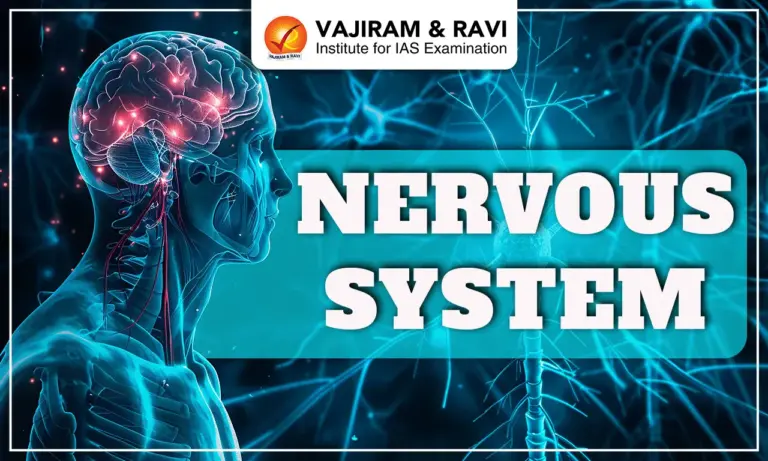
The nervous system is one of the most complex and vital systems in the human body, controlling every function we perform- from thinking, remembering, and feeling to moving, breathing, and reacting. It acts as the body’s electrical and communication network, connecting billions of specialized cells called neurons that transmit signals between the brain, spinal cord, and various body parts.
Nervous System
The nervous system works through electrical impulses and chemical signals, carrying information rapidly from one part of the body to another. It allows coordination, communication, and control, ensuring that the body acts as one unit. According to the National Institute of Neurological Disorders and Stroke (NINDS), the human brain alone contains about 86 billion neurons. These neurons form intricate networks that allow humans to respond instantly to internal and external stimuli, maintain balance, and exhibit intelligence.
Read About: DNA
Nervous System Historical Background
The study of the nervous system has evolved over thousands of years. Ancient physicians and philosophers observed the brain’s role in sensation and behavior, leading to the birth of neuroscience.
- Vedic India (1500-500 BCE): Ancient texts like the Ayurveda mention manas (mind) and nadi (channels), hinting at early understanding of nerves and brain functions.
- Ancient Egypt (1700 BCE): Medical papyri describe brain injuries and nerve-related paralysis.
- Greece (460-200 BCE): Hippocrates identified the brain as the center of intelligence and sensation.
- Galen of Pergamon (2nd century CE): Studied nerves through animal dissections; distinguished sensory and motor nerves.
- Renaissance Europe (1500s): Andreas Vesalius created detailed anatomical drawings of the brain and spinal cord.
- 17th-18th century: Thomas Willis introduced the term “neurology” and mapped brain functions.
- 19th century: Camillo Golgi developed a staining technique that made individual neurons visible; Santiago Ramón y Cajal formulated the Neuron Doctrine.
- 20th century onwards: EEG, MRI, and fMRI revolutionized the study of brain activity and neurological functions.





Nervous System Classification
The nervous system is divided into two main parts: Central Nervous System and Peripheral Nervous System. The CNS interprets information and makes decisions, while the PNS carries messages to and from the body. Together, they ensure smooth functioning of all body processes.
| Classification of Nervous System | ||
| Division | Main Components | Function |
|
Central Nervous System (CNS) |
Brain and Spinal Cord |
Acts as the control center; interprets and processes information |
|
Peripheral Nervous System (PNS) |
Nerves outside the CNS |
Connects CNS to limbs and organs; transmits sensory and motor information |
Central Nervous System (CNS)
The Central Nervous System (CNS) is the command center of the body, consisting of the brain and spinal cord. It receives, processes, and sends information throughout the body.
- Brain
The human brain, weighing about 1.4 kilograms, is the most complex organ, with billions of neurons connected by trillions of synapses. It is protected by the skull and covered by three layers of membranes called meninges. The brain consumes nearly 20% of the body’s oxygen supply, highlighting its high energy demands. The brain is divided into three main parts:
- Forebrain: Includes the cerebrum, thalamus, and hypothalamus. The cerebrum controls higher functions like reasoning, emotions, and decision-making.
- Midbrain: Acts as a bridge for visual and auditory signals.
- Hindbrain: Comprises the cerebellum, pons, and medulla oblongata, which control balance, posture, and vital functions like heartbeat and breathing.
- Spinal Cord
The spinal cord is a cylindrical structure that extends from the brainstem to the lower back. It functions as a communication highway, transmitting sensory information to the brain and motor commands back to the body. It also regulates reflex actions, providing immediate responses to protect the body from harm.
Peripheral Nervous System (PNS)
The Peripheral Nervous System (PNS) links the CNS to every body part. It includes cranial nerves (arising from the brain) and spinal nerves (arising from the spinal cord).
It is divided into two main systems:
- Somatic Nervous System (SNS): Controls voluntary movements of skeletal muscles.
- Autonomic Nervous System (ANS): Controls involuntary functions such as digestion, heart rate, and respiration. The ANS further has two divisions:
- Sympathetic Nervous System: Activates during emergencies (“fight or flight” response).
- Parasympathetic Nervous System: Calms the body and restores normal functions (“rest and digest”).
Read About: Cell and its Organelles
Neuron
A neuron is a specialized nerve cell that transmits electrical impulses. It is the smallest unit of the nervous system yet vital to its functioning. The junction between two neurons is called a synapse, where communication occurs through neurotransmitters such as dopamine, acetylcholine, and serotonin. Humans have nearly 100 trillion synaptic connections, forming a vast communication web.
Structure of a Neuron:
- Cell Body (Soma): Contains the nucleus and cytoplasm.
- Dendrites: Receive messages from other neurons.
- Axon: Transmits signals away from the cell body.
Types of Neurons in the Human Nervous System
Neurons vary based on function:
- Sensory Neurons: Carry signals from sensory organs (eyes, skin, ears) to the CNS.
- Motor Neurons: Transmit instructions from the CNS to muscles or glands.
- Interneurons: Connect sensory and motor neurons within the CNS for reflexes and complex processes.
Transmission of Nerve Impulse
The nerve impulse is an electrical signal that travels along a neuron. This process enables instant communication across the body in milliseconds..
- Resting Potential: The neuron is inactive but ready to transmit a signal. At rest, neurons maintain a resting potential of -70 millivolts.
- Action Potential: When stimulated, sodium ions flow in, reversing the charge and creating an impulse.
- Transmission: The impulse travels along the axon to the synapse rapidly (up to 120 meters per second).
- Synaptic Transmission: Neurotransmitters are released into the synaptic cleft, transferring the impulse to the next neuron.
Reflex Action in the Nervous System
A Reflex Action is an automatic response to a stimulus, such as blinking or pulling your hand away from a hot object. This mechanism protects the body from potential harm and functions without direct brain involvement, making it extremely rapid. The reflex arc pathway includes:
Receptor
↓
Sensory Neuron
↓
Spinal Cord
↓
Motor Neuron
↓
Effector Organ
Functions of the Human Nervous System
The nervous system plays a key role in:
- Sensory Input: Receiving information from surroundings.
- Integration: Processing and interpreting data.
- Motor Output: Initiating suitable responses.
- Homeostasis: Maintaining internal balance.
- Cognition and Emotion: Supporting memory, learning, and decision-making.
Disorders Related to the Nervous System
Neurological disorders affect millions worldwide. According to the GBD study published in The Lancet Neurology in 2024, 3.40 billion individuals lived with a neurological condition in 2021. The Global Burden of Disease Report (2020) estimated that neurological disorders are among the top 10 causes of death and disability worldwide. Common disorders include:
- Alzheimer’s Disease: Leads to memory loss and confusion.
- Parkinson’s Disease: Causes tremors due to dopamine deficiency.
- Epilepsy: Uncontrolled electrical activity in the brain leading to seizures.
- Multiple Sclerosis (MS): Immune system attacks nerve coverings.
- Meningitis: Inflammation of meninges due to infection.
Coordination Between Nervous and Endocrine Systems
The nervous system works closely with the endocrine system to regulate bodily functions. The hypothalamus acts as the link between the two, controlling hormone release from the pituitary gland. During stress, for instance, the hypothalamus activates the adrenal glands to release adrenaline and cortisol, preparing the body for emergency actions. This coordination maintains homeostasis, ensuring physiological balance.
Evolution of the Nervous System
The evolution of the nervous system shows gradual complexity among organisms:
- Cnidarians (e.g., jellyfish): Have nerve nets.
- Annelids and Arthropods: Possess ganglia and ventral nerve cords.
- Vertebrates: Developed centralized brain and spinal cord.
Humans have the most advanced nervous system, capable of consciousness, creativity, and abstract reasoning.
Nervous System UPSC
Neuroscience has developed at a significant rate these days. The various aspects of Neuroscience and Nervous System Research and Developments are as below:
- Recent Advances in Neuroscience and Nervous System Research: Recent decades have witnessed revolutionary progress in neuroscience:
- Brain Mapping: Imaging technologies like fMRI show active brain regions during various tasks.
- Neural Prosthetics: Artificial limbs controlled by brain signals are being developed.
- Stem Cell Therapy: Creates potential to regenerate damaged neural tissues offering hope for treating spinal cord injuries and neurodegenerative diseases..
- Artificial Intelligence: Neural networks mimic human brain processing. According to Nature Neuroscience (2024), research in neural implants and AI-based diagnostics is expected to revolutionize treatment for disorders like paralysis and dementia.
- Indian Aspect of Nervous System Studies: India has made significant strides in neuroscience research and medical innovation:
- National Brain Research Centre (NBRC), Haryana: Focuses on Alzheimer’s, epilepsy, and brain imaging.
- AIIMS Neurology Department: Conducts advanced research on stroke and neurodegenerative diseases.
Department of Science and Technology (DST): Funds national-level brain research through the “Neuroinformatics Initiative.”

 Last updated on March, 2026
→ UPSC Final Result 2025 is now out.
→ UPSC has released UPSC Toppers List 2025 with the Civil Services final result on its official website.
→ Anuj Agnihotri secured AIR 1 in the UPSC Civil Services Examination 2025.
→ UPSC Marksheet 2025 is now out.
→ UPSC Notification 2026 & UPSC IFoS Notification 2026 is now out on the official website at upsconline.nic.in.
→ UPSC Calendar 2026 has been released.
→ Check out the latest UPSC Syllabus 2026 here.
→ UPSC Prelims 2026 will be conducted on 24th May, 2026 & UPSC Mains 2026 will be conducted on 21st August 2026.
→ The UPSC Selection Process is of 3 stages-Prelims, Mains and Interview.
→ Prepare effectively with Vajiram & Ravi’s UPSC Prelims Test Series 2026 featuring full-length mock tests, detailed solutions, and performance analysis.
→ Enroll in Vajiram & Ravi’s UPSC Mains Test Series 2026 for structured answer writing practice, expert evaluation, and exam-oriented feedback.
→ Join Vajiram & Ravi’s Best UPSC Mentorship Program for personalized guidance, strategy planning, and one-to-one support from experienced mentors.
→ Shakti Dubey secures AIR 1 in UPSC CSE Exam 2024.
→ Also check Best UPSC Coaching in India
Nervous System FAQs
Q1. What is the Nervous System?+
Q2. What are the main parts of the Nervous System?+
Q3. What is a neuron in the Nervous System?+
Q4. How does the Nervous System coordinate reflex actions?+
Q5. What are common disorders of the Nervous System?+
Tags: nervous system